Updated, expanded and revised on October 20, 2026.
There is no one in the 2000-plus-year history of Vence more cherished, venerated, or revered than Saint Véran, one of the city’s first bishops in the late 5th century. Also known as Veranus, he is known for his great devotion and piety to both the Christian church and the city of Vence. His intelligence and wisdom during difficult times and his bravery when the Christian faith was under constant threat are credited with saving the city from ruin and disaster more than once. He is today one of the two patron saints of Vence (along with Saint Lambert).
Although the surviving historical records related to Saint Véran are rather sparse, his life and legacy play an important role in the history of Vence, deeply embedded in the traditions and heritage of not just this city, but the entire region. Several events that occurred during his lifetime (and beyond) have earned him the title of “Defender of Vence.” Venerated as a saint in the Catholic church, his feast day is celebrated on September 10. Every year on the Monday after Easter, a procession is held in his honor (along with Saint Lambert). Wooden busts of the two saints are removed from the cathedral and carried through town.
Véran is said to have led a quiet life of solitude and introspection. His tenure as the Bishop of Vence is often characterized by a steadfast dedication to pastoral care and a commitment to monastic values. Above all, he sought to strengthen the fledgling Christian communities he was a part of during very challenging times. Focusing on moral instruction and reinforcing Christian teachings among his followers, he stood unwaveringly behind the virtues and doctrines of the Catholic Church.

Saint Véran’s influence stretches far beyond his own lifetime. Across the centuries, his steadfast devotion, deep humility, and pastoral wisdom have continued to inspire countless generations. His name appears in liturgical calendars, local traditions, and devotional practices throughout the Catholic world, and his example has been invoked by clergy and laity alike as a model of gentle leadership and unwavering faith. In Vence and well beyond it, he remains a figure whose memory has never ceased to encourage spiritual reflection and Christian commitment.
Some modern writers claim that Véran’s name means “springtime,” but this interpretation has no solid linguistic foundation. The name Véran, from the Latin Veranus or Veranius, is a Roman personal name commonly found in late antique Gaul and is not derived from the Latin word “ver” (which does mean spring) in the sense of the season. The Latin word for springtime is simply “ver” or “vernum.” Rather than carrying a poetic meaning, it most likely functioned as a family or personal name, possibly related to verus (“true”), as was typical in Roman naming practices. The association with “springtime” appears to be a later symbolic or devotional interpretation rather than a genuine etymology.
What Do We Really Know About Saint Véran?
As one might expect for a man who lived almost 1600 years ago, the historical Saint Véran of Vence remains an elusive figure. He was a real person. He served as bishop of Vence sometime in the mid-5th century — roughly the time when the Western Roman Empire was collapsing, and new kingdoms were forming across Europe. This was an age of insecurity, political fragmentation, and deep spiritual searching. Bishops were not only religious leaders but also social and civic ones.
That Véran lived and led the Christian community of Vence is generally well accepted. His name appears in early lists of bishops, and his feast day, September 10th, is ancient. Those simple facts earn him a small but solid place in the history of Provence.
Yet the same early sources that confirm his existence tell us almost nothing about his personality, accomplishments, family, or spiritual gifts. No letters of his survive. There are no eyewitness descriptions of his life. No stories of miracles, sermons, or travels. Almost all details beyond “he existed and was bishop” are simply unverifiable. For the period in which Véran lived, this silence isn’t unusual; written records from early medieval Provence are very scarce.
Only his name and episcopal title appear in early Church lists and medieval martyrologies (catalogs or lists of saints and martyrs, often with brief notes about their lives and feast days), which give no biographical details.
The Life of Saint Véran by Canon Jacques Barcillon
The first extended account of Véran’s life that survives today is a handwritten biography titled Life of Saint Véran, composed in the 17th century by Canon Jacques Barcillon, over a thousand years after Véran’s lifetime. Barcillon cites a few legitimate sources but appears to draw heavily on general hagiographic (idealized or overly flattering, especially about a saint or holy person) conventions and oral traditions.
At one point in his account of Véran, Barcillon refers to an “old, barely legible manuscript” of Saint Véran’s life that he said came from the Carthusian historian Polycarpe de la Rivière. No trace of this manuscript has ever been found, and no other writer, ancient or modern, mentions having seen it. Polycarpe himself was known for reporting documents that cannot be verified, and Barcillon gives no description, quotation, or location for the manuscript he refers to. As a result, modern scholars consider this source uncertain at best, and Barcillon’s own work remains the earliest surviving text devoted to the life of Saint Véran of Vence.
It’s important to remember that Barcillon was a cannon of Vence. He was writing not long after the Council of Trent (1545–1563), a major Catholic reform movement, during a surge of religious passion, devotion, and renewed emphasis on saints, miracles, and piety. His work is more pious than it is historical. It is devotional, uncritical, heavily embellished, and dependent almost entirely on legends and traditions. It was meant to inspire devotion above all else, not necessarily document facts. He provides few citations, and his narrative is typical of 17th-century devotional hagiography. He seems to have been strongly motivated to elevate the prestige of his local patron saint.
For this reason, modern historians accept only the simple fact that Véran was bishop of Vence; almost everything else comes from later devotional tradition rather than documented history. With that in mind, what follows cannot be construed as a historical or factual biography, but rather an account drawn from the long-standing traditions that have come to shape the accepted story of Saint Véran and his enduring place in the life of Vence.
Download various versions and translations of the Saint Véran manuscript.
The Four Saint Vérans: A Problem of Historical Identity
Unfortunately, the story becomes even more complicated. Anyone attempting to reconstruct the life of Saint Véran of Vence soon encounters another difficulty: throughout the centuries, several saints and bishops bearing the name Véran, or Veranus in Latin, appeared in religious calendars, episcopal lists, and hagiographical accounts. Their identities became so thoroughly entangled that even respected ecclesiastical historians sometimes struggled to determine how many different men were actually involved.
Writing in the seventeenth century, Jacques Barcillon believed that four saintly bishops named Véran had lived in France. In his biography of Vence’s patron saint, he explained: “The Roman martyrology tells us of four Saints Véran, bishops, who lived more or less at the same time in France. The first was the bishop of Lyon (460), whose feast the Church celebrates on November 11. The second is ours, who lived at the same time as the one from Lyon. The third was the bishop of Cavaillon, who was present at the second Council of Mâcon in 588, and was buried in an oratory he had built in the village of Vaucluse, near the spring of the Sorgue, in the county of Avignon, where his tomb can be seen at the entrance of the church on the left, and whose relics are in the cathedral of Cavaillon. His feast is celebrated on November 16. The fourth was the bishop of Chalon, who baptized Theodoric, son of Childebert, king of France, who died in 590. His feast is kept on October 20.”
Barcillon’s account is a fascinating illustration of the problem, but it should not be taken as evidence that four separate bishops named Véran actually existed. His list reflects identifications circulating among ecclesiastical writers of his time, some of which were already disputed. Even the claim that all four lived at approximately the same time is misleading. The supposed bishops of Lyon and Vence belong to the fifth century, while Véran of Cavaillon lived in the sixth. The dates of their traditional feast days also vary between sources and do not necessarily establish that separate individuals were being commemorated.
The most difficult question concerns the supposed bishops of Lyon and Vence. Were they two different men, or did later historians mistakenly transform one saint into two?
The Mystery of Véran of Lyon
The starting point is a genuine fifth-century figure named Veranus, who was the son of Saint Eucherius, bishop of Lyon, and the brother of Salonius, bishop of Geneva. Eucherius had embraced the monastic life at Lérins, and both sons were associated with the intellectual and religious community that developed around the monastery. They received a Christian education influenced by some of the most distinguished churchmen of their generation, including Salvian of Marseille and, according to later traditions, Hilary of Arles.
Veranus is not merely a figure invented by medieval hagiographers. His existence is supported by contemporary ecclesiastical writings, including correspondence connected with Pope Leo the Great. In particular, Veranus and Salonius were associated with the theological discussions surrounding Leo’s celebrated letter to Flavian, patriarch of Constantinople, concerning the nature of Christ. Their participation places them within an important network of educated bishops and churchmen during the doctrinal controversies of the mid-fifth century.
However, the surviving contemporary evidence does not securely establish that Eucherius’s son ever occupied the episcopal see of Lyon. Nor does the correspondence independently establish the existence of a second contemporary Veranus who served as bishop of that city. This distinction is essential.
The traditional identification of Eucherius’s son with Saint Véran of Vence is longstanding and has considerable support in ecclesiastical scholarship. Nevertheless, the evidence must be handled carefully. His family relationships and correspondence are better documented than the details of his episcopal career, and the identification of the son of Eucherius with Vence’s bishop rests in part on the interpretation of later records and traditions.
The confusion was made worse by medieval episcopal lists that sometimes placed Eucherius’s sons among the bishops of Lyon, apparently following their father. Salonius is independently known as bishop of Geneva, while Veranus is traditionally associated with Vence. Their appearance in some Lyon successions therefore raises an obvious question: did they actually occupy the episcopal throne of Lyon, perhaps after serving elsewhere, or were their names introduced because of their close family connection with one of that city’s most celebrated bishops?
Some older historians proposed that Salonius succeeded his father at Lyon and that Veranus subsequently succeeded his brother. Others believed there had been two different bishops named Veranus, one at Lyon and another at Vence. Still others argued that the supposed bishop of Lyon was simply the bishop of Vence, remembered and venerated in the city where his father had served.
The existence of a separate fifth-century bishop named Véran at Lyon remains uncertain, and there is no compelling contemporary evidence requiring us to accept him as a distinct historical figure.
What the Bollandists Discovered
The Bollandists, the scholarly editors of the Acta Sanctorum, devoted a substantial part of their historical commentary on Saint Véran of Vence to precisely this problem. Their examination, published under September 10, is especially valuable because it does not merely repeat the traditional biographies. Instead, it compares competing interpretations, considers their sources, and attempts to determine which explanation is best supported by the evidence.
In section IV of their commentary, the Bollandist author identifies three principal explanations. The first maintains that there was only one relevant fifth-century saint named Veranus: the son of Eucherius, bishop of Vence, who was also commemorated at Lyon without ever having served as its bishop. The second proposes two distinct bishops, one at Vence and another at Lyon, both named Veranus and living at approximately the same time. The third suggests that Eucherius’s son originally served as bishop of Vence but later became bishop of Lyon, following his brother Salonius in the episcopal succession.
The author examines the third possibility and rejects the arguments advanced in its favor. In particular, he questions the supposition that bishops could readily transfer from one episcopal see to another in fifth-century Gaul. Such transfers were subject to serious canonical objections, and the proposed succession from Eucherius to Salonius and then to Veranus was not securely supported by contemporary evidence.
In section V, the author turns to the supposed existence of a separate bishop of Lyon. Here he makes an especially revealing observation: several historians who insisted that Véran of Lyon and Véran of Vence were different men nevertheless attributed to the Lyon figure documents and biographical details that appeared to belong to Eucherius’s son.
Among them was Cardinal Cesare Baronius, the influential sixteenth-century historian who helped revise the Roman Martyrology, the Catholic Church’s official liturgical catalogue of saints and blesseds commemorated throughout the year. Baronius distinguished a bishop named Veranus of Lyon from the bishop of Vence, yet also associated the Lyon saint with references in the writings of Gennadius of Marseille. The Bollandist author argued that these references concerned Eucherius’s son, traditionally identified as bishop of Vence, rather than proving the existence of another bishop at Lyon. The problem was therefore not simply that two men happened to share a name. Writers were sometimes taking evidence concerning one individual and assigning it to another whom they had already assumed to exist.
The Bollandists also examined the wording of the older martyrologies, particularly the entry commemorating Saint Veranus at Lyon on November 11: Lugduni sancti Verani episcopi. This can be translated as: At Lyon, Saint Véran, bishop. The Latin does not explicitly describe him as episcopus Lugdunensis, or bishop of Lyon. It places the commemoration at Lyon while identifying the saint as a bishop, without necessarily specifying which episcopal see he governed.
The distinction may seem insignificant, but it has considerable historical importance. A saint could be commemorated in a city with which he had strong personal, family, or religious connections without ever having occupied its episcopal throne. Since Eucherius had been bishop of Lyon, it would hardly be surprising for his son to have been remembered there, even if he ultimately served as bishop elsewhere.
The Bollandists also examined traditions concerning the supposed burial of Veranus at Lyon, including accounts that placed his remains alongside those of Eucherius, Salonius, and other early saints. They found these traditions unreliable as evidence of an episcopate at Lyon and preferred the tradition associating Veranus’s burial with Vence.
After weighing the arguments, the author explicitly favored the first explanation. In section V, paragraph 52, he concluded that the saint commemorated at Lyon was probably none other than Eucherius’s son, the bishop traditionally venerated at Vence. This was an important scholarly judgment, although not an irrefutable demonstration. It weakened the case for a separate bishop of Lyon named Véran without proving that every reference to the name must concern the same individual.
Saint Véran of Cavaillon: A Different Man
Fortunately, there is considerably less uncertainty about another saint bearing the same name: Saint Véran of Cavaillon, who lived approximately a century later, during the second half of the sixth century. Unlike the supposed additional bishop of Lyon, Véran of Cavaillon is supported by substantial contemporary evidence. He attended the Second Council of Mâcon in 585, and his activities are described by Gregory of Tours, one of the most important historical witnesses to Merovingian Gaul.
Gregory knew Véran personally and held him in high regard. He described him as a bishop of great virtue and recorded accounts of his healing powers, including his association with devotion to Saint Martin of Tours. Although Gregory’s descriptions of miraculous cures must be understood within the religious outlook of his time, his testimony provides valuable contemporary evidence that Véran was a real and respected bishop.
Véran was also involved in important ecclesiastical and political affairs. Following the assassination of Praetextatus, bishop of Rouen, in 586, he participated in an episcopal investigation associated with King Guntram. In 587, he was chosen to stand as baptismal sponsor for Theodoric, also known as Thierry, the son of King Childebert II. He was still active in 589, when he participated in efforts to resolve a dispute involving the convent of the Holy Cross at Poitiers.
These events place Véran of Cavaillon firmly within the documented history of the late sixth-century Frankish kingdoms. His death is generally placed after 589, although older traditions and reference works give differing dates. His memory became especially closely associated with Fontaine-de-Vaucluse, near the source of the Sorgue. According to local tradition, he was buried in an oratory he had established there, and a tomb long identified with him has been preserved at the church. Relics associated with the saint were also venerated at the cathedral of Cavaillon. These traditions explain Barcillon’s description of the saint’s burial and the location of his relics. However, the existence of an ancient tomb or a later relic tradition does not, by itself, establish every detail of the circumstances of his death or burial.
Véran of Cavaillon also became the subject of an extensive regional cult, accompanied by accounts of miracles, journeys, and other episodes that cannot all be independently verified. There is even a village named Saint-Véran in the Hautes-Alpes, although its association with a particular bishop named Véran is not entirely settled. Some traditions connect it with the bishop of Cavaillon, while others associate it with the saint of Vence.
The important point is that Saint Véran of Cavaillon is unquestionably distinct from the fifth-century Veranus associated with Eucherius and Vence. The chronological separation, together with the contemporary evidence for Cavaillon’s bishop, leaves no serious reason to merge the two.
Was There Really a Véran of Chalon?
The fourth figure on Barcillon’s list presents another problem. He describes a Saint Véran who served as bishop of Chalon-sur-Saône and baptized Theodoric, the son of Childebert II.
The difficulty is that this baptism is associated in the historical tradition with Véran of Cavaillon, not with an independently established bishop of Chalon. The supposed fourth saint may therefore owe his existence to a mistaken identification of the bishop who performed the ceremony.
One possible source of the confusion is the similarity between the Latin names of the two cities. Cavaillon appears in ecclesiastical Latin under forms such as Cabellionensis or Cavellionensis, while Chalon-sur-Saône appears as Cabilonensis. In medieval manuscripts, where spelling was not always consistent and abbreviations were common, the two names were particularly easy to confuse. A reference to the bishop of Cavaillon could consequently be interpreted as referring to the bishop of Chalon, especially by a later writer unfamiliar with the original circumstances.
The problem is complicated by the fact that Gregory of Tours also wrote about events involving Chalon-sur-Saône, an important center of Merovingian royal activity. Some manuscript place names connected with his travels have themselves been subject to differing interpretations. This does not establish a bishop named Véran at Chalon, but it illustrates how easily the geographical identities could become confused.
The existence of an additional sixth-century bishop named Véran at Chalon is therefore not established by the surviving contemporary evidence. The baptism of Theodoric cannot safely be used to prove that such a bishop existed, since the event is attributed to the historically documented Véran of Cavaillon. We should not claim that a bishop of Chalon named Véran could never have existed. The surviving historical record is too incomplete for such an absolute statement. Nevertheless, there is no convincing reason to add him to the list of securely established historical figures.
What the Roman Martyrology Tells Us
The confusion surrounding these different saints can also be traced through the history of the Roman Martyrology. The first printed editions of the revised Roman Martyrology appeared under Pope Gregory XIII in 1583. An edition approved in 1584 established the text for wider official use, and Cardinal Cesare Baronius subsequently revised it, publishing corrected editions in 1586 and 1589. Further revisions followed under Pope Urban VIII in 1630 and Pope Benedict XIV in the eighteenth century, particularly in connection with the edition of 1748. These revisions did not immediately resolve the uncertainties surrounding the various saints named Véran.
The older Martyrology continued to commemorate a Saint Veranus, bishop, at Lyon on November 11, and another bishop of the same name in the territory of Orléans on October 19. The Lyon entry did not explicitly identify his episcopal see, while the Orléans entry gave the location of his commemoration or burial without naming the diocese he had governed. The wording of these entries created opportunities for differing interpretations. A bishop commemorated at Lyon could be assumed to have occupied the episcopal throne of Lyon, while one commemorated near Orléans might be assigned to another diocese on the basis of evidence drawn from elsewhere. This was precisely the difficulty encountered by Baronius, the Bollandists, and other ecclesiastical historians.
The Orléans entry is particularly revealing. Baronius associated the Veranus commemorated there with Chalon, while later historical interpretations connected the entry with Véran of Cavaillon. The Bollandists devoted a separate investigation to this problem in their treatment of Saint Véran under October 19, examining the rival identifications and the evidence advanced for each.
The entries themselves were remarkably persistent. The traditional Roman Martyrology continued to commemorate Veranus at Lyon on November 11 and in the territory of Orléans on October 19 into the twentieth century. The 1914 edition, for example, retained these older geographical descriptions rather than explicitly identifying the two saints as bishops of Vence and Cavaillon. It would therefore be misleading to suppose that the Roman Martyrology had consistently recognized four distinct bishops named Véran, or that the older entries unambiguously confirmed the separate existence of bishops at Lyon, Vence, Cavaillon, and Chalon. Much of that fourfold classification came from the interpretations supplied by commentators, not from four clear entries in the official text.
The Modern Martyrology and the Two Historical Saints
A significant change came with the comprehensive revision of the Roman Martyrology published in 2001, followed by a corrected and expanded edition dated 2004. In the revised Martyrology, the entry for November 11 explicitly commemorates Saint Véran at Vence in Provence. It identifies him as the son of Saint Eucherius, bishop of Lyon, records his education at Lérins, and associates him with correspondence addressed to Pope Leo the Great concerning the theological teaching expressed in Leo’s letter to Flavian.
This is an important development. Where the older Martyrology had placed a Saint Veranus at Lyon without explicitly identifying his episcopal see, the modern version commemorates him at Vence and identifies him with the son of Eucherius. The same edition separately commemorates Saint Véran of Cavaillon on October 19, describing him as a bishop distinguished by his virtues, particularly his care for the sick.
The modern Catholic Church therefore explicitly recognizes two differently identified saints named Véran: the fifth-century bishop associated with Vence and the sixth-century bishop of Cavaillon. It does not require us to accept separate bishops of Lyon and Chalon in addition to these two figures. The revised wording also agrees substantially with the interpretation preferred by the Bollandist scholar centuries earlier. It identifies the son of Eucherius with the bishop of Vence rather than treating the commemorated saint as a separate bishop of Lyon.
Nevertheless, a distinction must be made between official religious recognition and historical proof. The Martyrology is an authoritative record of Catholic liturgical commemoration, but it is not intended to function as a modern critical biography. Its adoption of a particular identification does not mean that every detail of the saint’s life can be independently demonstrated from fifth-century documents.
Four Names, but Probably Only Two Bishops
What, then, should we conclude about Barcillon’s four Saint Vérans? The evidence supports two principal historical figures: a fifth-century Veranus, son of Eucherius of Lyon and traditionally identified as bishop of Vence, and a sixth-century Veranus who was unquestionably bishop of Cavaillon.
The separate identification of a fifth-century bishop of Lyon named Véran remains unsubstantiated. The evidence used to support his existence can plausibly be explained by the commemoration at Lyon of Eucherius’s son, who was associated with Vence. Likewise, the supposed sixth-century bishop of Chalon may have emerged through confusion with the bishop of Cavaillon, particularly because of the similarity between the Latin names of the two cities and the differing interpretations of ecclesiastical records.
This does not mean that all the uncertainties have disappeared. The evidence for the family relationships and theological correspondence of Eucherius’s son is stronger than the evidence for the precise course of his episcopal career. Our knowledge of Véran of Cavaillon is more substantial, but even his biography contains legendary elements that cannot be treated as established facts. Nor should we assume that differences in feast days automatically prove the existence of different individuals. A single saint could be commemorated on different dates in different places, sometimes reflecting a local celebration, a translation of relics, or an independent religious tradition. Conversely, saints who shared a name could become confused even when they had lived in completely different centuries.
The history of these four supposed bishops reveals how difficult it can be to separate historical individuals from the traditions that accumulated around them. Names passed from one martyrology to another, local commemorations were interpreted as evidence of episcopal office, and later historians sometimes repeated the conclusions of their predecessors without returning to the original documents.
For Saint Véran of Vence, the lesson is particularly important. His historical identity cannot be reconstructed simply by gathering every medieval reference to a saint named Veranus and treating them all as descriptions of the same man. Each source must be examined in its own context, with attention to its date, purpose, reliability, and relationship to earlier accounts. What remains is a recognizable fifth-century ecclesiastical figure, closely associated with one of the most important Christian families of his generation, whose memory became inseparable from the religious history of Vence. Beyond that foundation, we must distinguish carefully between what contemporary documents establish, what later scholars reasonably infer, and what centuries of devotion and legend have added to his story.
Saint Véran Beyond the Roman Martyrology
Although Saint Véran of Vence does not appear in the best-known early martyrologies, including those associated with Saint Jerome, Bede, and Usuard, several later works commemorate him. The older martyrologies do mention a Saint Véran of Lyon on November 11, although whether this was the same person remains a matter of debate. Véran of Vence was also omitted from the Roman Martyrology, despite Cardinal Baronius acknowledging him as a saint in his annotations and identifying September 10 as the date of his death. The French ecclesiastical historian Louis-Sébastien Le Nain de Tillemont (1637–1698) later expressed surprise that Baronius had not included him.
Other martyrologists were more forthcoming. In 1625, the Italian scholar Filippo Ferrari included Véran in his Catalogue of Saints Not Included in the Roman Martyrology, commemorating him on September 10 as bishop of Vence. André du Saussay’s Gallican Martyrology (1637) offered a much more elaborate account, describing Véran as the son of Eucherius, brother of Salonius, a former monk of Lérins, and a revered bishop whose remains were buried in a marble sarcophagus in the church of Vence. Claude Chastelain, in his Universal Martyrology (1709), also identified Véran as the son of Eucherius, but placed his feast on September 9. The Paris Martyrology of 1727 returned to September 10, describing Véran as a former monk of Lérins who became bishop of Vence.
An especially interesting reference appears in the work of the French scholar Jean Savaron (1566–1622). In his commentary on the letters of the fifth-century writer Sidonius Apollinaris, Savaron quoted an entry from what he called the Martyrology of the Church of Vence. This account described Véran as a monk of Lérins and disciple of Saint Hilary, who later became bishop of Arles. It also stated that Véran was buried in a marble sarcophagus set into the wall of the church of Vence, where he became renowned for miracles, and that he died on September 10. The Benedictine monk Vincent Barralis reproduced the passage in his Chronologia Lerinensis (1613), while Denis de Sainte-Marthe included a slightly modified version in the third volume of his Gallia Christiana (1725). Sainte-Marthe described the Vence martyrology as ancient, although its actual date of composition and the whereabouts of the original manuscript have not been established.
Taken together, these references show that Véran’s veneration was well documented outside the Roman Martyrology, particularly in French ecclesiastical and monastic traditions. However, many of these writers relied on earlier accounts, sometimes copying one another, so their testimonies cannot necessarily be regarded as independent confirmation of the details of his life. They are nevertheless valuable evidence of how the memory of Saint Véran was preserved and transmitted over the centuries, especially in Vence and at the Abbey of Lérins.
The BHL 8538
In a study published in 2023 entitled “L’hagiographie en Provence. Provinces d’Arles, Aix et Embrun (Ve–XIIe siècle),” historians Eliana Magnani and Véronique Olivier address an early text known as an Éloge, catalogued as BHL 8538. They state that the Bollandists attributed this text to Véran of Vence, but that it actually concerns a Véran who was bishop of Lyon.
BHL stands for Bibliotheca Hagiographica Latina, the standard scholarly catalogue of Latin texts concerning saints. It was compiled by the Bollandists, a group of Jesuit scholars who have specialized in the critical study of saints’ lives since the 17th century. Each text receives a catalogue number, which allows historians to identify it without confusing it with other biographies, sermons or miracle collections about the same saint. BHL 8538 is classified as a Laudatio, or eulogy, of Saint Véran. A laudatio is a text written in praise of someone, often commemorating their virtues, religious achievements or holiness. It is not necessarily a complete biography, and its purpose may be primarily liturgical or devotional. This makes it different from Jacques Barcillon’s lengthy 17th-century biography.
The Institut de recherche et d’histoire des textes (IRHT), which maintains a modern database of Latin hagiographical manuscripts, still catalogs BHL 8538 as: Veranus ep. Venciensis | BHL 8538 | Laudatio, which translates to: Véran, bishop of Vence | BHL 8538 | Eulogy. This doesn’t mean that Magnani and Olivier are incorrect in their assertion that the entry doesn’t releate to Saint Véran of Vence, but it does show the attribution is still present in a contemporary specialist database.
Such ecclesiastical recognition does not, of course, establish the historical accuracy of every tradition surrounding the saint. The details of Véran’s life, the precise dates of his episcopate, and the development of his local cult remain subjects for historical investigation. Nevertheless, the surviving fifth-century documents, the medieval evidence of his veneration in the Vence region, and his explicit identification in the modern Roman Martyrology provide a substantial foundation for recognizing him as a genuine historical and religious figure.


Our Saint Véran does appear in an 1836 French publication entitled Pères, Martyrs, et Autres Principaux Saints by l’Abbe Godescard. This was, in fact, was in fact a substantially reworked adaptation of an English book entitled the Lives of the Fathers, Martyrs, and other Principal Saints written by Alban Butler, an English Catholic priest. Interestingly enough, Véran of Vence does not appear in Butler’s version, though he does in Godescard’s version. Described as a “free translation,” Godescard’s version expanded Butler’s original work considerably, adding extensive historical and critical notes, incorporating the Roman Martyrology, and introducing several hundred additional lives of French saints, including locally venerated episcopal figures absent from Butler’s English text.
Already, it becomes clear how challenging it is for a modern historian to write about the life of Saint Véran of Vence. Most sources date our Véran’s feast day as September 9th or 10th, while some modern sources now place it on November 11th. Véran of Lyon is commemorated on October 19th in some calendars, yet other references assign that date to Véran of Cavaillon, whose feast is also variously given as September 15th or 19th. And despite Barcillon’s assertion, there is no trace in any martyrology of a Saint Véran from Chalon with a feast on October 20th. It seems very likely that the so-called Saint Véran of Chalon arose from a simple misreading of Cavallionensis (Cavaillon) as Cabillonensis (Chalon). The overlapping names, shifting feast days, and centuries of mistaken attributions show just how easily the different Vérans became confused in later tradition.


In 1945, a French Catholic priest and church historian named Léon Cristiani published a long scholarly article (over 90 pages) entitled “Liste chronologique des saints de France, des origines à l’avènement des Carolingiens (essai critique).” Known for his critical, source-based work on early Christianity in Gaul, saints’ cults, episcopal lists, and hagiographical traditions, Cristiani undertook a systematic assessment of the saints of France from the earliest Christian period to the advent of the Carolingians in 751.
Because of its explicitly critical method, the study is particularly valuable for evaluating early bishops and saints known chiefly through later hagiography, including local Provençal traditions. Cristiani lists Saint Eucher and acknowledges Saint Véran of Vence as his son, while also listing Saint Véran in his own right—an inclusion that reflects Cristiani’s judgment that this familial and episcopal tradition rests on historically plausible foundations, even if it derives from later sources.
Cristiani lists Véran of Cavaillon under the name of “Vérain / Vrain / Veranus” with a feast date of October 19th and notes that he is the patron saint of Cavaillon. He also lists Véran of Châlons-sur-Marne with a feast day of May 8th among a “a long list of saints who probably lived in the 6th century, without it being possible to assign them a definite date.” He does not, however, list Véran of Lyon at all.
Through the centuries, history and legends have frequently blurred, merged, confused, and conflated the various Vérans. Véran of Lyon is the most historically documented. Véran of Vence has the strongest local cult, but the scarcest early sources. Véran of Cavaillon is well known for a popular legend wherein he vanquishes a dragon, but this story is sometimes also applied to Saint Véran of Vence. All three of these saints are venerated in southern Gaul, and all three lived within a 100-year period, leading to centuries of confusion.
One’s head begins to spin trying to keep everything straight. Understanding what we can really say about Véran of Vence can often be quite challenging and sometimes almost impossible.
Christianity Comes to Vence
When looking at the life of Saint Véran, it’s important to understand the times in which he lived. Christianity began to take root in Vence as early as the 3rd century CE, following a similar pattern across the Roman Empire. It was most likely the slaves of wealthy Roman families who first brought the new religion into the Roman cities.
After Constantine officially recognized and converted to the religion in 313, significant changes began to spread throughout the land, as social and economic customs shifted. Gradually, the church gained increasing power, eventually challenging the emperor’s authority. A Christian diocese was established in almost all of the cities that held official Roman status.
Tradition holds that St. Trophimus of Arles was the first to bring the message of Christ to Vence around 161 CE. According to some accounts, St. Audinus became the first recorded Bishop of Vence sometime around 363. In time, the first Christian church was constructed, possibly using stones from a recently demolished Roman temple dedicated to Mars. According to legend, the people of Vence buried statues of Roman deities (deemed false gods by the Christians) beneath each pillar of the new church, symbolizing the triumph of Christ over Satan.
A surviving Roman document, the Notitia Galliarum, indicates that Vintium was one of eight Roman cities in the province of Alpium Maritmarum. Each of these cities would go on to be the seat of a bishopric.
Vence was instrumental in spreading Christianity across the region during the final years of Roman influence. Historians differ on the names and dates of Vence’s first bishops, but in addition to St. Audinus the most commonly accepted record includes the following: St. Eusebius, who in 376 joined the Bishops of Nice and Arles at the Council of Aquileia; Juvenius in 410; Severus around 419; and Arcadius in 430, who attended the Council of Riez in 439 and served until his death in 442.
Véran’s Early Life
Véran was born around the beginning of the 5th century into a devout Christian family of high standing. Barcillon dates his birth to “around the year 412,” but then later contradicts himself when he says that he died at the age of 80 in 481 or 482. The exact place of his birth is unknown, though it is generally accepted that it was probably in or near Lyon. It is almost certain that he was of Gaulish (French) origin. Barcillon cites the Jesuit scholar Théophile Raynaud, who affirmed this in his work on Saint Valérian of Cimiez, where he argued forcefully that most of the early bishops of southern Gaul, especially Valérian, were not foreigners, but native-born Gauls, an argument that applies directly to Saint Véran. Based on a letter written by Sidonius Apollinaris to Véran’s brother Salonius (which still exists), the two brothers spent their childhood and early youth in Vienne (in Dauphiné). At that time, Vienne was an important administrative capital—the seat of the Praetorian Prefect of Gaul.
Véran’s father, Saint Eucher (Eucherius of Lyon – probably 380 to 454), was a Roman senator in Lyon before becoming its bishop. Eucher is remembered today as a pivotal figure in the formative Christian Church of Gaul and a significant early Christian theologian. Barcillon says that, “All the writers of his century, and those who wrote afterwards, tell us that he was one of the greatest men in holiness and learning, and one of the most worthy prelates of his time.”
Gennadius of Marseille (known in French as Gennade de Marseille) was a fifth-century Christian priest, theologian, and historian who lived in Marseille during the final decades of the Western Roman Empire. He probably died around AD 496, although his exact birth and death dates are unknown. Gennadius was an important intellectual figure in the early Church, particularly renowned for his knowledge of Christian literature and theology. His best-known work, De Viris Illustribus (On Illustrious Men), was a collection of short biographies of Christian writers and religious figures, continuing an earlier work by Saint Jerome. Written during the second half of the fifth century, the book is especially valuable because Gennadius lived relatively close to the events he described. Although he was not necessarily an eyewitness to those events, his writings preserve important information about individuals who lived only a few decades before him.
In chapter 64 of De Viris Illustribus, discussing Eucherius’s religious writings, Gennadius states: Disseruit etiam ad personam filiorum Salonii et Veranii, postea episcoporum, obscura quaeque sanctarum capitula Scripturarum. This translates to: He also explained difficult passages of Holy Scripture for his sons Salonius and Veranus, who subsequently became bishops. This provides contemporary evidence that, according to a writer living in the fifth century itself, Eucherius had two sons named Salonius and Veranus, and both eventually became bishops. Gennadius expressly states that Eucherius’s sons Salonius and Veranus subsequently became bishops. This is direct testimony from a writer living relatively close to the events, not a conjecture based on later saintly legends. However, he does not actually identify the episcopal sees of either son. He does not explicitly state that Salonius became bishop of Geneva or that Veranus became bishop of Vence. His brief statement does provide a firm historical foundation for a central part of the traditional story of Saint Véran, while also revealing exactly where our documentary knowledge ends and historical interpretation begins.
Véran’s mother, Galla (sometimes written as Galles, probably active in the 380s to the 420s), also played a significant role in the Christian transformation of Gallo-Roman society. He had two sisters, both of whom would later become saints, Tulle and Consortia. His only brother, Salonius, two years older, would go on to become Bishop of Geneva (though some say Genoa) and was later sainted as well.
In his book Histoire de Vence from 1860, the renowned Vence historian Abbé E. Tisserand says that, “This family often spent part of the year at the Castle of Viturme near Vienne or at Beaumont near Mont-Mars, facing Saint-Paul-la-Durance.” It was in Viturme that both Véran and Salonius became friends with Sidonius Apollinaris, a very influential Gallo-Roman aristocrat and poet, who would go on to become the Bishop of Clermont and marry Papianilla, the daughter of Emperor Avitus.
A letter from Apollinaris, written to both Véran and his brother, has survived: “The charge you have taken,” wrote Sidonius, “binds you to the soil; try at least to choose a favorable moment to come and see me at Viturme, so that if both of you cannot come together, one may come after the other. The friendship that exists between us, and the life we lead, which makes us alike in every way, makes me passionately wish, whenever I come to Viturme, that you and your brother were still living here as you once did.”

Early in Véran’s life, his father and mother decided to renounce worldly life and devote themselves to the Christian church and monastic ideals, living a life of spiritual contemplation and ascetic practices. Their marriage is said to have evolved into a “marriage of friendship,” and they lived “as brother and sister” as they devoted all their time and attention to faith, prayer, and devotion. The family practiced a lifestyle of “unwealth,” forsaking all but the bare minimum of earthly possessions.
The Abbey of Lérins
Some historical accounts say that Eucher left his wife and children (with his wife’s consent) and withdrew to the Lérins Abbey (founded by Saint Honoratus and which still stands today), one of the Lérins Islands off the coast of Cannes, later settling on the neighboring island of Lero (now Sainte-Marguerite). He was said to have lived as a hermit, though he kept in touch with many of the important scholars and religious leaders of the time. Later, Galla and the two boys joined him on the island. The two girls are not mentioned in these accounts.
Other reports say that Galla, Tulle, and Consortia went to live in Beaumont (or possibly Téoule) while Véran, Salonius, and Eucher went to Lérins. Still others say it was only after Galla’s death that Eucher took his sons to the abbey. Whether in Beaumont, Téoule, the Lérins Abbey, or on the island of Sainte-Marguerite, Galla is likely to have died sometime in the 420s.
Barcillon recounts that after spending several years partly at Lérins and partly on Lero, where monks withdrew for a more austere and solitary life, Saint Eucher decided to live entirely hidden from the world. With the approval of Saint Honoratus, he chose a piece of land from his former estate in Provence, at Montucaro near the Durance, now known as Saint-Euchile or Auquile. There, in a bare cave still visited today out of devotion, he withdrew. He walled up the entrance almost entirely, leaving only a small opening for light, food, and the few necessities brought to him by his faithful Galla.
For years, Eucher lived in this retreat in penance, prayer, and self-denial. But God, who intended him to become bishop of Lyon, revealed his hiding place to the clergy of that city through an angel in 434. The Church, then without a pastor, sought him out, and when he refused to leave his solitude, the archdeacon had the wall broken down, took him out by force, and brought him to Lyon, where he was consecrated as Bishop of Lyon and obliged to carry out his ministry. He became a respected leader and teacher, leaving his sons in the care of the monks. He is today recognized by the Roman Catholic and the Eastern Orthodox Churches as a saint. His feast day is on November 16th.
While very little is known about Véran’s mother, she is among the very few late Roman women acknowledged by name in history. Paulinus of Nola, a famous Roman senator, writer, and poet, addressed his letter Epistola 51 to Eucher and Galla. It is said that after Eucher was made Bishop of Lyon, she occupied his cave, and that her daughter Consortia served her as Galla had previously served Eucher.

In his Life of Saint Véran, Barcillon addresses some confusion surrounding Véran’s parents. Apparently, there were two Saint Euchers who lived about 100 years apart, and both were at one time Bishop of Lyon. Barcillon notes that some authors argued that parts of Eucher’s story belonged to the second Saint Eucher, whose similar name, status, married life, and later election as bishop supposedly caused early writers to merge the two men. In this view, the first Eucher was the father of Salonius and Véran, while the latter Eucher was the father of Consortia and Tulle, each having lived in solitude before being made bishop of Lyon. These writers based their claim on a manuscript said to be preserved at the Church of Saint-Just in Lyon, which described Consortia and her father living in the mid-6th century, long after the first Eucher’s death in 454, and they believed this proved the existence of a second Eucher.
A noted French historian and archaeologist specializing in Late Antiquity, Paul-Albert Février, disputed this connection between Saint Véran and Saint Eucher. Based on his research, which uncovered historical inconsistencies, he argued that the association of Véran of Vence with Eucher might have been constructed in later centuries to enhance the sanctity and prestige of Véran’s ecclesiastical lineage. Inventing noble parentage and spectacular miracles was common and acceptable at the time.
In a letter written by Henri-Louis Chapon, the then Bishop of Nice, Chapon says that Véran arrived at Lérins at the age of twelve. This letter was printed in the March 27, 1914 issue of a local Catholic magazine called La Semaine Religieuse. It was an invitation to the faithful and the wider public to attend the ceremonies being planned for April 16, 1914 to celebrate the discovery of the “lost” relics of Saint Vérand and Saint Lambert.
For Salonius, we have direct evidence from Eucherius himself that the boy was indeed at Lérins. In the preface to his Instructiones, Eucherius recalls sending Salonius to the monastery when he was about ten years old, placing him under the guidance of Honoratus. For Veranus, however, we lack a comparable personal statement. His association with Lérins is highly plausible given the family’s circumstances, but we do not have equally explicit contemporary evidence establishing exactly when he entered, how long he remained, or precisely what his monastic status was.
Along with his brother Salonius, Véran was placed under the care of Saint Hilary, a close relative of Saint Honoratus and considered by many to be one of the greatest men of his time. The two boys were taught the sacred and theological disciplines by Saint Salvian and Saint Vincent. Saint Honoratus himself was responsible for teaching them what Barcillon calls “the most elevated secrets of mystical theology, which loosens the soul entirely from earthly attachments and binds it with an indissoluble link to God.”
During his time at the monastery, Véran was surrounded by a group of holy men who would be remembered for centuries. Saint Salvian, Saint Hilary, Saint Vincent, Saint Apollinaire, and Saint Loup were just a few of the men who shared this time with Véran and grew close to him. In 426, Saint Honoratus was made the Archbishop of Arles, and Saint Hilary took charge of the monastery. In 428, Saint-Hilaire succeeded Saint Honoratus as the Archbishop of Arles. Salvian became the Bishop of Marseille, and Saint-Loup became the Bishop of Troyes. This community of brothers in faith had an indelible effect on Véran and certainly played a large role throughout his life in his faith and dedication to the church.
In a surviving letter to Eucherius, conventionally numbered Letter 8, Salvian praises the Eucher’s dedication to his sons’ religious instruction. He describes the two young men as having begun to become magistri ecclesiarum, meaning teachers or masters of the churches, and recalls that they had once been his own pupils. Importantly, he also describes Eucherius as the man from whom they were born. This reinforces the conclusion that Salonius and Veranus were Eucherius’s biological sons, rather than merely spiritual disciples called sons in the conventional language of Christian correspondence.
Saint Hilary was so impressed with the two brothers as his students that he wrote to Eucher praising them and calling them “holy pledges and the temple of God.” Eucher, a prolific writer, was so happy that he wrote two essays specifically for his sons. To Véran, who displayed a more reflective, pensive life, he dedicated Formulae spiritalis intelligentiae (Formulas of Spiritual Understanding), probably written in the early 430s. It is a guide to interpreting the symbolic and allegorical meanings of passages in the Bible. The opening reads: Eucherius Verano filio in Christo salutem. This translates to: Eucherius sends greetings in Christ to his son Veranus. Eucherius then explains why he is sending the work: Formulas spiritalis intelligentiae componendas tibique mittendas pro studio paternae erga te sollicitudinis existimavi. This translates to: I thought it appropriate to compose these formulas of spiritual understanding and send them to you, out of a father’s concern for you. This is unusually strong evidence for the personal relationship. Eucherius does not merely mention someone called Veranus. He addresses him as his son and explicitly refers to his paternal concern.
For Salonius, who was more drawn to and engaged in ecclesiastical studies, Eucher wrote Questions du Vieux et du Nouveau Testament (Questions on the Old and New Testament).
Sometime around 426, both Véran and Salonius became monks at Lerins, under the guidance of Saint Maxime. Some writings of Saint Salonius survive from this time: two brief biblical commentaries on Proverbs and Ecclesiastes, preserved in major patristic collections such as Migne’s Patrologia Latina, a massive 19th-century collection of Latin Christian writings. Unfortunately, no authentic writings by Véran are known to exist.
Salvian of Marseille wrote a theological work titled De gubernatione Dei (The Governance of God) in the mid-5th century, a moral and theological treatise that he dedicated to a young cleric named Salonius. This Salonius is understood to be the son of Saint Eucher of Lyon and the brother of Saint Véran, because the timing, location, and description of the dedicatee match everything known about Eucher’s well-educated sons. No other figure of that name fits the period, so the Salonius in Salvian’s dedication is almost certainly Véran’s brother.
Saint Véran and the First Council of Orange, November 441
There is a particularly intriguing piece of evidence concerning Saint Véran of Vence that deserves much closer attention than it generally receives. It comes from the First Council of Orange, held on November 8, 441, when the Christian Church in southern Gaul was still establishing its institutions, defining the responsibilities of its clergy, and asserting its authority in the declining Western Roman Empire.
Among the ecclesiastics recorded as attending that council was a man named Veranus, listed as a deacon of Lyon. More importantly, he was associated with Eucherius, bishop of Lyon. If we accept that this Eucherius was indeed the father of Véran of Vence, this presents an intriguing possibility: was Saint Véran a deacon in Lyon before becoming bishop of Vence? There is a lot of circumstantial evidence supporting this idea, but nothing that conclusively establishes that the Veranus at the Council of Orange was the same man who would later become bishop of Vence.
The most important source for this theory is the surviving list of people who participated in the Council of Orange. The relevant passage, as reproduced in Charles Munier‘s scholarly edition of the Gallic councils, Concilia Galliae a. 314–a. 506, reads: Ex prouincia Lugdunensi prima ciuit. Lugduninsis Eucherius episcopus, Aper presbyter, Veranus diaconus. This translates to: From the province of Lugdunensis Prima, the city of Lyon: Eucherius, bishop; Aper, priest; Veranus, deacon.
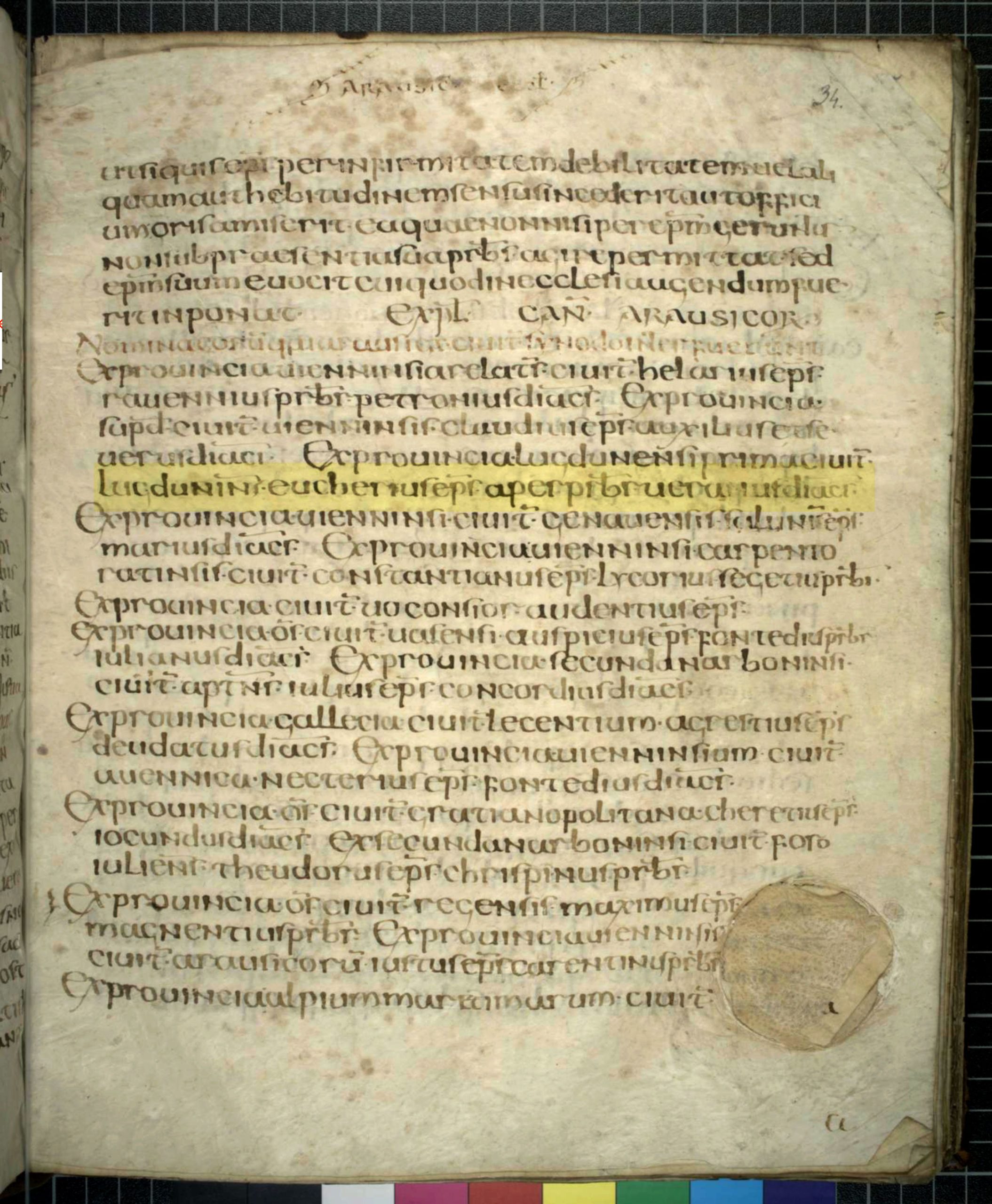
This is not a quotation from a seventeenth-century hagiography or a legend transmitted through local tradition. It is a passage preserved in the textual tradition of an actual fifth-century ecclesiastical council. The late six-century manuscript, known as Codex 212, is preserved in the Cologne Cathedral Library in Germany. Although the text concerns a meeting held in 441, the surviving manuscript was copied approximately 150 years later. The text is therefore a transmitted record of a fifth-century event, not an original contemporary document that we can examine today. It contains the surviving attendance list of the First Council of Orange in 441. The wording is exceptionally clear about three people: Eucherius, the bishop of Lyon; Aper, a priest associated with Lyon; and Veranus, a deacon associated with Lyon. The text identifies Veranus’s ecclesiastical rank, his association with Lyon, and his presence alongside the bishop and a priest at the council. It does not, however, identify him as Eucherius’s son or as a future bishop of Vence.
The attendance list contains something that makes the identification of Veranus much more convincing than it first appears. Immediately after the entry for Eucherius and his accompanying clergy, the list records: Ex prouincia Vienninsi ciuit. Genauensis Salunius episcopus, Marius diaconus. This translates to: From the province of Viennensis, the city of Geneva: Salonius, bishop; Marius, deacon. Salonius was the son of Eucherius of Lyon and the brother of Veranus. In other words, the council’s attendance list places the following individuals together, in consecutive entries: Eucherius, bishop of Lyon; Salonius, bishop of Geneva and Eucherius’s son; and Veranus, a deacon from Lyon. The manuscript itself does not specify these family relationships, but we know independently that Eucherius had two sons named Salonius and Veranus. That is a remarkable coincidence if the deacon at Orange was an entirely unrelated man.
The picture suggested by the council is of a father attending a major ecclesiastical gathering with one son already a bishop and another still serving as a deacon. But this is still an interpretation. The council does not call Veranus filius Eucherii, meaning son of Eucherius, or frater Salonii, meaning brother of Salonius. Fortunately, a modern historian has examined this precise problem.
One of the most valuable studies on this subject is by the historian Françoise Prévot, entitled “Recherches prosopographiques autour d’Eucher de Lyon,” published in 2005 in the scholarly collection Saint Maurice et la Légion Thébaine, pages 119–138. On page 121, Prévot writes: Salonius est certainement l’aîné, car, au concile d’Orange en 441, il est déjà évêque de Genève, tandis qu’un Veranus, qui est très probablement son frère, n’est encore que diacre de Lyon. This translates to: Salonius is certainly the elder, since at the Council of Orange in 441 he is already bishop of Geneva, whereas a certain Veranus, who is very probably his brother, is still only a deacon of Lyon. Prévot has independently arrived at the identification we are investigating, and she considers it very probable, while stopping short of claiming certainty.
Her reasoning also yields a further biographical inference: Salonius was probably the older of Eucherius’s two sons. She supports this not merely through their respective clerical ranks, but also by observing that Gennadius of Marseille lists Salonius before Veranus when referring to Eucherius’s children.
The big mystery here is, if the Véranus who attended the Council of Orange was indeed our Saint Véran of Vence, how, when and why did he arrive in Lyon? No one who has written about Véran has suggested he spent time there. They place him at the monastery in Lérins and then as bishop of Vence. Of course, this does not mean that he may have spent some of the time between in Lyon.
One of the distinguishing characteristics of Lérins during the fifth century was its extraordinary influence on the leadership of the Church in Gaul. Monks trained there regularly went on to assume positions elsewhere. Consider three men from Véran’s immediate religious circle. Honoratus left Lérins around 427 or 428 to become bishop of Arles. Hilary, his disciple and later successor, also moved from the monastic community into the episcopate at Arles. Eucherius himself, after living in religious retirement in the Lérins islands, became bishop of Lyon, probably during the 430s. And the most directly relevant example is Salonius, Eucherius’s elder son. We have explicit evidence of his monastic upbringing, yet by November 441 he had left that environment to become bishop of Geneva. These were not exceptional departures from the religious world of Lérins. They were part of the way the monastery influenced the wider Church.
The historian Stéphane Gioanni discusses this phenomenon in his article “Moines et évêques en Gaule aux Ve et VIe siècles,” published in Médiévales in 2000. He describes how the monks of Lérins provided the Church of southeastern Gaul with priests and bishops, although this movement sometimes produced tensions with established ecclesiastical authorities.
This gives us an entirely plausible explanation for what could have happened to Veranus. When Eucherius was appointed bishop of Lyon, his son might have accompanied him or joined him sometime afterward. Having already received an advanced religious education at Lérins, Veranus would have been an attractive candidate for ordination and service within his father’s church. By November 441, he could have been serving as a deacon there. In November 441, he accompanied Eucherius to the Council of Orange. Subsequently, after the death or departure of Severus, who was still bishop of Vence in 442, Veranus was chosen to succeed him, probably sometime during the 440s. That is a historically plausible scenario. But it remains a hypothetical reconstruction, not a documented episode in his life.
Bishop of Vence
As word of Véran spread throughout the area, the clergy and residents of Vence chose him to guide them as bishop sometime in the early 440s. On November 13, 442, the First Council of Vaison took place. Its surviving attendance list includes this passage: Ex prouincia Alpium Maritimarum ciuit. Vensiensis Seuerus episcopus, Emeterius diaconus. This translates to: From the province of Alpes Maritimae, the city of Vence: Severus, bishop; Emeterius, deacon. This establishes that the bishop of Vence in November 442 was Severus, not Véran. The text is preserved in the same scholarly collection of Gallic council records as the attendance at the First Council of Orange noted above. So, we know that it was sometime after this date that Véran became bishop.
In his letter regarding the ceremonies for the lost relics, Henri-Louis Chapon says the year was 446. According to Barcillon, the date of Saint Véran’s ordination as bishop of Vence, October 10th, comes from the authority of André du Saussay, a 17th-century doctor of the Sorbonne and author of the Martyrology of France. Du Saussay’s work, which catalogued the feast days and historical notices of French saints, records this date for Véran’s elevation to the episcopate. Véran was consecrated by his former teacher, Saint Hilary.
Barcillon describes Véran’s arrival in Vence, saying “… he was received by all with a joy and love impossible to describe.” Unfortunately, he found his diocese in a pitiful state of disorder and disarray. Vence was not alone. As the Roman Empire crumbled and terror gripped the citizens, many turned away from the church, adopting lifestyles and habits that shocked Véran and his followers. It is said that at this time in the development of Christianity, the entire movement was engulfed by corruption, sacrilege, and atrocities.
Barcillon writes, “The elderly lived in disorder caused by long-established bad habits; the young in debauchery and libertinage; young women in bold shamelessness; and most people, in short, took pride in doing what the laws of Christianity forbade, with a hardness of heart they shared with those who live as if there were no God.” The clergy of the time were no better, he said, plagued with scandal, violence, tyranny, injustice, extortion, and worse.
In his work The Governance of God, Saint Salvian laments the moral decay of Christian society and contrasts it with “barbarian” virtue, arguing that Christians are often worse than the barbarians because they profess faith. When speaking of the barbarian invasions occurring throughout Europe at the time he wrote: “The barbarians are less vicious than we, and we are surprised that being so corrupt, we are not even more miserable!… Alas! What has become of our former beauty? Why does the Lord suffer us to be conquered by the barbarians?” Then the answer: “We deserve it.”
Barcillon agrees with Salvian, writing that the vicious attacks throughout the region were nothing less than God’s anger towards the Christians who had strayed so far from the path. “This century was like a flood of barbarian nations through which God justly punished the sins of the Christians. Just as no innocent person is abandoned, no guilty person goes unpunished,” he writes.
During Véran’s lifetime in the 5th century, Gaul was repeatedly unsettled by the movements of several migrant and military peoples. The Vandals, Alans, and Suevi crossed the Rhine in 406 and swept across the provinces before continuing on toward Spain and Africa. The Visigoths established a lasting presence in southern Gaul, while the Burgundians settled along the Rhône and Saône valleys. Even the Huns briefly threatened the region, culminating in Attila the Hun’s advance into Gaul in 451. These disruptions formed the backdrop to Véran’s episcopate, shaping the insecurity and shifting political landscape in which he carried out his ministry.
It is said that many lesser men would have given up upon finding the diocese in its current state, but that Véran was not deterred. His gentle countenance, rough and simple clothing, modest bearing, and deep humility, despite his noble birth, brought widespread admiration from everyone around him. Believing that reform must begin with the clergy, he first set about guiding them, offering his own way of life as the model he expected them to follow.
His life reflected a pious simplicity, with only what he truly needed. He lived on herbs, roots, and occasional vegetables or fruit. Oil, salt, vinegar, and a little wine were considered luxuries, only to be consumed on feast days. His bed was hard, just a plank covered with coarse cloth. He spent much of his time studying scripture and engaged in prayer and meditation. His speech was always calm and measured, his conduct thoughtful and sensible, and he carried out his duties with a steady, unhurried diligence. In short, his lifelong commitment to humility and poverty was very evident.
Barcillon writes: “He worked to restore divine worship throughout his jurisdiction, to support the priests and have them respected, to remove abuses, to reconcile enemies, to settle disputes, and to provide for both the spiritual and bodily needs of his beloved flock, whom he instructed continually with remarkable success.”
Véran was known to always place the poor, widows, and orphans first, giving to them without reserve and often denying himself to provide more for them. His constant generosity inspired his people, awakening in them a renewed desire to do good that soon produced remarkable results throughout his diocese.
The Fight Against Eutychianism and Other Heresies
Véran was renowned for his sanctity, strong leadership, and unwavering commitment to the Catholic faith during these years. He is said to have worked tirelessly to protect the Church from numerous heresies and heterodoxies (beliefs or teachings that deviated from accepted doctrine but were not necessarily formally condemned) spreading across the land during his time. In fact, a medieval writer documents twenty-eight deviant sects that sprang up during the early years of Christianity. Vérran was determined to free his flock from these misguided ways of thinking and to halt the advance of these false teachings in his diocese, even as they seemed to gain ground throughout Gaul.
He played a key role in resisting early doctrines that threatened the church such as Arianism (practiced by the Visigoths), a theological doctrine that denied Christ’s full divinity, opposing the orthodox Christian doctrine of the Trinity; and Pelagianism, a doctrine that argued against the concepts of original sin and predestination contradicting the orthodox Christian doctrine that all humans inherit a sinful nature due to Adam’s disobedience.
Barcillon recounts a vivid story linking Véran to one of the great doctrinal events of the fifth century. In June of 449, Pope Leo the Great wrote his famous “Tome to Flavian,” which opposed the teachings of Eutyches, an early Christian doctrine that held that the human and divine natures of Christ were one and the same. This contrasted with orthodox Christianity, which teaches that Jesus has two distinct natures, fully human and fully divine. The treatise was widely circulated and discussed throughout the Christian world. Barcillon says that forty-seven bishops in Gaul, including Véran, replied with a synodal letter expressing their gratitude, but there is no surviving evidence of this letter.
What we do have is another document that Barcillon also describes. A genuine letter survives in the correspondence of Pope Leo the Great, written by three Gallic bishops, Ceretius, Salonius, and Veranus, thanking the pope for his doctrinal teaching and asking him to review and correct a text they had copied. The letter itself is real. It survives as Letter 68 in the traditional collection of Leo’s correspondence and is commonly placed around 450 or 451. The challenge lies in identifying which Veranus signed it, since the document does not name his diocese. It does, however, establish that a bishop by the name of Veranus existed at this time and that he was closely associated with Salonius. Tisserand mistakenly attributes the authorship of the letter to Véran alone and quotes directly from it:
“I beseech that your Holiness may review the work which we, in our zeal for preservation, have taken care to commit to these pages, hoping it will be beneficial both in present and future times. And if anything is lacking due to an error of the scribe, may you deign to correct it; or, if you wish to enhance this page with any argument beneficial to all who read it, may you kindly order it to be added to this book with attentive piety, so that not only many of our holy bishops throughout Gaul, but also many of the laity, your sons, who earnestly desire this letter for the sake of manifesting the truth, may deserve to transcribe, read, and keep it, having received it back from us and corrected by your holy hand. — Veranus, a devotee of your Apostolate, greets your Beatitude and asks that you pray for me.”
Salonius and Cérétius also signed this declaration of faith and support to Pope Léo. We should note that, while tradition identifies the letter’s author as Saint Véran of Vence and the chronology supports this, the surviving manuscripts do not explicitly name his diocese. Barcillon dates this letter to 451, before Saint Véran of Lyon had assumed the bishopric there. If that date is correct, it would almost certainly mean the letter was written by Saint Véran of Vence. Modern historians, however, consider the attribution probable but not provable in strictly documentary terms.


Dangerous Times
Véran presided over the Vence Christian community during a particularly difficult time. The Roman Empire was on the verge of collapse. Various armies were invading the territories from all sides. The Visigoths, Ostrogoths, Alans, Vandals, and others were moving into the region, roaming the land in search of new conquests, leaving death and destruction in their wake. Names like Attila the Hun (who invaded Gaul in 451) and the Vandal king Genseric (who sacked Rome in 455) are recorded in history as some of the most ruthless, savage, and brutal warriors of all time.
According to a long-standing local tradition, it was Véran’s holiness that saved Vence during the ravages of Genseric. While the barbarians pressed across the region, the saint’s reputation for purity, humility, and pastoral zeal had already won him deep respect far beyond his small diocese. The story tells that when Genseric approached Vence with the same fury that had devastated other towns, Véran went out to meet him, calm and unarmed, relying only on the authority of his virtue. Struck by the bishop’s courage and the serene dignity of a man who lived what he preached, Genseric relented and spared the town from pillage. Whether or not the episode can be documented, the tale reflects the enduring belief that Véran’s character, more than political influence or force, was powerful enough to soften even the hardest of hearts.
Euric, King of the Goths
During the latter part of Véran’s life, Gaul came under the rule of Euric the Goth, the Arian king of the Visigoths, whose policies created real difficulties for the Catholic clergy. Several bishops, most notably Faustus of Riez, Sidonius Apollinaris of Clermont, and others in Aquitaine, were exiled or imprisoned, and church property was sometimes confiscated. Later writers greatly exaggerated the extent of this persecution, claiming that whole regions were supposedly stripped of their bishops, but contemporary sources do not support such claims. The disruption, though serious, was far from the wholesale devastation described by some early-modern authors.
Euric was an Arian Christian and, as king of the Visigoths, exerted considerable pressure on the Catholic Church. While some historians have presented him as a theological fanatic determined to persecute those who held orthodox Christian beliefs and to destroy those not willing to convert to his view of Christianity, in reality, Euric’s persecution was political as much as religious. He saw many Catholic bishops as Roman loyalists, political threats, and symbols of Roman authority in newly conquered territories. He was not a barbarian, but rather a well-educated, well-spoken man who knew much about history and politics.
Of all the stories that have come down to us through the ages about Saint Véran, he is maybe most famous for the time when he is said to have confronted Euric in 476 and persuaded him to spare Vence from an impending assault. Not surprisingly, there are several different versions of this story. In one version, Euric was marching on Provence with his army, seeking to expand his kingdom into Gaul and Spain, taking advantage of the Roman Empire’s weakening.
Euric and his army arrived near what we know today as Pont-du-Loup, a small town on the banks of the Loup River, a short distance from Vence. Tissserand (and Chapon) claim that Euric was accompanied by Genseric, king of the Vandals, but there is no historical evidence to support this. Chapon is clearly simply repeating what he has read in Tisserand’s history of Vence (as he does in several other parts of his letter). Barcillon writes that, in fact, Genseric had invaded the area a few years earlier and that Véran had met with him and begged him to take pity on the town.
Tisserand writes that Euric’s bloody trail was strewn with the bodies of saints who stood in his way, including Saint Gratien of Toulon, Saint Léonce of Fréjus, Saint Valère of Antibes, and Saint Deuthère of Nice. He says that the monastery at Lérins was virtually abandoned as the monks sought refuge elsewhere. However, none of the sources on late-Roman Provence substantiate the specific martyrdoms of those four saints at his hands, and the notion of the Lérins community fleeing en masse in direct response to him also lacks any historical evidence. These elements reflect later hagiographical tradition more than the verifiable fifth-century record.
The story goes that Saint Véran strode confidently into the center of Euric’s camp, walking calmly past the soldiers and warriors. He respectfully but sternly admonished Euric for his Arian beliefs, and despite the obvious danger, he urged him to convert to Catholicism and cease his oppression of the orthodox Christian community. Véran’s powerful spiritual authority and persuasive words somehow convinced Euric to retreat, leaving the city of Vence unharmed. This led to Véran becoming known as the “Defender of Vence,” a title that continues to this day.
In another, much more dramatic and fantasized version of this legend, Véran confronted Euric more forcefully, “commanding him to cease his abominable crimes.” In this version, Euric is a bloodthirsty barbarian, devoid of any religious beliefs. Euric, enraged by the daring boldness of Véran, threatened to split him from head to toe with his spear. Véran remained firm, daring the warrior to strike him. Euric drew back and threw his spear at Véran, only to see the spear change course in mid-air, fly above Véran’s head, and embed itself in a distant tree. What looked like blood could be seen gushing from the wound of the tree.
“Bishop,” said Euric, “if by tomorrow morning flowers bloom around my spear, I will believe your words and accept your God.” Véran sat beneath the tree all night in silent prayer. The next morning, a purple bindweed could indeed be seen growing and blooming all around the spear. When he saw this miracle, Euric fell to his knees and exclaimed, “Bishop, your God is now my God, and I shall obey!”
“Return from where you came,” said Véran, “and commit no more crimes.” The Visigoth army vanished into the hills. Saint Véran had saved Vence.
Another well-known legend tells of Véran confronting a monstrous dragon, or great serpent, that was said to terrify the countryside. In the story, he subdues the creature through prayer and drives it away, a symbolic expression of his role as a spiritual protector against evil. This episode, however, almost certainly belongs to the traditions surrounding Saint Véran of Cavaillon, whose dragon-slaying miracle is firmly rooted in Provençal folklore. It seems likely that, over time, the tale was mistakenly transferred to Véran of Vence, whose name and sanctity made him an attractive figure for such legendary embellishments.
Véran the Mediator – the Dispute Between Arles and Vienne
According to Jacques Barcillon, writing in the seventeenth century, Saint Véran enjoyed a particularly close relationship with two successive popes, Leo the Great (440–461) and Hilarius (461–468). Barcillon suggests that this relationship developed through regular visits to Rome, where bishops were said to gather each June to honor the relics of Saint Peter. Although such religious pilgrimages were an established tradition, no surviving contemporary document confirms that Véran himself made these journeys or personally met either pope in Rome. Nevertheless, Barcillon portrays him as a trusted ecclesiastical figure whose wisdom and judgment were occasionally called upon to resolve disputes among the bishops of Gaul.
One of the most remarkable examples concerns a disagreement between Saint Léonce, Bishop of Arles, and Saint Mamertus, Bishop of Vienne, in 463 and 464. The controversy was part of a much older struggle between two powerful episcopal cities, each claiming extensive authority over neighboring dioceses and the right to consecrate their bishops. The dispute had occupied church councils, successive popes, and even the Roman imperial government for decades. In 417, Pope Zosimus had granted considerable privileges to Arles, while subsequent popes sought to clarify or restrict those powers. Pope Leo the Great intervened again on May 5, 450 with Letter 66, an important ruling that established a division of ecclesiastical authority between Arles and Vienne. Leo allowed Vienne to retain jurisdiction over Valence, Tarentaise, Geneva, and Grenoble, while placing the remaining disputed churches under the authority of Arles.
The immediate crisis arose when Mamertus consecrated a bishop for Die, a town that, under Leo’s settlement, belonged to the jurisdiction of Arles. Léonce objected, and the controversy eventually reached Pope Hilarius, who had succeeded Leo in 461. In October 463, Hilarius instructed Léonce to convene a council of bishops to investigate Mamertus’s conduct. After receiving the council’s report, the Pope issued his judgment on February 25, 464.
This is where the story becomes particularly interesting for the history of Saint Véran. In his seventeenth-century biography, Barcillon describes how Pope Hilarius appointed Véran of Vence as an apostolic commissioner to resolve the dispute. According to Barcillon, Véran travelled to Arles and Vienne, carefully considered the arguments advanced by both bishops, and eventually delivered a judgment that reconciled the two prelates. He supposedly ruled that neither metropolitan could exercise unlimited authority beyond his own province and upheld Mamertus’s consecration of the bishop of Die as legitimate. Barcillon presents the outcome as a remarkable achievement, suggesting that Véran had succeeded where popes, councils, and emperors had struggled to establish lasting peace.
Fortunately, this episode can be examined against an authentic fifth-century document. Pope Hilarius’s letter of February 25, 464, survives among his correspondence (Letter XI in the Patrologia Latina arrangement), and it explicitly mentions a bishop named Veranus. The Pope states that he has sent written instructions to Veranus, whom he calls his brother and fellow bishop, authorizing him to approach Mamertus on his behalf. He writes: “Unde nostrae moderationis nomen tenentes, ad Veranum fratrem et coepiscopum nostrum scripta direximus, ut praedictum ex nostra delegatione conveniat…” This translates as, “Therefore, maintaining our customary moderation, we have sent written instructions to Veranus, our brother and fellow bishop, so that he may approach the aforementioned man [Mamertus] on our behalf…” Even though the letter explicitly says that Pope Hilarius had sent written instructions directly to Bishop Veranus, those separate instructions have not been found in any form. The February 25th letter makes it clear that this is not a story invented by Barcillon: a bishop named Veranus really was entrusted with a papal commission concerning the dispute.
However, the contents of the papal letter differ significantly from Barcillon’s account. Hilarius had already determined that Mamertus had acted improperly by consecrating a bishop outside his jurisdiction. Veranus was instructed to communicate the Pope’s judgment and warn Mamertus against further violations of the established ecclesiastical boundaries. If Mamertus refused to comply, he risked losing the authority he still possessed over four neighboring dioceses. The Pope also stipulated that the bishop consecrated for Die should have his position confirmed by Léonce of Arles.
Thus, although the papal commission itself is securely documented, there is no surviving evidence that Veranus independently adjudicated the entire dispute, ruled in favor of Mamertus, or personally reconciled the two bishops. The separate instructions addressed directly to Veranus have not survived, and the ultimate outcome of his mission is not fully known. Barcillon appears to have expanded a genuine papal intervention into a much more elaborate account of Véran’s diplomatic achievements.
There remains another important question: was the Veranus mentioned in Hilarius’s letter actually Saint Véran of Vence? The Pope identifies him as a bishop but does not name his diocese. This omission has caused considerable disagreement among historians. Some earlier scholars associated him with Lyon, the city where Eucherius, traditionally regarded as Véran’s father, had served as bishop. Others identified him with Vence. The Bollandist scholars responsible for the Acta Sanctorum examined these competing interpretations and argued that Vence was the more convincing identification, particularly because Veranus also appears in another papal letter concerning ecclesiastical affairs in the province of the Maritime Alps.
What, then, can we reasonably conclude? The dispute between Arles and Vienne certainly took place, and the papal documents confirm that a bishop named Veranus was entrusted with an important role in its resolution. Identifying him with Saint Véran of Vence is historically plausible and has the support of a long scholarly tradition, but it cannot be demonstrated beyond doubt from the surviving letters alone. Barcillon’s account goes considerably further than the contemporary evidence allows, particularly in its description of Véran’s supposed ruling and successful reconciliation of the two bishops.
Rather than dismissing the entire episode as a hagiographical invention, it is more accurate to recognize that Barcillon may have built an embellished narrative around a genuine historical event. The papal commission is real. Whether its recipient was Saint Véran of Vence remains open to discussion, while the extraordinary diplomatic triumph attributed to him by Barcillon belongs, for now, to the realm of tradition rather than documented history.

Saint Véran and the Dispute Over Nice and Cimiez
Another remarkable episode in the traditional life of Saint Véran concerns an ecclesiastical controversy that arose in the middle of the fifth century over the bishoprics of Nice and Cimiez. Described at considerable length by Jacques Barcillon in his seventeenth-century biography, the affair involved Pope Leo the Great, his successor Hilarius, and several influential bishops in southern Gaul. Unlike many of the miraculous events attributed to Véran, this dispute is firmly rooted in contemporary historical documents, including a surviving papal letter addressed directly to a bishop named Veranus.
At the heart of the controversy was the question of who possessed ecclesiastical authority over Nice and Cimiez, two neighboring communities that, despite their proximity, had originally developed separate bishoprics. Cimiez, known to the Romans as Cemenelum, had once been the administrative capital of the province of the Alpes-Maritimes, while Nice, originally established as a Greek settlement, had maintained longstanding connections with Marseille. During the fifth century, their different administrative and ecclesiastical histories contributed to uncertainty over which metropolitan bishop possessed the authority to supervise their churches and consecrate their bishops.
The principal figures in the dispute were Ingenuus, Bishop of Embrun and metropolitan of the Alpes-Maritimes, and a bishop named Auxanius, whose own episcopal see is not identified in the surviving papal correspondence. Some historians have suggested that Auxanius was Bishop of Aix-en-Provence, whose interests would have been affected by attempts to bring Nice under the metropolitan jurisdiction of Embrun.
The controversy had already reached Rome during the pontificate of Leo the Great, who governed the Church from 440 until 461. We know this because his successor, Pope Hilarius, explicitly refers to earlier reports submitted to Leo by a bishop named Veranus and other bishops of the province. Leo had responded with a ruling concerning the ecclesiastical arrangements in the region, including the principle that Nice and Cimiez should be governed by a single bishop.
Following Leo’s death in November 461, however, Auxanius obtained a new decision from Pope Hilarius that apparently contradicted the earlier ruling. The surviving letter does not establish precisely what arguments Auxanius presented, but Hilarius later acknowledged that his decision had been obtained through misleading or incomplete representations. Ingenuus of Embrun subsequently protested, maintaining that the new arrangements violated the existing ecclesiastical rules and infringed upon his metropolitan authority.
The dispute was further complicated by the recent consecration of another bishop in one of the two contested locations. The consecration was reportedly intended to prevent someone else from extending his ecclesiastical authority, although the identity of the bishop who performed it remains uncertain. Some historians attribute the action to Auxanius, while others have considered whether Ingenuus himself was responsible.
Eventually, Pope Hilarius reconsidered the matter. In a letter written sometime between 463 and 466, he acknowledged the earlier ruling of Leo the Great, questioned the legitimacy of the privileges subsequently obtained from him, and reaffirmed the metropolitan rights of Embrun. He also insisted that Nice and Cimiez should return to the administration of a single bishop, as his predecessor had determined.
The letter was addressed to three bishops: Léonce, generally identified as Bishop of Arles; Veranus; and Victurus, whose episcopal see is uncertain. Hilarius entrusted them with examining Ingenuus’s complaint and ensuring that neither the established ecclesiastical canons nor Leo’s previous judgment would be overturned by improperly obtained privileges.
This surviving letter is particularly important for the history of Saint Véran because it establishes that Veranus was not simply a passive participant in the controversy. The Pope explicitly states that Veranus, together with other bishops of the province, had previously submitted reports to Leo the Great. Thus, the man named in Hilarius’s letter had already played a role in the dispute before 461, and was subsequently entrusted with helping to resolve it under Leo’s successor.
Barcillon presents a much more elaborate account. According to his biography, Véran and his colleagues travelled through the disputed territories, investigated the claims of the opposing bishops, examined the relevant documents, and delivered a judgment restoring the legitimate authority of Embrun. He describes Véran as a wise and respected mediator whose intervention brought the opposing parties to a peaceful reconciliation.
Unfortunately, the surviving fifth-century records do not confirm these additional details. We possess Hilarius’s instructions to the three bishops, but no independent report of their investigation, their deliberations, or any formal judgment they may have issued. Nor can we establish that both parties willingly accepted their decision or that the controversy was immediately and peacefully resolved. The later union of Nice and Cimiez is a historical reality, but the precise circumstances and timing of its implementation remain uncertain.
There is also the question of whether the Veranus mentioned in Hilarius’s letter was actually Saint Véran of Vence. The letter calls him a bishop but does not explicitly identify his diocese. This omission has produced disagreement among historians, some of whom associated him with Lyon, while others identified him with Vence.
Nevertheless, the identification with Vence has considerable scholarly support. The Bollandist historians who examined the question in the Acta Sanctorum argued that Veranus was more likely the bishop of Vence, partly because of his documented involvement in the ecclesiastical affairs of the Alpes-Maritimes. More recently, the historian Jean-Pierre Weiss, in a detailed study published in 1972–1973, explicitly identified Veranus as Bishop of Vence and reconstructed his role in securing the original union of Nice and Cimiez. Pablo Poveda Arias, writing in 2023, likewise identifies Veranus of Vence as an important figure in the defense of Embrun’s metropolitan authority.
These identifications do not remove every historical uncertainty. The surviving papal letter itself does not provide the definitive statement, “Veranus, Bishop of Vence,” that would settle the question beyond doubt. Nevertheless, there are good historical reasons for associating the bishop named in the document with Saint Véran of Vence, and the identification cannot reasonably be dismissed as a seventeenth-century local invention.
What makes this episode particularly valuable is that it allows us to move beyond Barcillon’s hagiographical narrative and examine authentic evidence from the fifth century. The original letters sent to Leo the Great by Veranus and his fellow bishops have not survived, nor has Leo’s reply, but their existence is explicitly confirmed by Hilarius’s later correspondence. Moreover, the papal letter itself has survived through early manuscript copies, including a sixth-century copy now preserved in the Bibliothèque nationale de France.
We therefore have a historical foundation for at least part of the traditional account. A bishop named Veranus participated in a significant ecclesiastical controversy concerning the territory surrounding Vence, corresponded with Pope Leo the Great, and was subsequently entrusted by Pope Hilarius with helping to resolve the dispute. Identifying him with Saint Véran of Vence is a well-supported scholarly interpretation, although not an absolute certainty. Barcillon’s description of his successful mediation, on the other hand, goes beyond what the surviving evidence allows us to establish.
A Possible Appearance at the Council of Arles
There may be another indication of Véran’s continued activity later in the fifth century. Some local historians, including Tisserand and Chapon, associate him with a council held at Arles around 470–475, during the episcopate of Léonce. This council was convened to address controversial teachings about predestination, grace, and human free will, particularly those attributed to a priest named Lucidus.
Although complete minutes of the council have not survived, a letter written by Lucidus and addressed to a group of bishops preserves their names. Among them appears a bishop called Verianus, listed alongside several prominent contemporary churchmen, including Mamertus of Vienne, Patiens of Lyon, Auxanius, and Faustus of Riez. The document is reproduced in Charles Munier’s 1963 scholarly edition of the Gallic council records.
The name Verianus is sufficiently close to Veranus to raise the possibility that the two refer to the same bishop, but the document does not identify his episcopal see. Nor does the inclusion of his name among the recipients necessarily prove that he personally attended the council. This therefore remains a possible additional reference to Saint Véran of Vence rather than a securely established event in his life.
The Death of Saint Véran
Véran was called home to Lyon in 456 to tend to his dying father. Some accounts say that he remained in Lyon as bishop for a time. In fact, the name Véran appears on an old document listing the bishops who succeeded Eucher. Once again, this is most likely a confusion between Véran of Vence and Véran of Lyon, though it is puzzling, as most accounts do not confirm Véran of Lyon as a bishop.
Most sources say that the exact date of Véran’s death is uncertain. Barcillon says it occurred in 481 or 482 and places it on September 10th, which later became Veran’s feast day. Tisserand asserts that he lived until 492, but this date comes from medieval episcopal catalogues rather than any contemporary evidence. In his Pastoral Letter Chapon says he died in 480. Other writes suggest his death could have been as early as 465.
Barcillon recounts the saint’s passing: “Upon hearing the news of his death, the inhabitants from all parts of the diocese came in great numbers to Vence to attend his funeral, with sorrow and tears that showed how deeply this loss affected them. His clergy, his household, and several people of rank who were present also showed their great grief by the abundance of their tears.”
Véran left no will, as he had no real possessions, having given up the need to accumulate earthly goods early in life. Barcillon writes, “He therefore had nothing to give at his death, except the blessings he drew down from heaven through his prayers upon his diocese, which continue in our own time; the good example he gave to the clergy; the instructions he left to all his people; and the good order he established in his church. Are these not the most precious gifts one could have hoped for?”
After Véran died, he was canonized almost immediately. Legend says that his body was placed in a beautiful Roman marble sarcophagus that today forms part of the altar in the chapel dedicated to him in the Vence Cathedral, though, once again, there is no documented historical evidence to support this.

The Martyrologe of the Church of Vence, dating from the 16th century states that on September 10th: “In Gaul, in the city of Vence, deposition of the blessed Véran, bishop of Vence, who was a monk of Lérins, disciple of the blessed Hilary, abbot of said island and later bishop of Arles, who was buried in the said church of Vence in a marble sarcophagus.”
It should be noted that at least one source from the time, the Martyrologe of Saint Jerome (a list of Saints and Martyrs with information about each one) states that Véran was buried in Lyon. Again, this is likely confusion between the two saints.
The Miracles of Saint Véran
Interestingly, no miracles are attributed to Saint Véran during his lifetime. In fact, even after his death, we have only vague and indefinite accounts. Barcillon says, “God, who is wonderful in His saints, wished to make His servant Saint Véran worthy of praise through many miracles after his death, just as He had made him renowned for many virtues during his life. The blind, the deaf, the crippled, the lame, and the fever-stricken received healing through his prayers at his tomb, and many others at various times received different graces through his intercession. I omit the details of these miracles because I have not been fortunate enough to obtain a full account of them, having no source on which to rely except the ancient martyrology of the Church of Vence and the special prayer composed for his invocation, both of which tell us that God honored him with many miracles.”

The Monastery of Saint-Véran
There is conflicting information about an important monastery that was founded in Saint Véran’s name sometime after his death on the banks of the Loup River, a short distance from Vence. Tisserand writes that the monastery was created shortly after Véran’s death and that it is thought to have flourished for some time before being destroyed, possibly by the Lombards in the 6th century or the Saracens in the 8th century. The Abbaye de Saint-Véran du Loup (also known as Notre-Dame de la Dorade or Notre-Dame la Dorée) was said to have been built on the exact spot where Véran confronted Euric the Goth and famously convinced him to leave the city of Vence in peace. The monastery was rebuilt in the 10th century under the direction of the then-current Bishop of Vence, Durand.
Barcillon gives a different account, stating that a church was built by Charlemagne in the late 8th or early 9th century at the exact location, named after Saint Véran. Barcillon describes the location as “in the territory of Caigne near the river Loup, on the main road to the left when going from Antibes to Nice.” When Bishop Durand came to Vence from the monastery of Saint Eusèbe, he brought with him a monk named Ponce to help him restore virtue and devotion to God to the people of the diocese.
At this point, the church built by Charlemagne had fallen into ruin, and almost nothing remained of it. While visiting the ruins of the church one day, Durand and Pons decided it was the perfect location for a monastery to be built in honor of Saint Véran. The first abbot was Dom Constantin, who most likely came from the same monastery of Saint Eusèbe from which Durand and Pons had come. The old Charlemagne church was rebuilt along with the monastery.
Much of what we know about this monastery comes from records of land donations made by local residents. A husband and wife, known only as Pierre and Ermengarde, made a significant donation of property to the monastery in 1012, including three vineyards. They also donated a barn and outbuildings. Four years later, they donated more property near the Loup River and in the district of Canadel. It is said that another monastery, the monastery of Canadel, was built here sometime around this time.
Another couple, Saraman and Bonnefente, along with their daughters, donated seven cesterces of farmland near the Loup River to the Saint Véran monastery, along with a vineyard and an additional plot of land.
Abbot Constantin died in 1030, and the monk Ponce succeeded him. In 1032, Prince Leotger and Princess Odèle donated more land to the monastery. Guy and Blismonde, together with their sons Obert and Guillaume, donated land and vineyards the same year. In 1033, Lamber and his wife, Austrude, along with their sons Foulques and Guillaume, donated more property to the monastery.
In 1055, after the death of Abbot Abbé Ponce, the abbey was united with the Abbey of Lérins to ensure its sustainability and future growth. Unfortunately, over the following decades and centuries, it slowly fell into a state of decline. Perhaps it was due to the devastating epidemics that swept through Provence during those years. Or maybe it was destroyed during one of the many wars that erupted. Perhaps pirate raids were instrumental in its collapse. The truth is, we do not know what happened to it.
What we do know is that the monastery of Lérins apparently had no interest in restoring the monastery and at some point it returned it and the church it contained to the chapter of Vence. In the 17th century, when Barcillon was writing his Life of Saint Véran, he wrote of the church and monastery saying “…nothing remains but the four walls, without a roof. One can still see in the church a marble tomb, which may have belonged to Abbot Constantin or Abbot Ponce, or perhaps one of the lords who made donations to it.”
Today, nothing remains of this church or monastery, and no one knows exactly where it was located.
The Busts of Saint Véran and Saint Lambert
The plague had descended on Vence in 1465. It was not the first time, nor the last time, that the black death would visit the small town. After it had passed, the people of Vence credited Saint Véran and Saint Lambert with keeping Vence relatively free of the disease, at least compared to neighboring towns that had fared much worse. They had prayed vigilantly to their patron saints during the crisis, and Vence was, for the most part, spared. This was another instance in which Saint Véran, in particular, earned his title as the “Defender of Vence.”
We know that busts of the saints were created around this time to honor them for their protection of the city. In his book Vence – Ses Monuments – Ses Saints – Ses Évêques – Ses Curés – Son Église – Son Trésor – Ses Reliques – Ses Chapelles (published in 1914), Jacques Daurelle (a noted historian of Vence) says that the bishop at the time, Raphaël Monso, commissioned an artist from Paris (Laurent de Pardis or Laurent Parisis) to create a gilded silver bust of Saint Véran. In his book Vence – Un Diocèse, Un Cité, Un Canton, Laurent Dailliez says that the artist was named Paridis and that he was from Nice, not Paris.
The bust was delivered to Vence and inaugurated by either Bishop Jean de Vesc on October 10, 1491, or by Jean’s brother, Aymard de Vesc, on October 10, 1495 (accounts differ). A bust of Saint Lambert was commissioned around the same time, but not as lavish, made from gilded copper (not silver). Dailliez notes that Canon Christophe Malamaire, using his own funds, paid for this statue of Saint Lambert, which was also created by Laurent de Paridis. The remains of the saints were exhumed and displayed in metal reliquaries, topped with the metal busts. Both busts are noted and described in the inventory of the church’s treasury taken in 1507.

We should note that in his book Vence – parcourue pour vous…, published in 2001, Daniel Petite (a more recent historian of Vence) says that the remains of the saints “were exhumed and then displayed in metal reliquaries topped with wooden busts.” Petite makes no mention of the gilded silver and copper busts. Perhaps there was more than one set of busts from this time period? It seems more likely that Petite is simply mistaken here.
Over three hundred years later, when the French Revolution spread across the land, the priests feared that the busts would be destroyed, the reliquaries melted down, and the precious relics lost forever. The relics were removed and hidden. What became of the original busts and reliquaries is unknown. It’s possible, though not certain, that the wooden busts survived, as we will see a bit later. Unfortunately, the hiding place of the relics was forgotten, and for well over one hundred years they were lost.
In 1825, Antoine Blanc, the parish priest, commissioned new busts from a silversmith in Paris, Mr. Choiselat. These were made of copper and then silver-plated. Véran’s bust was inaugurated on September 10, 1825, and Lambert’s, made and delivered later, on May 26, 1826.
You can read a more in-depth account of the busts and relics of Saint Véran and Saint Lambert in this article: Devotion, History and Art: The Relics, Reliquaries and Busts of Saint Véran and Saint Lambert of Vence.
The 1592 Siege of Vence and how Saint Véran (along with Saint Lambert) Saved the City Once Again
The late 16th century proved to be a particularly challenging period for the city of Vence. With the spread of the Protestant Reformation across Europe, conflict seemed to loom everywhere. The French Wars of Religion, as we now call them, lasted nearly 40 years (from 1562 to 1598), pitting Reformed/Calvinist Protestants against the Roman Catholic Church. Time and again, the small city of Vence found itself entangled in these disputes. Numerous lives were lost, homes were destroyed, and fields and crops were devastated.
During this period, even two of Vence’s own bishops, Jean-Baptiste Rambaud de Simiane (who served from 1555 to 1560) and Louis Grimaldi de Beuil (bishop from 1560 to 1576), broke away from the Catholic Church and declared themselves Protestants. Nearby villages, including Saint-Jeannet, Coursegoules, and Gourdon, converted to Protestantism, yet Vence did not follow suit. In Vence, a substantial Catholic majority remained, effectively confining those who had adopted the new reformed faith to areas outside the city’s walls and gates. While they were allowed to gather for prayer and worship, this could only take place outside the city.
Claude de Villeneuve, Lord of Vence from 1556 to 1596, was one among many nobles who embraced the new Protestant faith. His conversion only intensified the already tense and confrontational relationship between the city and its lord. Following his shift in faith, he was forbidden from entering Vence’s streets. Whether his change of religion reflected genuine belief or, more likely, a strategic move against the more prominent nobles loyal to Rome, mattered little. Even the Crown appeared to be hedging its bets amid the turbulence of political and religious conflict; during these wars, one French king—one of five who reigned between 1547 and 1589—changed religion no fewer than four times!
For a brief period, the religious conflicts were overshadowed by the onslaught of disease. From 1579 to 1582, the plague once again ravaged Vence and its surrounding areas, forcing shops to close and decimating entire families. Bishop Audinc Garidelli fled to the nearby village of Saint-Paul, abandoning the townspeople to face the crisis alone. Without a moral leader, a sense of lawlessness took hold, and crime and corruption became widespread as fear permeated the city walls. After three harrowing years, the plague finally subsided, but any relief was short-lived, as the religious strife quickly returned with renewed intensity.
In the late 1580s, the Baron de Vins led an army that reclaimed nearly every town in the region, with Grasse as the sole exception, reestablishing them as Catholic territories. Charles Emmanuel, the Duke of Savoy and a staunch Catholic, advanced into Provence, ostensibly to consolidate these recent Catholic gains. The people of Vence, along with their bishop, welcomed him warmly and offered their support. However, they were unaware that the Duke’s true motives had little to do with religious loyalty; his actual aim was to wrest Provence from France and King Henry IV’s control.

In 1590, King Henry IV dispatched the Protestant Duc de Lesdiguières to reclaim Provence, and soon after, Savoy was driven out of most of the region. Here, however, historians differ in their interpretations. Many view these battles and the impending siege of Vence as a religious clash between Catholics and Protestants, while others interpret the conflict as more political: King Henry IV was simply reclaiming his territory by any means necessary. Lesdiguières acted more as a mercenary for the king, and it’s even likely that most of his soldiers were Catholic. Meanwhile, many Protestants still resided in Provence, casting doubt on the notion that the conflict was purely religious.
In 1591, a Protestant captain under Lesdiguières, De Cannaux, demanded Vence’s surrender. When the city refused, he breached the walls, seized a substantial sum, and continued on to Saint-Jeannet. By the following spring, Vence had fallen under Savoy’s control, De Cannaux was stationed at the nearby Château of Malvans, and Coursegoules and Saint-Paul had returned to Protestant hands.
Claude de Villeneuve, Lord of Vence, died on May 13, 1592, drowning while attempting to cross the Argens River. His son, Scipion de Villeneuve, took his place as the new lord, residing in Cagnes-sur-Mer. Aware of the strained relations between his father and Vence and viewing the city as a defiant dependent, he demanded the inhabitants’ immediate submission. When they refused, he called upon Lesdiguières, who established a camp on the plateau of Saint-Michel, where the Vence stadium now stands.
Lesdiguières launched an assault on the town, to which Vence responded with their single cannon. Outmatched by the attackers’ strength, the townspeople’s hope began to wane. At this critical moment, Canon Laure, a cleric of the Cathedral, placed the busts of Saint Véran and Saint Lambert on the Cathedral tower. He gathered the citizens of Vence around and implored them not to lose faith. He assured them that if they continued to fight, Saint Véran and Saint Lambert would deliver them from this siege. His act of faith is commemorated in the Complainte du Siège de Vence, a small 1920s booklet that recounts the events of this battle.
“Sorrowful brothers, all behold.
The big news,
Tonight, you will be free,
And Vence the beautiful!
Let us carry our Saints on the tower:
They will fight in their turn!
Soldiers, on the ramparts, under the Signadour!
Let us fight and pray: I attest,
God will do the rest! …”
This rekindled hope among the villagers, who rallied to defend Vence with renewed vigor and determination. A fierce barrage of cannon fire struck the city walls, and a brutal battle followed. The people of Vence responded valiantly, holding the ramparts and intensifying their defense. Inspired by the Saints’ presence, they displayed remarkable courage. As the attackers advanced with battering rams and ladders, the townspeople fought back by hurling rocks and pouring boiling lead down on them.
Some versions of this legend say that after Saint Véran and Saint Lambert were placed on the tower of the cathedral, every cannonball that was directed towards Vence bounced off the ramparts and returned to the invading army, slaughtering dozens of men.
More than 500 invading soldiers are reported to have perished in the assault, prompting Lesdiguières to withdraw on June 2. To save face, he declared Vence unworthy of the effort and redirected his forces toward the Estérels. Vence had prevailed; the saints had, in the people’s eyes, saved the city. As news of this “David and Goliath” tale spread across France, credit for the victory was consistently attributed to Saint Véran and Saint Lambert. Over the years, this legend has grown, been honored, and celebrated to this day as a symbol of resilience and faith.
To the left of the Porte d’Orient, one of the principal entrances to Vence’s old town, a larger stone beneath a window sill bears the date 1592. This stone still marks the spot where Lesdiguières’ cannons created a small breach in the city walls, a lasting reminder of the siege.
You can read a more in-depth account of the 1592 Siege of Vence in this article: Faith, Fire, and Betrayal in the French Wars of Religion.
The French Revolution and the Lost Relics
The years of the French Revolution were a time of chaos throughout the land. But never more so than for the Catholic Church. Revolutionaries across the country were determined to desecrate, eradicate, and annihilate everything they could get their hands on that was related to the church. Thousands of priceless artifacts were destroyed. During these years, the precious relics of both Saint Véran and Saint Lambert went missing. No one knew if they had fallen into the hands of the revolutionaries or if, as the people of Vence whispered to each other, someone had hidden them away for protection, maybe somewhere in the cathedral. What seemed certain is that they were gone, perhaps forever. One particularly ominous rumor claimed that anyone who found these relics and touched them would die within a year.
In 1896, Henri Chapon was elected Bishop of Vence. In the following years, he made several pastoral visits to Vence and became curious as to what had become of the relics hidden away during the French Revolution. In a pastoral letter, he wrote:
“Until very recently, the old cathedral possessed only a few incomplete fragments of these holy relics. During my first pastoral visits, I was deeply troubled by this and even more concerned because nothing, either in the history of the Church of Vence or in oral tradition, explained their disappearance. The most probable hypothesis was that, under the threat of persecution or invasion, devout and foresighted hands had hidden this sacred treasure to protect it from profanation. Memories gathered and preserved by a few elderly people, though somewhat vague and imprecise, seemed to confirm this hypothesis.”
He entrusted Abbé Bouchard, the archpriest of the Cathedral of Vence, with researching and investigating the missing relics. Unfortunately, Bouchard died before being able to do so. Instead, it was his successor, Abbé Marius-Emile Baude, the former dean of the parish of nearby Le Bar, who took up the task in 1913. As he was reviewing documents in the parish archives, he came across an old Latin manuscript describing the life and miracles of Saint Lambert. This document is believed to have survived from the 11th century. At the bottom of the document, Baude discovered a remarkable handwritten addition, written in Latin.

“I affirm and testify that, for the greater glory of Almighty God, on December 10, 1793, I removed the holy relics of Saint Véran and Saint Lambert placed in a silver reliquary, and respectfully gathered them in a gilded wooden chest, in the presence of Paul Pons, priest, and Pierre Geoffroy, who also act as witnesses, and we have signed with our own hand in Vence on December 10, 1793.” It was signed by Pierre Abou (priest and steward of this church), Paul Pons (priest) and Pierre Geoffrou.
Abou and the others had hidden the relics of Saint Véran and Saint Lambert to prevent them from falling into the hands of the revolutionaries who would most certainly have destroyed them. But where had they placed this chest? Where were the relics now? Baude discovered a second document, hidden among a volume of baptismal, marriage, and burial records, with additional information.
“In the year 1814, on the 30th of April, I received from Mr. Pierre Abou, priest, former beneficiary, and capiscol of the cathedral chapter of Vence, the gilded wooden chest containing the relics of Saint Véran, which he assured me were the same that existed before 1792, the time of the Revolution in France. He had removed this chest from the Chapel of the Holy Relics, now the Chapel of the Sacred Heart of Jesus, so that they would not be desecrated by the impious during the Revolution. We have returned the same chest to its secure location in an iron grille where it was previously deposited and preserved at the back of the said chapel, behind what is now the painting of the Sacred Heart of Jesus. In witness whereof, in my capacity as parish priest delegated in this ecclesiastical district, now part of the diocese of Aix, and responsible for the recovery and verification of the relics, I have signed in Vence, on the year and day above. SAVORNIN, parish priest, ABOU, priest.”
Were the lost relics of Saint Véran and Saint Lambert finally coming home? More evidence was found in the parish register of 1825 through 1865. On page 98, there is a report signed by Mr. Blacas (vicar general), Chaix (canon and parish priest), and J.-B. Blacas (vicar) stating that on September 9, 1839, they had verified the relics of Saint Véran and Saint Lambert and then returned them to the wooden chest. Saint Véran’s relics were placed in five white silk pouches, and Saint Lambert’s in three.

It was clear that several men had been aware of the whereabouts of the relics over the last century, namely Father Savornin, Father Chaix, and the Vicar Blacas. They had verified them and held them in their hands.
It was also known that on December 21, 1841, Abbé Jean Pierre Chaix, the parish priest of Vence from 1827 until 1852, had presented a reliquary containing relics of Saint Véran and Saint Lambert to the Marquis de Panis, his son, and his daughter-in-law. The relics were given as a thank you for the Panis’ gift of a gold cloth veil for the Benediction of the Blessed Sacrament.
Abbé Charles Joseph Maurel, who succeeded Abbé Chaix and served as the parish priest of Vence from 1852 to 1865, had reportedly removed the large iron grille that protected the hidden relics in 1858. The grille was moved to the sacristy to protect the cathedral’s safe.
Why had all these men kept the relics hidden? Why had they not restored them to a public place in the cathedral for all to see? Why had they told no one where these precious relics were? No one knew. Why was it not until Bishop Chapon arrived in the 1890s that anyone had inquired whether the relics had survived the French Revolution and where they were? Anyone in the church for the last one hundred years could have read the note at the bottom of the 11th-century manuscript that Pierre Abou left with information about the whereabouts of the relics.
Father Baude was determined to locate the relics and bring the saints home.
On June 7, 1913, Father Baude, along with the mayor of Vence, Mr. Bougearel, two parish vicars, and a few others, had the large painting hanging above the altar in the Chapel of the Sacred Heart in the cathedral removed. Behind it was the door of a cupboard. When the cupboard was opened a large gilded wooden box was removed along with two other wooden chests and wooden busts of Saint Véran and Saint Lambert.
The wooden bust of Saint Lambert includes a mitre (the tall, pointed hat traditionally worn by bishops), while the bust of Saint Véran does not. A metal mitre was added later for Véran. In his book Vence – Ses Monuments – Ses Saints – Ses Évêques – Ses Curés – Son Église – Son Trésor – Ses Reliques – Ses Chapelles, Jacques Daurelle says that, “These busts are not mentioned in inventories or archives but are nonetheless old.”
Three days later, on June 10th, the three chests were opened in a public ceremony attended by the Bishop of Nice, numerous civil and religious authorities, and a large contingent of the faithful public. Five white silk pouches containing the relics of Saint Véran and three containing those of Saint Lambert were removed. Other relics were also found. Certificates attesting to the authenticity of the relics had been placed in one of the smaller wooden chests.
Another note, this one from Father Bruny, revealed that he had taken a relic of Saint Lambert from one of the pouches and sent it to the priest of Vidauban. So, here was yet another man who knew all along where the relics were hidden and had kept it a secret for some unknown reason.
For days and weeks, the small town of Vence was abuzz with excitement, energy, and lively chatter. All anyone could talk about was the discovery of Father Baude. The faithful filled the church, and more people gathered in the streets and squares, all eager to hear stories about the two patron saints of Vence. Children who had never heard of these saints before were suddenly captivated by the legends. Jacques Daurelle says that, “Even the most skeptical and unbelieving felt stirred by the memory of the past, by the evocation of all the marvelous events that, over the centuries, had marked the history of Vence.”
In April of 1914, a grand procession was organized to celebrate the discovery of the relics. The Archbishop of Aix presided over the ceremonies, which were attended by a cardinal and the Abbot of Lérins.
It is worth mentioning that there is also a legend in Vence regarding the missing relics. In this version of the story, an upholster from Aix-en-Provence who specialized in repairing religious ornaments, named Mr. Baunaud, had arrived at the cathedral to offer his services. This was after Father Baude had discovered the documents about the relics, but before he had removed the painting to find them.
Mr. Baunaud told Father Baude that he had had a strange dream the night before in which he found some important relics behind a painting in a church. Father Baude took Mr. Baunaud into the Vence Cathedral, where he had never been before. He was able to identify the Chapel of the Sacred Heart of Jesus and the painting hanging there as the ones he had seen in his dream. No one really takes this “story” seriously.
The Story of Little Marie Carle
Shortly after the relics of Saint Véran and Saint Lambert were discovered and returned to their rightful place in the Cathedral of Vence, a story emerged about a little girl named Marie Carle and a miracle that took place. This is the story Daurelle tells:
Little Marie Carle lived with her mother, father, and two siblings in the old town of Vence in the early 1900s. The father, Honoré, worked in the fields, and the mother had a small fruit and vegetable shop on the edge of Place Surian. The oldest daughter, Sérapine, who was twelve at the time these events occurred, helped her mother in the shop and ran errands for her. The boy, Alexandre, aged nine, was still in school. Marie had been born disabled and was never able to stand or walk. She was just three and a half years old when the relics of Saint Véran and Saint Lambert were recovered in 1913. Like everyone else in town, she heard the endless talk about the two saints, who were said to have performed miracles while alive. She heard they could heal the sick.
Each day, Marie would sit in front of her mother’s shop and greet the people who arrived. The Cathedral of Vence was visible to her from where she sat. She had heard that the newly discovered wooden busts of Saint Véran and Saint Lambert had been placed in a room of the cathedral with a window overlooking the square below.
She told her mother, “Mother, I want to go to the church to see Saint Véran and Saint Lambert. Can you carry me?” Her mother replied that she was simply too busy to do so. “Then give me some paper and a pencil so that I can write to Saint Véran and Saint Lambert and ask them to come and heal me.” Her mother complied, and soon Marie (being unable to actually write, of course) was scribbling and drawing on the paper. She gave the letter to her mother when she was finished.
Every day, the same thing would be repeated. Marie would ask her mother if the saints had received her letters and if they would be coming to see her soon. Until one day, Tuesday, August 19, 1913, to be exact, when Marie’s mother heard her calling to her from in front of the shop. “Mama! Mama! Saint Véran and Saint Lambert are looking at me!”

The parish priest had opened the window of the room where the two statues of the saints were being held. Placed on high pedestals, the wooden busts were clearly visible from the square.
Marie’s mother walked to the front of the store only to find Marie was gone. She nearly fainted from shock and astonishment when she saw little Marie running towards the church. Numerous neighbors, including Mr. and Mrs. Servelle, who ran a small shop next to the church, witnessed the events. They later said that Marie, who they described as having legs “no thicker than a thumb,” was running around the square like a little rabbit, asking everyone for flowers she could take to Saint Véran and Saint Lambert before going into the church to see them.
Is this story true? Is there any semblance of truth to the events as described above? Perhaps something, but not exactly like this, did occur? Who knows. Daurelle did not claim to be an eyewitness to this story, but it took place, supposedly, during the time he was writing his book. There should therefore be plenty of contemporaneous accounts or evidence corroborating these events. There does not seem to be.
After Daurelle tells the story, he says, “We recount the event as it happened, leaving it to the ecclesiastical authority to evaluate and give it the value it deserves. Saint Véran and Saint Lambert performed many miracles in the past. Why wouldn’t they continue to perform them today to show the people of Vence that they are still the city’s protectors and benefactors?”
Although this is said to have happened fairly recently in the overall scheme of things, just over 100 years ago, I have been unable to find much further documentation or corroboration of it anywhere. Petite mentions the incident in his book, but only in a passing reference, with the word “reportedly.” There is no information about it online. I am therefore quite skeptical of this “miracle.” But it is a nice story.
Saint Véran in the Vence Cathedral
As one of the two patron saints of Vence, Saint Véran is represented prominently in the Vence Cathedral. A chapel on the south side of the nave is dedicated to him. The front of the altar is made from a portion of a beautiful Luni marble Roman sarcophagus (with some faint traces of polychromy) from the 4th century. This sarcophagus was not created specifically for Véran. It appears to have been used for someone else earlier.
The sarcophagus depicts a man and a woman, almost certainly a married couple, surrounded by a large shell. The man is holding something, possibly a diptych. The woman is wearing a three-row necklace. Her right hand rests on the man’s left shoulder, and her left hand holds his right arm. The bottom portion of the scene appears to be damaged. The figures of three children appear below the couple, two in the left corner, one of whom is holding a mask over his face. A third appears towards the right, seated next to a bird which seems to be pecking at a piece of fruit, possibly at the entrance to a cave. The main figure in this bottom scene is missing; we can see the stones that once held it in place. In the top corners, two tritons blow trumpets. This scene is framed on both sides by elegant, wavy grooves known as strigils.
If you look closely near the center of the carvings, you will see a small hole. Its purpose is unclear. One account states that before the sarcophagus was used for Saint Véran’s remains, it served as the basin of a fountain. In another account, we are told that visitors to the tomb were allowed to push a small piece of cloth, attached to a stick, through the hole to touch Véran’s remains. Once the cloth had touched him, it was considered sacred. When removed, the visitor was now in possession of a holy cloth blessed by Saint Véran himself.

The two original ends of this sarcophagus were removed. A portion of one, depicting a philosopher holding a scroll, is embedded in a pillar close to the chapel. A portion of the other, depicting another philosopher, is embedded in an adjacent pillar.
Behind the altar, a large painting depicts Véran blessing a crowd. During a restoration, the name of Jean-Baptiste Bardon was found on the piece, confirming him as its creator. Bardon was an 18th-century Provençal painter known for creating various religious works throughout the area.
Next to the Chapel of Saint Véran is a wall showcase that houses the two gilded wooden busts of the saints, recovered in 1913 by Father Baude. Daurelle thinks it is possible, “given the crude sculpting,” that these busts predate the gilded silver ones from the 1400s. He says they were restored in the 1600s, with Lambert’s receiving a layer of silvering over plaster and Véran’s receiving a layer of gilding, also over plaster. As I mentioned earlier, these may be the two wooden busts that originally topped the first reliquaires in 1465, if those reliquaires were indeed topped with wooden busts rather than metal ones.

The two silver-plated copper busts made in 1825 and 1826 (described earlier) sit behind the altar in the niches of the chancel. In a small box beneath each bust, the relics and remains of each saint rest.
Just past the choir is the Chapel of the Blessed Sacrament, which occupies the bottom level of the cathedral’s bell tower. On the north wall, painted on wood, are portraits of both saints dating from the 18th century.
Was Saint Véran Ever Officially Canonized?
Saint Véran of Vence belongs to the long history of Christianity that predates the formal, centralized system of canonization. In late antiquity and the early Middle Ages, sainthood was not proclaimed by Rome but emerged naturally from the devotion of Christian communities. Believers honored those who had shown exceptional virtue or steadfastness, gathering at their graves, recounting signs and wonders, and keeping their memory alive through local tradition. Over time, it fell to the diocesan bishop to acknowledge and regulate these grassroots cults, giving official standing to what the faithful had already recognized.
It was only several centuries later, between the 10th and 12th centuries, that the papacy gradually assumed full authority over the recognition of saints. The first instance of a pope formally declaring a saint occurred in 993, and by 1170, Pope Alexander III had made it explicit that no one was to be honored publicly as a saint without Rome’s authorization. Saint Véran, therefore, never underwent this later, juridical form of canonization. His sanctity rests instead on the older, universally accepted pattern of recognition: the witness of his life, the signs attributed to him, and the longstanding devotion of the faithful of Vence, all of which secured his place among the saints in the manner customary in his own age.
In essence, Saint Véran’s sanctity was affirmed not through a papal proclamation but through the steadfast devotion of the Christian community. His reputation for holiness, the wonders associated with him, and the support of the clergy who safeguarded his memory all contributed to his recognition as a saint. This form of veneration was genuine, uninterrupted, and entirely in keeping with the practices of the Church as they stood in the early medieval period.
Access
Vence can easily be reached from just about anywhere in France by taking the A8 until you get to Cagnes-sur-Mer. If you are coming from the east, get off on Exit 48, and if you are coming from the west, you’ll want Exit 47. Take the M336, then the M36, and finally the M236 north into Vence. The most accessible parking is in the Parking du Grand Jardin, right next to the old town. Parking Toreille and Marie Antoinette Parking are both close by.
There are two buses that run from Nice to Vence: #9 and #655. Just be careful with the #9, it can be a bit confusing because it has two routes leaving from Grand Arenas in Nice. One route stops at the Polygon Riviera mall, which is still about 8 km from Vence. Look at the route displayed at the top of the bus. It should say “L’Ara,” which is the last bus stop in Vence. All the #9 buses returning to Nice from Vence go all the way to Grand Arenas.
There is no train service directly to Vence. You can take the train to Cagnes-sur-Mer, then take either the #9 or #655 bus to Vence.
The Vence Office de Tourisme is just across the street from the Grand Jardin. While you can visit the old town at any time, on any day of the year, I would suggest you try to come on any day but Sunday or Monday so you can enjoy some of the shops and boutiques that would otherwise be closed.
What: Faith and Legends – Uncovering the 5th Century Mystique of Saint Véran of Vence
Where: Vence (Alpes-Maritimes) (Google Maps)
When: All year
Phone: Vence Office de Tourisme: 04 93 58 06 38
Website: vence-tourisme.com
Facebook: vencetourisme