The Universal Martyrology: The 1709 Printing
Claude Chastelain was a French Catholic priest, Church historian, and hagiographer (someone who studies and writes about the lives of saints) who became a leading authority on the history and traditions of the Catholic Church in late seventeenth-century France. Born in Paris in 1639, he became an honorary canon of Notre-Dame Cathedral. He devoted much of his career to studying ancient religious texts, ecclesiastical calendars, and liturgical traditions. His research took him throughout France and into Italy and Germany, where he studied the practices and religious books of different churches. His expertise led to an important role in revising the Parisian Breviary (a book of daily prayers and readings used by Catholic clergy in Paris), published in 1680 under Archbishop François de Harlay. Chastelain was particularly concerned with identifying inaccuracies and inconsistencies that had accumulated in religious texts over the centuries and, wherever possible, establishing more reliable accounts of the saints and their commemorations. He died in Paris on March 20, 1712, and was buried in Notre-Dame Cathedral.
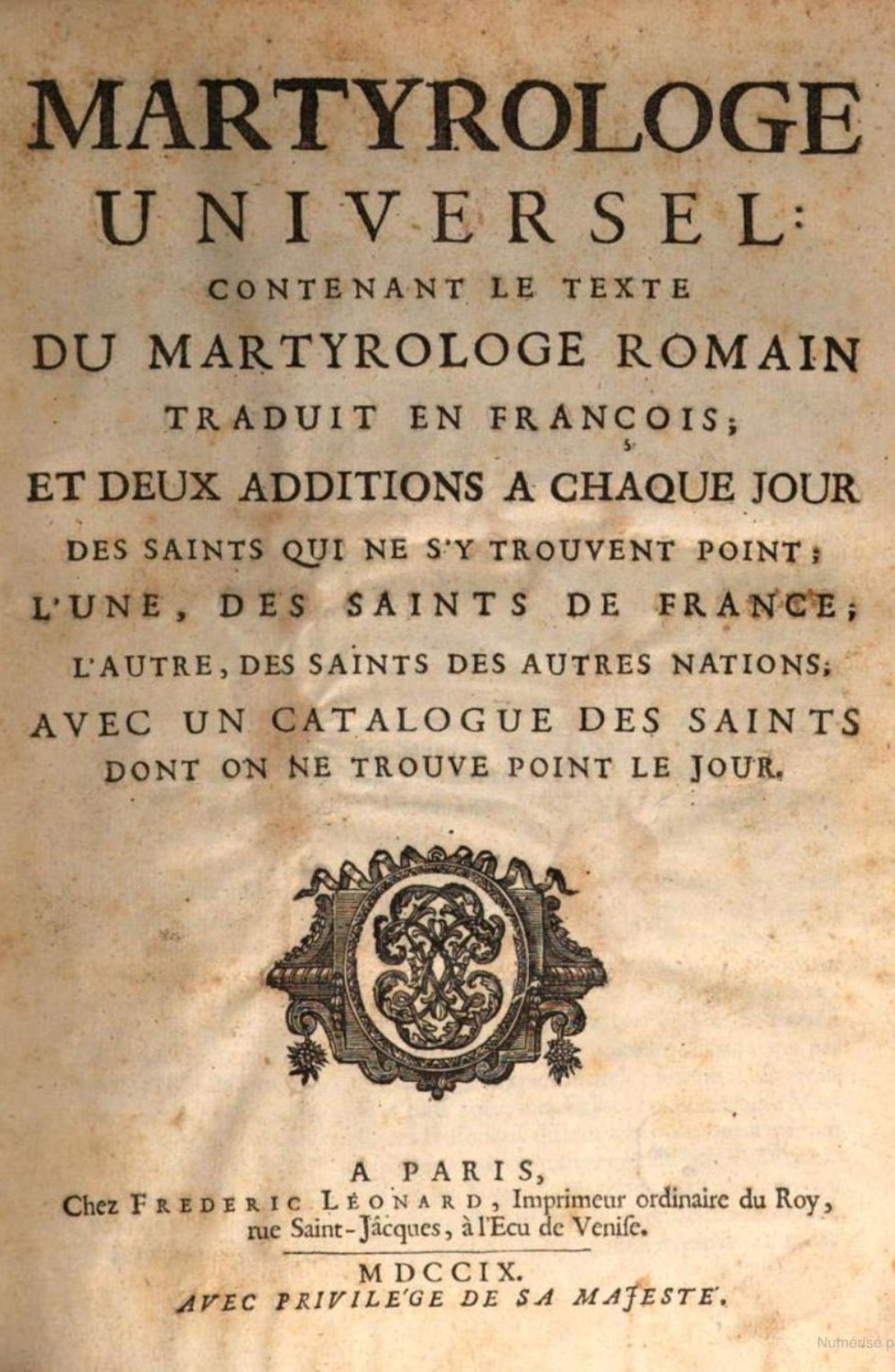
Chastelain’s most important work on the lives and history of Christian saints was his Martyrologe universel (Universal Martyrology), published in Paris by Frédéric Léonard in 1709. This ambitious work, with 1,204 numbered pages, brought together information from the official Roman Martyrology (the Catholic Church’s official calendar of saints and their feast days) and a much wider range of historical, religious, and local sources. Chastelain had previously published a partial French translation of the Roman Martyrology in 1705, covering January and February, but his 1709 publication extended the undertaking to the entire year. For each day, he provided a French translation of the Roman Martyrology, accompanied by two supplementary collections: one devoted to saints of France and another to saints of other countries. He also included a catalog of saints whose feast days could not be established, together with indexes, corrections, and supplementary information.
This broader approach made the Martyrologe universel especially valuable to historians because it preserved references to many locally venerated saints who were absent from the official Roman Martyrology. Rather than simply reproducing an established list, Chastelain sought to bring together traditions that had developed independently across churches and regions, sometimes noting discrepancies between them. Among the figures of particular interest are Saint Véran and Saint Lambert, the two patron saints of Vence. Chastelain commemorates Véran on September 9 and provides a revealing annotation concerning the Saint Véran commemorated at Lyon on November 11. He also records Lambert as Péloguin, an unusual choice that offers another glimpse of the variations in names found in historical religious texts. His work is therefore an important witness to how both saints were remembered and identified at the beginning of the eighteenth century.
Full title: Martyrologe universel, contenant le texte du Martyrologe romain traduit en françois; et deux additions à chaque jour des saints qui ne s’y trouvent point; l’une, des saints de France; l’autre, des saints des autres nations; avec un catalogue des saints dont on ne trouve point le jour
Author: Claude Chastelain (1639-1712)
Language: French
Publisher: Frédéric Léonard, Imprimeur ordinaire du Roy
Publication Date: 1709
City: Paris
Numbered Pages: 1,204 (plus 8 preliminary pages)
— Saint Véran —
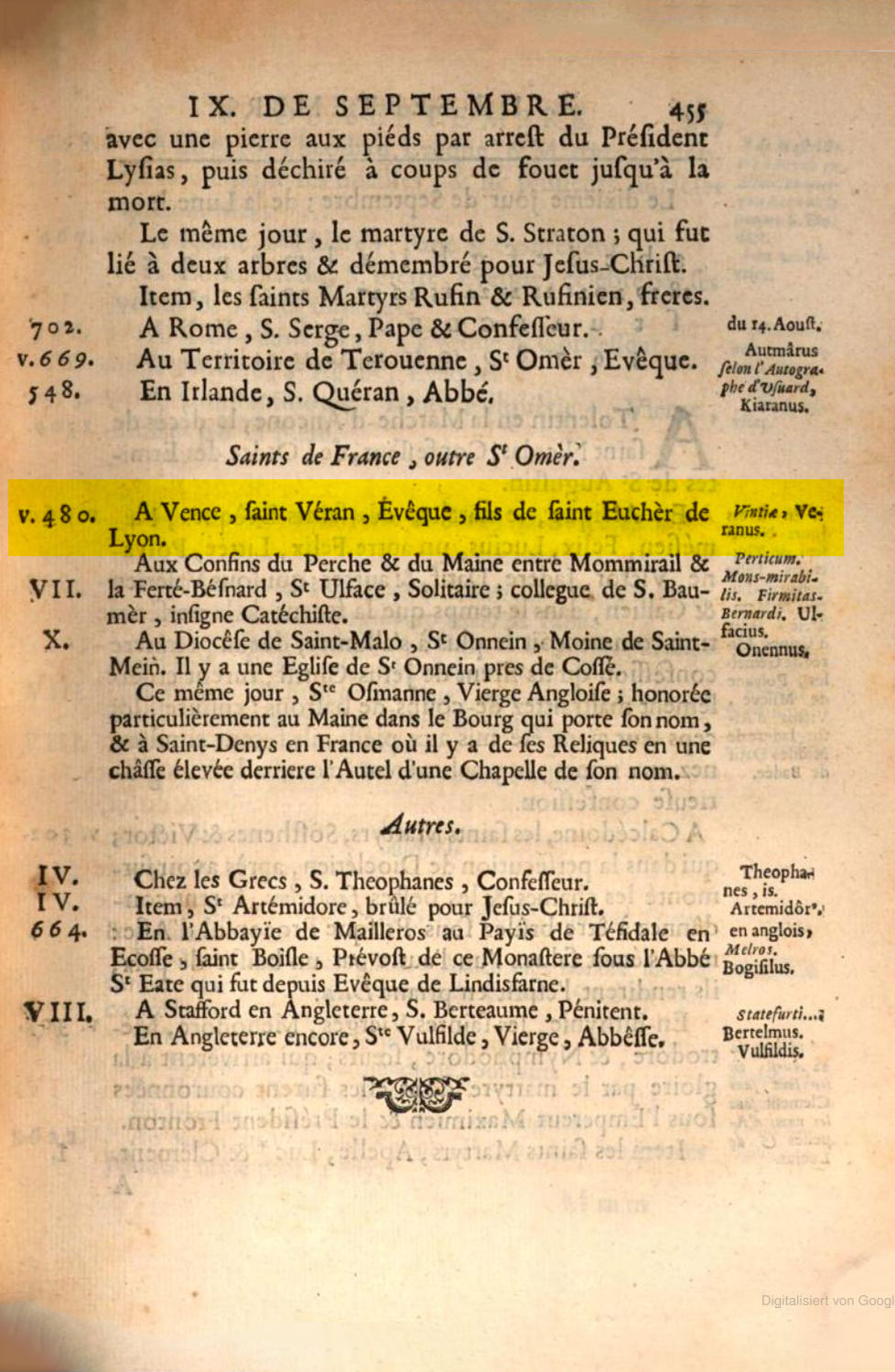
September 9 – Saint Véran of Vence
Page 455: A Vence, ſaint Véran , Évêque , fils de ſaint Euchèr de Lyon.
English translation: At Vence, Saint Véran, bishop, son of Saint Eucherius of Lyon.
What this tells us: Chastelain explicitly identifies Véran as Bishop of Vence and the son of Saint Eucherius of Lyon. This is significant because it connects the local tradition of Vence with the family of Eucherius, whose sons Véran and Salonius are known from fifth-century ecclesiastical writings. Chastelain places the commemoration on September 9, rather than September 10, the date more commonly associated with Véran in the local tradition and later hagiographical accounts. He also includes an approximate date of 480 in the margin, although the entry does not explain whether this refers to Véran’s death or simply his approximate period of activity. It should therefore not be regarded as an established date of death. Importantly, the entry appears among Chastelain’s additions of French saints rather than in his translation of the official Roman Martyrology. It therefore demonstrates the recognition of Véran’s local cult without implying that he had been given a separate official Roman commemoration on September 9.
October 19 – Saint Véran of Cavaillon
Page 530: Au Diocêſe d’Orleans, la dépoſition de S. Vrain §, Evêque.
Marginal note: § de l’II Nov.
English translation: In the Diocese of Orléans, the deposition (burial) of Saint Vrain §, bishop.
Marginal note: § see November 11.
What this tells us: Chastelain’s October 19 entry, which appears in his French translation of the official Roman Martyrology rather than among his supplementary entries for the saints of France, commemorates Saint Vrain, Bishop of Cavaillon, rather than Saint Véran of Vence. Although the entry does not identify his episcopal see, the approximate date of 600 and the marginal reference to November 11 establish a clear connection with Chastelain’s later entry for Saint Vrain of Cavaillon. The October 19 entry places Saint Vrain’s commemoration in the Diocese of Orléans, reflecting the particular importance of his cult at Jargeau, where relics attributed to the saint had been preserved since the Middle Ages. Chastelain describes the commemoration as the saint’s déposition, a term ordinarily associated with burial or death, although he records the saint’s death separately on November 11. Earlier liturgical traditions at Jargeau distinguished the arrival of Saint Vrain’s relics on October 19 from his principal feast and a separate solemn translation of the relics. This suggests that the October 19 commemoration may have marked the arrival of his relics at Jargeau rather than the anniversary of his death. However, Chastelain himself does not explain the distinction between the two dates.
The marginal reference to November 11 is particularly significant. On that date, Chastelain records the death of Saint Vrain, Bishop of Cavaillon, near Albenga on the Ligurian coast of Italy, and notes that his relics were preserved at Jargeau in the Diocese of Orléans. Taken together, the two entries demonstrate that Chastelain recognized different commemorations associated with the same saint. They also help clarify his treatment of the various bishops named Véran. While his September 9 and November 11 entries appear to associate Saint Véran of Vence with the traditional Lyon commemoration, his October 19 entry and the separate November 11 reference to Saint Vrain of Cavaillon show that he distinguished the fifth-century Bishop of Vence from the later Bishop of Cavaillon. The entries therefore provide further evidence that Chastelain regarded these as two historically distinct individuals, despite the similarities in their names and the overlapping traditions surrounding their commemorations.
November 11 – Saint Véran of Lyon
Page 573: A Lyon, S. Véran, Evêque *; qui par sa foy & par le mérite de ses vertus a rendu sa vie fort éclatante.
Marginal note: * de Vence; du 9 Sept.
English translation: At Lyon, Saint Véran, bishop, * whose faith and the merit of his virtues made his life very illustrious.
Marginal note: * Of Vence; see September 9.
What this tells us: This entry, which appears in Chastelain’s French translation of the official Roman Martyrology rather than among his supplementary entries for the saints of France, is particularly interesting because it concerns the longstanding difficulty of distinguishing Saint Véran of Vence from the Saint Véran commemorated at Lyon on November 11. The principal text describes Véran as a bishop associated with Lyon, following the older martyrological tradition. Chastelain, however, adds an asterisk after the word Evêque and supplies the note de Vence; du 9 Sept., connecting this entry directly with his commemoration of Véran of Vence two months earlier.
There are two possible interpretations. Chastelain may simply be directing readers to his September 9 entry for further information about another bishop named Véran. However, the actual wording of the note, particularly the unqualified phrase de Vence, suggests a stronger connection. Rather than explicitly distinguishing two saints, Chastelain appears to identify the bishop commemorated at Lyon with the Bishop of Vence, or at least to treat the two commemorations as referring to the same individual. This would place him among those early modern scholars who questioned whether the traditional Saint Véran of Lyon and Saint Véran of Vence were genuinely separate figures. The note is too brief to establish his reasoning with certainty, but it provides valuable evidence of the uncertainty surrounding their identification in the early eighteenth century.
November 11 – Saint Véran of Cavaillon
Page 573: A Arbeingue sur la mer de Gennes entre Final & Oneille, le décès de S. Vrain, Evêque de Cavaillon ; dont les Reliques ſont à Gergeau, Diocêse d’Orleans.
English translation: At Albenga, on the Gulf of Genoa, between Finale and Oneglia, the death of Saint Vrain, Bishop of Cavaillon, whose relics are preserved at Jargeau, in the Diocese of Orléans.
It is also worth noting that Chastelain includes a separate entry for Saint Véran of Cavaillon on November 11, thus recording this date as the anniversary of the death of Saint Véran of Cavaillon. It appears among Chastelain’s additions of French saints rather than in his translation of the official Roman Martyrology. Combined with his entry for Saint Véran at Lyon, whom he identifies in a marginal note as the Bishop of Vence, this means three of the four “Vérans” appear in Chastelain’s November 11 entries. The important distinction is that Chastelain appears to recognize only two individuals: Saint Véran of Vence, also associated with Lyon, and Saint Véran of Cavaillon.
Additional references to Saint Véran
Page 999: In the additions and corrections section, Chastelain provides the following supplementary entry for page 795:
LE VEN . JUVINE , Evêque de Vence , nommé Saint dans un manuscrit de la Vie de S. Véran. Juvinius.
English translation: The Venerable Juvine, Bishop of Vence, called a saint in a manuscript of the Life of Saint Véran. Juvinius.
What this tells us: This brief entry introduces another intriguing figure from the early history of the Diocese of Vence. Juvine, also known as Juvin or by the Latin name Juvinius, appears in traditional lists of the bishops of Vence, which generally place him in the early fifth century, often around the year 410 or 412, before the episcopate traditionally attributed to Véran. However, these dates are uncertain, and Chastelain’s entry provides no evidence to establish when Juvine actually served as bishop. Chastelain’s wording is especially interesting because he calls Juvine “Venerable” while reporting that a manuscript of the Life of Saint Véran actually calls him a saint.
Even more intriguing is this reference to a manuscript of Véran’s life. It is tempting to associate this with the seventeenth-century biography written by Jacques Barcillon, a canon of Vence Cathedral. Still, Barcillon’s surviving account does not appear to mention Juvine or Juvinius. Chastelain may therefore have been referring to another manuscript or version of Véran’s life, possibly one no longer readily identifiable. Without further evidence, the manuscript cannot be securely identified. Nevertheless, this reference deserves attention because it suggests that Chastelain had access, directly or indirectly, to a tradition concerning Véran that is not represented in Barcillon’s familiar biography. It does not by itself establish the antiquity of that tradition or the historical existence of Juvinius.
Page 1063: In the Index of Place Names, both Saint Véran and Saint Lambert Péloguin are identified as bishops of Vence. They appear under Vintium, the Latin name associated with Vence. This confirms that Chastelain consistently places both saints in the city’s episcopal history.
Page 1115: In the Index of Saints’ Names, Saint Eucherius is identified as the father of Salonius and Véran, with a reference to November 16. This date concerns the commemoration of Eucherius himself, rather than an alternative feast day for Véran. The reference reinforces Chastelain’s acceptance of the traditional family relationship linking Eucherius, Salonius, and Véran.
— Saint Lambert —
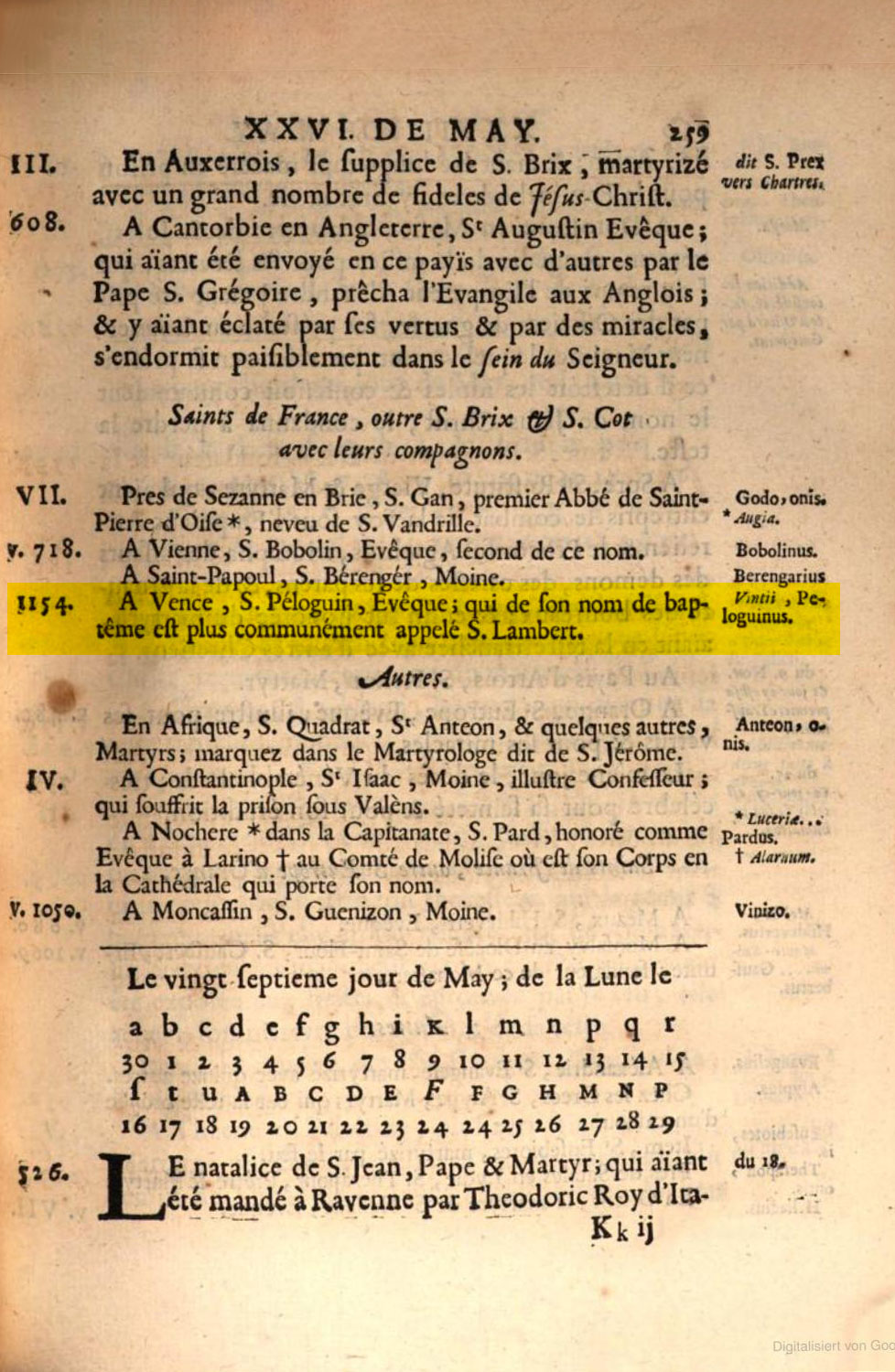
May 26 – Saint Lambert of Vence
Page 259: À Vence, S. Péloguin, Évêque; qui de son nom de baptême est plus communément appelé S. Lambert.
English translation: At Vence, Saint Péloguin, bishop, who is more commonly known by his baptismal name, Saint Lambert.
What this tells us: Chastelain’s entry, which appears among his additions of French saints rather than in his translation of the official Roman Martyrology, is particularly interesting because he introduces the Bishop of Vence as Péloguin, rather than the much more familiar Lambert. The name also occurs in the forms Péloquin and Pelouquin in later sources. By explaining that Lambert was his baptismal name and the name by which he was more commonly known, Chastelain makes an explicit distinction between the two forms. This does not necessarily mean he preferred Péloguin in everyday use, but rather that he considered it important enough to preserve in his martyrology.
The entry reminds us that medieval saints were not always identified consistently in later historical and religious works. Names could vary by local language, regional tradition, or the sources individual authors used. Chastelain’s wording provides evidence that both Péloguin and Lambert were associated with the same Bishop of Vence by the beginning of the eighteenth century. However, it should not be regarded as independent proof of which name Lambert originally received at baptism. The entry also confirms the May 26 commemoration traditionally associated with Saint Lambert of Vence.
Additional references to Saint Lambert
Page 1137: In the Index of Saints’ Names, Lambert Péloguin is identified as Bishop of Vence, with a reference to May 26. This connects the two names explicitly and confirms the date of his commemoration.
Page 1157: In the same index, Péloguin is identified with Lambert, again with a reference to May 26. The separate indexing of the names allows readers to locate the saint whether they know him as Lambert or Péloguin.
Page 1195: In the supplement to the Index of Saints’ Names, Lambert of Baudun is identified as the same person as Lambert Péloguin, but the date is given as March 26 rather than May 26. Baudun is an older spelling of Bauduen, the Provençal village traditionally associated with Lambert’s birth and later veneration. The identification therefore links Saint Lambert of Vence with Saint Lambert of Bauduen, confirming that Chastelain regarded these names as referring to the same individual.
The March 26 date is more difficult to explain. Elsewhere in the volume, Chastelain consistently associates Lambert Péloguin with May 26, which is also his established feast day. The discrepancy in the supplementary index is therefore most likely a printing or indexing error. To identify Lambert’s principal feast day, the repeated May 26 references provide much stronger evidence than this isolated exception.
The 1823 Revision by Nicolas Viton de Saint-Allais
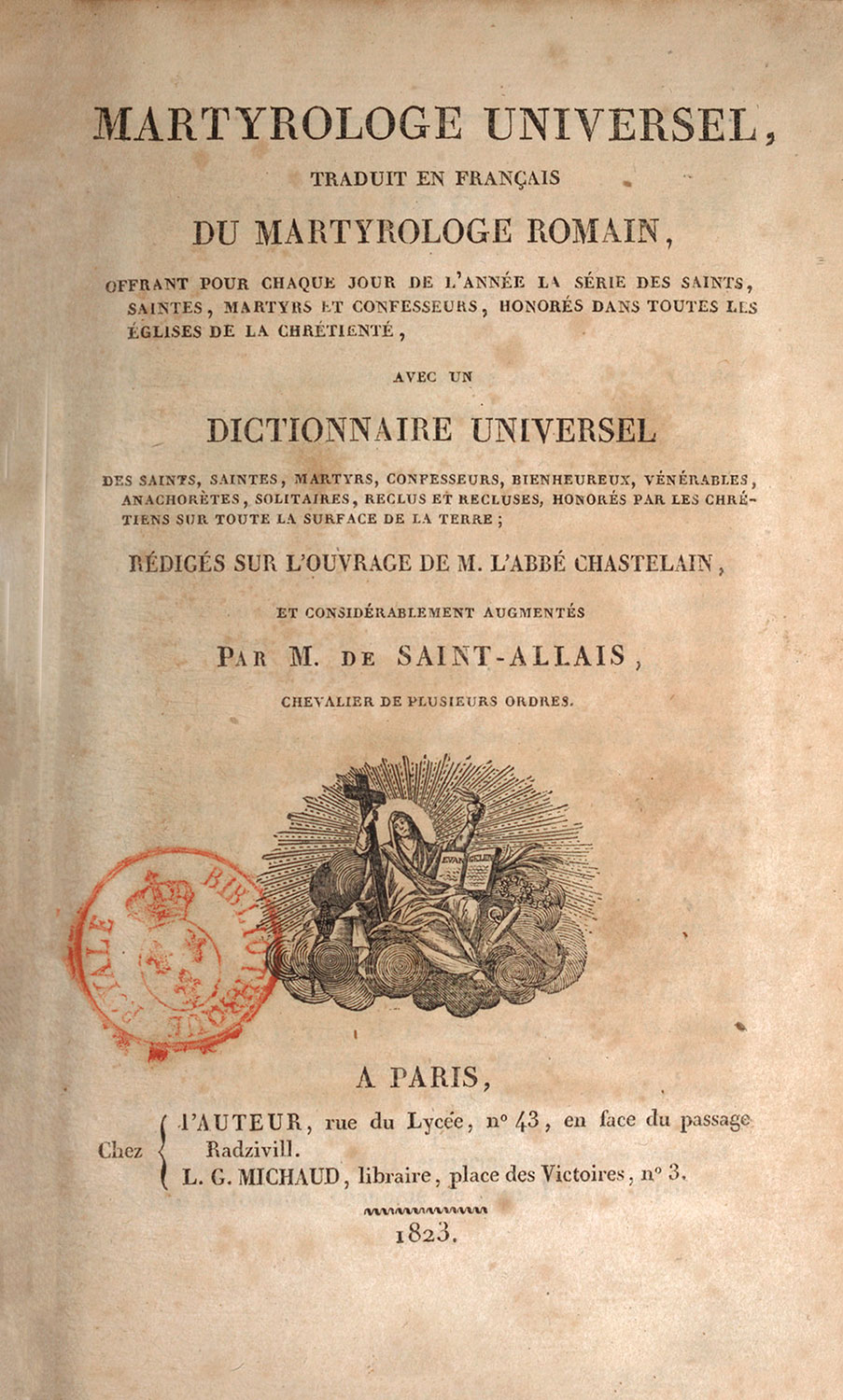
In 1823, French historian and genealogist Nicolas Viton de Saint-Allais (1773–1842) published a new edition of Chastelain’s Martyrologe universel, originally published in Paris in 1709. Although Saint-Allais described his work as considerably augmented, the resulting publication was much more compact than Chastelain’s original. While the 1709 edition contained 1,204 numbered pages, the new publication contained 487 pages of main text and a separately paginated dictionary of 157 pages. Rather than simply reproducing Chastelain’s extensive compilation, Saint-Allais reorganized and condensed much of the material into a more accessible reference work.
The 1823 edition retained a French translation of the Roman Martyrology. It included a separately paginated Dictionnaire universel des saints, covering saints, martyrs, confessors, hermits, and other religious figures venerated throughout the Christian world. The dictionary occupied 157 pages, following the 487-page main text. Although Saint-Allais drew heavily on Chastelain’s earlier research, his publication was substantially different, reflecting an attempt to present the material in a more concise and accessible format. It remains an interesting example of how early eighteenth-century martyrological scholarship was reworked for readers more than a century later.
Full title: Martyrologe universel, traduit en français du Martyrologe romain, avec un dictionnaire universel des saints, saintes, martyrs, confesseurs, bienheureux, vénérables, anachorètes, solitaires, reclus et recluses honorés par les chrétiens sur toute la surface de la terre, rédigés sur l’ouvrage de M. l’abbé Chastelain et considérablement augmentés par M. de Saint-Allais
Author: Nicolas Viton de Saint-Allais (1773–1842), based on the work of Claude Chastelain (1639–1712)
Language: French
Publisher: Chez l’auteur (Nicolas Viton de Saint-Allais)
Publication Date: 1823
City: Paris
Numbered Pages: 644 (487 pages plus 157 separately numbered pages)
— Saint Véran —
September 9 – Saint Véran of Vence
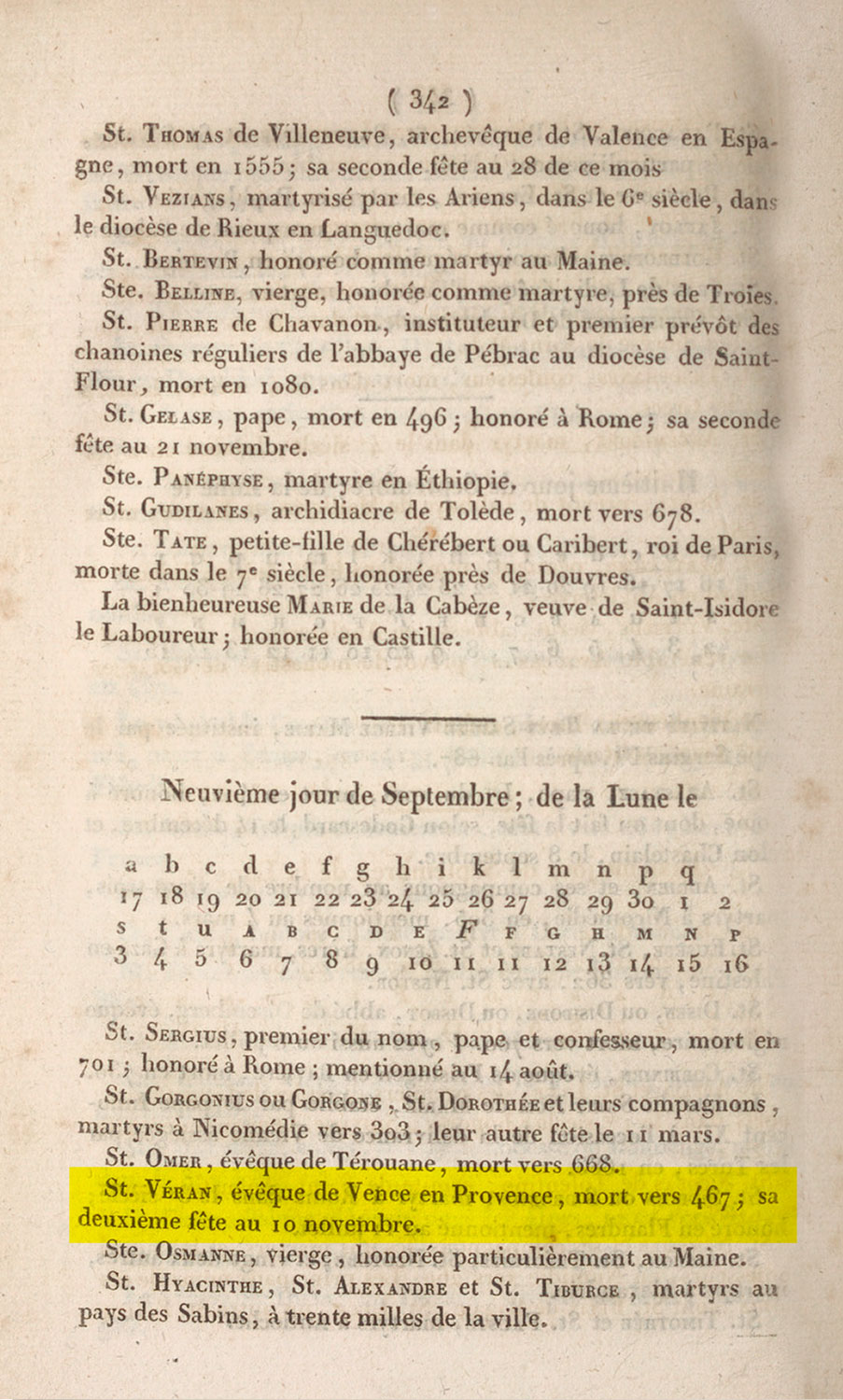
Page 342: St. Véran, évêque de Vence en Provence, mort vers 467 ; sa deuxième fête au 10 novembre.
English translation: Saint Véran, Bishop of Vence in Provence, who died around 467; his second feast day is celebrated on November 10.
What this tells us: Both Claude Chastelain’s original Martyrologe universel of 1709 and Nicolas Viton de Saint-Allais’ revised edition of 1823 commemorate Saint Véran of Vence on September 9. Still, their entries differ in several interesting respects. Chastelain identifies Véran as the son of Saint Eucherius of Lyon and includes an approximate date of 480 in the margin. However, he does not explicitly identify this as the year of Véran’s death. SSaint-Allais omits the reference to Eucherius and instead gives an approximate date of death of 467, compared with Chastelain’s earlier chronological reference to around 480.
Saint-Allais also mentions a second feast day on November 10. This is particularly interesting because the November commemoration of Saint Véran traditionally falls on November 11, as recorded in numerous earlier martyrologies, including the Roman Martyrology. Furthermore, Saint-Allais himself includes another entry for Véran of Vence on November 11, suggesting that the November 10 date in his September entry is probably an error, although confusion between different local commemorations cannot be excluded. By explicitly describing the November commemoration as a second feast of Véran of Vence, Saint-Allais also appears to follow the interpretation that the September and November commemorations refer to the same saint, rather than to two different bishops named Véran.
These differences show how Saint-Allais revised and condensed Chastelain’s original work while adding chronological information. His entry is shorter, omits the reference to Véran’s parentage, and substitutes a different approximate death date. Neither author provides supporting evidence for these dates in the entries themselves, leaving unanswered which historical sources they consulted. By describing the November commemoration as a second feast of Véran of Vence, Saint-Allais clearly associates the September and November observances with the same saint, even though he separately identifies another Véran as Bishop of Lyon.
October 19 – Saint Véran of Cavaillon
Page 394: St. VRAIN ou St. URAIN ou VÉRAN , évêque de Cavaillon au comtat Venaissin, mort vers 600 ; sa seconde fête au 11 novembre.
English translation: Saint Vrain, or Saint Urain, or Véran, Bishop of Cavaillon in the Comtat Venaissin, who died around the year 600; his second feast day is November 11.
What this tells us: A comparison of the October 19 entries in Claude Chastelain’s original Martyrologe universel of 1709 and Nicolas Viton de Saint-Allais’ revised edition of 1823 reveals several interesting differences in how the two authors present Saint Vrain, Bishop of Cavaillon. Chastelain’s entry is relatively brief, recording the commemoration of Saint Vrain in the Diocese of Orléans and assigning him an approximate date of 600. Although he does not identify the saint’s episcopal see in this particular entry, he provides a marginal reference to November 11, where he explicitly identifies Vrain as Bishop of Cavaillon and notes that his relics were preserved at Jargeau in the Diocese of Orléans. The association with Orléans reflects the importance of Saint Vrain’s local cult, particularly at Jargeau, where relics attributed to him had been venerated since the Middle Ages.
Saint-Allais retains the October 19 commemoration and the approximate date of death around 600 but substantially revises the presentation. Rather than emphasizing the saint’s association with the Diocese of Orléans, he identifies him directly as Bishop of Cavaillon in the Comtat Venaissin. He also introduces three alternative forms of the saint’s name, Vrain, Urain, and Véran, making explicit the connection between names that appear in different historical and regional traditions. Like Chastelain, Saint-Allais acknowledges a second commemoration on November 11, but he describes it explicitly as the saint’s second feast day rather than simply providing a cross-reference. His entry is therefore more informative regarding the saint’s identity and alternative names. However, it omits the geographical association with Orléans and the information about his relics found elsewhere in Chastelain’s work.
Taken together, the two entries demonstrate a consistent distinction between Saint Vrain, or Véran, of Cavaillon and the earlier Saint Véran of Vence. Both authors place the Bishop of Cavaillon around the year 600 and associate him with commemorations on October 19 and November 11. However, their different approaches show how revisions of historical martyrologies can shift the emphasis of individual entries. Chastelain preserves information about the geographical setting of the saint’s veneration, while Saint-Allais emphasizes identifying the bishop and clarifying variations in his name. The comparison is particularly useful because it confirms that both authors recognized the Bishop of Cavaillon as distinct from the fifth-century Bishop of Vence, despite the similarities in their names and the overlapping November 11 commemorations.
November 11 – Saint Véran of Vence, Lyon, Cavaillon and Châlons-sur-Saône
Page 424: St. Vrain ou Véran, évêque de Cavaillon au Comtat-Venessain, mort vers 600 ; mentionné au 19 octobre. / St. Véran, évêque de Lyon, successeur de Saint-Eucher. / St. Véran, évêque de Vence, mort vers 467; mentionné au 9 septembre. / St. Véran, évêque de Châlon-sur-Saône.
English translation: St. Vrain or Véran, Bishop of Cavaillon in the Comtat Venaissin, who died around 600; mentioned under October 19. / St. Véran, Bishop of Lyon, successor to Saint Eucherius. / St. Véran, Bishop of Vence, who died around 467; mentioned under September 9. / St. Véran, Bishop of Chalon-sur-Saône.
What this tells us: A comparison of the November 11 entries in Claude Chastelain’s original Martyrologe universel of 1709 and Nicolas Viton de Saint-Allais’ revised edition of 1823 reveals significant differences in how the two authors understood and distinguished between the various saints named Véran. Chastelain records the traditional commemoration of Saint Véran at Lyon, describing him as a bishop distinguished by his faith and virtues. However, he adds an asterisk and the marginal note de Vence; du 9 Sept., apparently identifying the bishop commemorated at Lyon with Saint Véran of Vence, whom he had already described on September 9 as the son of Saint Eucherius of Lyon. Chastelain also includes a separate entry for Saint Vrain, Bishop of Cavaillon, who died around 600, noting that his relics were preserved at Jargeau in the Diocese of Orléans. Thus, in these entries, Chastelain appears to recognize just two distinct individuals: Saint Véran of Vence, also associated with Lyon, and Saint Véran of Cavaillon.
Saint-Allais, writing in 1823, takes a considerably different approach. Rather than associating the Lyon and Vence commemorations with a single individual, he lists four separate bishops named Véran or Vrain: Véran of Cavaillon, who died around 600; Véran of Lyon, whom he identifies as the successor of Saint Eucherius; Véran of Vence, who died around 467; and Véran of Chalon-sur-Saône. His identification of Véran as Eucherius’ successor at Lyon is particularly noteworthy because this claim had already been disputed by earlier scholars, including those who argued that Eucherius’ son became Bishop of Vence and never occupied the episcopal see of Lyon. Saint-Allais also omits Chastelain’s description of Véran’s virtues and the information concerning the relics of Véran of Cavaillon, replacing these details with a more concise list of names, locations, and approximate dates.
The most interesting difference concerns the relationship between Véran of Lyon and Véran of Vence. Chastelain’s marginal annotation suggests that he regarded them as the same person, whereas Saint-Allais’ separate entries indicate that he considered them distinct bishops. Yet Saint-Allais’ treatment is not entirely consistent. In his September 9 entry, he describes the November commemoration as a second feast of Véran of Vence, although he gives the date as November 10, probably a typographical error. His November 11 entry also refers readers back to September 9 for Véran of Vence. Although Saint-Allais distinguishes Véran of Lyon from Véran of Vence, he also recognizes November 11 as a commemoration of the Bishop of Vence. This is not necessarily contradictory, since two different saints could share the same feast day. The more significant inconsistency is that Saint-Allais gives November 10 as Véran of Vence’s second feast in his September entry, while recording his commemoration on November 11 elsewhere in the book.
These differences illustrate how the identities of the various saints named Véran remained uncertain well into the nineteenth century. Whereas Chastelain appears to have recognized that the Lyon and Vence traditions referred to the same individual, Saint-Allais presented them as separate saints without fully reconciling the overlapping commemorations. His four entries reflect the persistence of conflicting historical and liturgical traditions rather than establishing that four historically distinct bishops named Véran actually existed. They also show how later revisions of martyrologies could perpetuate earlier uncertainties, even while attempting to provide a clearer, more systematic account of the saints.
Additional references to Saint Véran
Page 81: Saint-Allais retains a reference to Juvine, Bishop of Vence, in connection with the Life of Saint Véran. However, unlike Chastelain, he does not explicitly mention that a manuscript of Véran’s life called Juvine a saint. This is another example of how Saint-Allais shortened the original material, sometimes leaving out interesting historical details.
Page 139: Saint-Allais associates Saint Véran of Cavaillon with October 19, confirming that he recognized this date as one of the bishop’s commemorations, alongside November 11.
Page 141: Saint-Allais lists four bishops named Véran, treating those of Cavaillon, Chalon-sur-Saône, Lyon, and Vence as separate individuals. Interestingly, he associates Véran of Vence with both September 9 and November 11, reflecting the continuing overlap between the traditions surrounding the bishops of Lyon and Vence.
— Saint Lambert —
May 26 – Saint Lambert of Vence
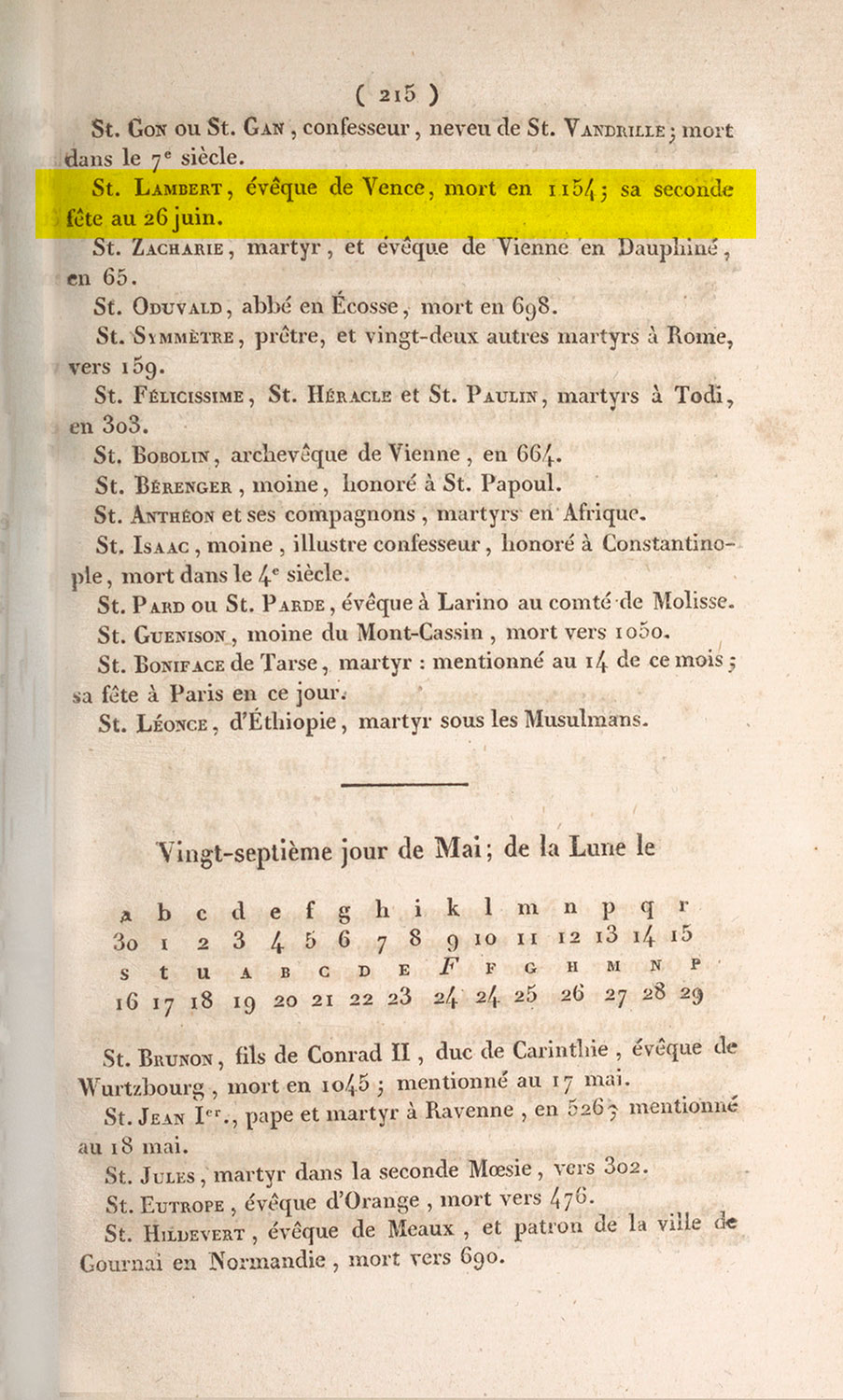
Page 215: St. Lambert, évêque de Vence, mort en 1154 ; sa seconde fête au 26 juin.
English translation: Saint Lambert, Bishop of Vence, who died in 1154; his second feast day is June 26.
What this tells us: Saint-Allais’ 1823 entry for Saint Lambert differs considerably from Chastelain’s original 1709 version, particularly in its treatment of the saint’s name and feast days. Chastelain identifies the Bishop of Vence as Saint Péloguin, explaining that he was more commonly known by his baptismal name, Lambert. Saint-Allais omits Péloguin entirely in this May 26 entry, referring to him simply as Saint Lambert, Bishop of Vence. This change is significant because it removes the unusual alternative name preserved by Chastelain and adopts the name by which the saint is most commonly known today. Note that Saint-Allais does use Péloguin in his June 26 entry.
Saint-Allais also states explicitly that Lambert died in 1154, a date Chastelain had already provided in the margin of his original entry. More interestingly, Saint-Allais introduces a second feast day on June 26, exactly one month after the principal commemoration on May 26. Chastelain makes no mention of this additional feast in his May 26 entry. Saint-Allais does not explain the significance of June 26 or identify the event it commemorated, leaving open the question of whether it represented a local liturgical tradition, a commemoration associated with Lambert’s relics, or some other observance.
The comparison shows how Saint-Allais simplified Chastelain’s account while adding information about Lambert’s veneration. Although the 1823 entry is shorter and omits the historical reference to the name Péloguin, its recognition of a second feast day suggests that more than one commemoration of Saint Lambert was recorded in the early nineteenth century. Neither entry explains the origins of these traditions, but together they offer useful evidence of how successive editions of the Martyrologe universel represented Lambert’s identity and liturgical commemorations.
June 26 – Saint Lambert of Vence
Page 253: St. Lambert dit St. Péloguin , évêque de Vence, mort en 1154; mentionné au 26 mai.
English translation: Saint Lambert, also known as Saint Péloguin, Bishop of Vence, who died in 1154; commemorated on May 26.
What this tells us: Saint-Allais’ June 26 entry complements his earlier commemoration of Saint Lambert on May 26. On page 253, he identifies the saint as Saint Lambert, dit Saint Péloguin, Bishop of Vence, records his death in 1154, and refers readers back to May 26. This confirms that Saint-Allais regarded the two commemorations as belonging to the same individual. Interestingly, although he omits the name Péloguin from his May 26 entry, he reintroduces it here as an alternative name for Lambert. This reverses the emphasis found in Chastelain’s original 1709 edition, where the saint is introduced as Péloguin and Lambert is described as his more commonly used baptismal name.
The most significant difference between the two editions is the recognition of June 26 as an additional feast day. Chastelain records Saint Lambert only on May 26, with no corresponding entry or reference to June 26. Saint-Allais, however, explicitly identifies June 26 as Lambert’s second feast in his May 26 entry and then includes a separate commemoration on that date, referring readers back to the principal feast. The two entries therefore establish that, by 1823, Saint-Allais recognized two annual commemorations associated with the Bishop of Vence, exactly one month apart.
Neither entry explains the origin or significance of the June 26 observance. It may have represented a local liturgical tradition, a commemoration associated with Lambert’s relics, or another event connected with his veneration. Still, the text provides no evidence to establish its purpose. Likewise, the absence of June 26 from Chastelain’s 1709 edition does not necessarily mean that the observance originated between 1709 and 1823. It may simply reflect differences in the sources available to the two authors or in their decisions about which commemorations to include. Nevertheless, Saint-Allais’ explicit recognition of the second feast provides valuable evidence that a June 26 commemoration of Saint Lambert was recorded in the early nineteenth century, a detail absent from Chastelain’s earlier work.
Additional references to Saint Lambert
Page 82: Saint-Allais lists both May 26 and June 26 for Saint Lambert, confirming that he recognized two feast days for the Bishop of Vence, unlike Chastelain, who recorded only May 26.
Page 109: Saint-Allais identifies Péloguin as another name for Saint Lambert of Vence, associating it with May 26. This confirms that he retained the alternative name used by Chastelain, even though Lambert was his preferred name.
Conclusion
Comparing Claude Chastelain’s 1709 Martyrologe universel with Nicolas Viton de Saint-Allais’ revised edition of 1823 reveals more than a century of continuity and change in the treatment of Saint Véran and Saint Lambert of Vence. Chastelain preserves valuable details concerning their identities, family relationships, alternative names, and local commemorations. At the same time, Saint-Allais reorganizes much of this material, introduces additional chronological information, and records feast days absent from the earlier publication.
Particularly revealing are the continuing uncertainties surrounding the various bishops named Véran, especially the relationship between the commemorations at Lyon and Vence, and the preservation of the unusual name Péloguin in the entries for Saint Lambert. Neither publication answers every question about the lives of these two saints, but together they help us better understand how the stories and traditions surrounding Saint Véran and Saint Lambert changed over the years.