As I walked up the small street on the west side of Vence on my way to a game of pétanque I stopped to look inside a small nondescript structure sitting next to the side of the road. A modest window in the narrow door, consisting only of vertical wooden slats, allowed me a good view inside the dimly lit structure. On the back wall was a beautiful (though damaged) fresco depicting Jesus next to the cross, surrounded by Roman soldiers with whips and lances. I had probably walked up and down this street at least a dozen times before and never noticed this small chapel. Or, for that matter, the five other similar chapels that also line the same street!
It was only after reading an article about the Calvaire de Vence (The Calvary of Vence) that I realized I had passed by these important Vence monuments many times before. I think this is probably the case for many people. Very, very few tourists ever visit these chapels (or even know about them) and the same is probably true for the vast majority of people who live in Vence. It’s a shame, because they have a fascinating story to tell and play an important part in the religious history of Vence.
These chapels, built in the early 1700s, were originally filled with a collection of over fifty almost life-sized wooden polychrome statues that portrayed the various scenes of the Mysteries of the Passion, from the Garden of Olives to the Resurrection. Later, in the late 1800s, frescos would be added to each of the chapels to complement (or maybe replace) the statues. Almost fifty of these statues have survived. From their original creation, through the French Revolution and into the late 19th century, they attracted faithful pilgrims from near and far.

Jacques Chave notes in his definitive book on the subject, Le Calvaire de Vence, that the correct name for this series of chapels is a Way of the Cross. However, over the years the name Le Calvaire de Vence has become so associated with the chapels that it is almost always used. “Way of the Cross” refers to the path that pilgrims make where various “stations” are found along the way representing the footsteps of Jesus along the Via Dolorosa, following what was believed to be his path to Calvary (also known as Golgotha), the hill where he was crucified.
This small hill in the L’Ara district (previously known at times as Larrat, L’Arat and La Rat) of Vence where the Calvaire Chapels are located was once named Mont-Calvaire, possibly because a large cross may have been erected at its highest point. A cadastral map (an official French map created for property registration and taxation purposes) from 1679 does indeed indicate that some structure was located there at the time. It shows a “Calvary Path” that passes in front of the Sainte-Anne Chapel, crosses through a grove of oak trees and ascends towards the top of the hill.
In reality, it’s not much of a hill, only reaching 344 meters before it descends down on the western side to the Malvan River. Before the road was paved and given its current name of Chemin du Calvaire it was just a quiet path that led from the outskirts of Vence through patches of trees and farm land. Having reached the top of Mont-Calvaire one was presented with wonderful views of the Mediterranean Sea to the south and the Baous mountain range to the north.
In his essay from 1994, “The Calvary Chapels In Vence,” noted Vence historian Oswald Baudot says that this path “shows the symbolic link that once connected this chapel (the Sainte-Anne chapel) with the place known as Calvaire. To what earlier monument did this place owe its name before the chapels were built? I do not know, for lack of documents. To a cross, no doubt? It was certainly the existence of this Mont-Calvaire that gave Honoré Blanc the idea of building his monument there.”

If you proceed up the Chemin du Calvaire today you will find a total of six chapels still intact alongside the road. There is one large chapel, known as the “grand,” mother” or “main” chapel, and five smaller ones. Additionally, there is what remains of a seventh chapel that has been partially destroyed. There is some confusion as to the number of chapels that were originally built. We have various accounts which contradict each other. Eight, nine, ten, eleven and even fourteen have all been suggested by one writer or another.
The earliest documentation which has survived, a small guide to the chapels published in 1725 by Canon Honoré Blanc (the man most responsible for the creation of these chapels) says there were eight. But in his own will, dated February 4, 1738, Blanc says there were ten. Perhaps two chapels were added between 1725 and 1738?
In his book Un Touriste à Vence, published in 1855, the Vence historian Eugene Tisserand says, “On a small mound covered with rocks rise ten chapels, nine small ones and a large one,” corroborating the number of ten. However, fifty years later, in 1906, an official inventory made by the state lists only nine. What happened to the tenth chapel?
In his book Vence et Ses Monuments, Jacques Daurelle says that as of 1934 only “six of the nine” chapels remained. He says, “the other three have disappeared or have been so altered that they no longer resemble chapels.”
Baudot says, “I believe I can state that there were never more than nine chapels in total, including the large one, which counted as three because it had two small side chapels.” So, six small chapels and the large chapel.
The chapels that comprise the Calvary of Vence have suffered greatly over the last three centuries. At least two have been completely destroyed and the others have deteriorated considerably. As the chapels fell into disrepair the statues were moved from the smaller chapels into the “grand” chapel and the nearby Sainte-Anne chapel for safekeeping. At some point they were eventually moved into the Vence Cathedral where they remain today. For years there has been talk of restoring the chapels and returning the statues to their rightful location, but it remains to be seen if that will ever happen.

Early Christian Pilgrimages
The practice of the Way of the Cross originated in Jerusalem, a tradition that dates back to the early Christian centuries. Several early “travelogues” documenting such pilgrimages provide us with invaluable insights into early Christian practices. The Bordeaux Pilgrim, written in 333 by an unknown author is the earliest known account and details a trip from Bordeaux to Jerusalem, across the Roman Empire. Another account, written most likely between 381 and 384 and titled Peregrinatio, is attributed to Egeria (or Aetheria) a devout Christian woman, possibly from Spain or Gaul. She provides detailed, vivid, personal descriptions of the sacred places she visits, often recounting their biblical significance and how local Christian communities celebrated liturgical events there.
In 614, the Sassanid Persians invaded the Byzantine Levant and captured Jerusalem. The city was recovered in 628 by the Byzantine emperor Heraclius, but only a decade later, in 638, Muslim Arab forces under Caliph Umar ibn al-Khattab completed their conquest of the region. In the late eighth century, diplomatic exchanges between Charlemagne and the Abbasid caliph Harun al-Rashid, who ruled from 786 to 809, helped secure certain protections for Christian pilgrims and religious institutions in the Holy Land. This fragile arrangement continued, in varying forms, until the second half of the eleventh century, when the Seljuk Turks advanced into the region and captured Jerusalem in 1073.
Control of the Holy Land and its sacred monuments was highly contested for centuries, which made Christian pilgrimages difficult and dangerous. They began to organize into larger groups and to bring armed troops with them on their visits. From this the Crusades were born.
In 1099 Jerusalem was captured by the Christian crusaders during the first Crusade. Control of the Holy Lands was once again in the hands of Christianity. However, this control was fragile and intermittent. In 1229, during the Sixth Crusade, a treaty was negotiated between the Holy Roman Emperor Frederick II and Ayyubid Sultan al-Kamil which granted Christians control of Jerusalem and other sacred sites but allowed Muslims access for religious practices. This treaty did not last long and in 1244 the Holy Lands were returned to Muslim rule marking the end of a significant Christian presence in the area.


Nevertheless, Christian pilgrims continued to visit the Holy Lands. In 1312 Pope Clement VI assigned the Franciscan Friars the responsibility of overseeing and preserving the sacred places in the Holy Lands. They were also tasked with safeguarding and supporting pilgrims on their way to and from Jerusalem. These pilgrims paid heavy fees for the rights to visit the Holy Lands, to follow Jesus’ path and to hold religious celebrations. Those who embarked on this pilgrimage were granted indulgences, meaning a “remission of the penalties associated with sins.” As time went by, due to the danger and fragile peace in the area, the pilgrimages began to decline.
The Way of the Cross
Beginning somewhere around the 13th or 14th century Christians in Europe began to develop what might be called a “substitute” for a trip to the Holy Lands, first introduced by the Franciscans who sought to replicate the Via Dolorosa experience for those unable to travel to the Holy Land. The Way of the Cross was created which involved a number of “stations” that marked the significant parts of Jesus’ path to Calvary, from his arrest to his cruxifixction, death and resurrection. These formations (usually found in a church) were recreated in paintings, sculptures, engravings and other works of art as a way of illuminating the story of Jesus, especially for those who could not read. Intended and designed as tools to educate the public, these physical representations were quite powerful in that they engaged all of the visitors senses, emotions and thoughts.
Canon Daniel Brehier, the current priest at the Vence Cathedral says that, “Accompanying the Savior in His Passion is an act of faith, a sign of gratitude, and love for the fulfillment of the mystery of salvation.”

Early Examples of the Way of the Cross
In Varallo, in the Piedmont region of northern Italy, northeast of Turin, the Sacro Monte di Varallo (the Sacred Mount of Varallo) was begun at the end of the fifteenth century. Traditionally dated to 1491, it was founded by the Franciscan friar Bernardino Caimi, who had served in the Holy Land and wanted to recreate its sacred places for those who were unable to undertake the long and difficult journey to Jerusalem. Rather than being simply a representation of the Way of the Cross, the complex was conceived as a “New Jerusalem,” allowing pilgrims to follow the principal events in the life, Passion, death, and Resurrection of Christ.
The remarkable complex, which continued to develop over several centuries, now comprises a basilica and approximately forty-five chapels. Their scenes begin with Adam and Eve and continue through the Annunciation, Nativity, ministry, Passion, Crucifixion, burial, and Resurrection of Christ, together with several scenes associated with the Virgin Mary. The chapels contain more than 800 life-sized figures made principally from painted wood and polychrome terracotta, surrounded by extensive frescoed settings. Sculpture, painting, architecture, theatrical staging, and the natural landscape were combined to create an extraordinarily realistic and immersive experience. Pilgrims did not simply look at individual works of religious art; they moved through a carefully arranged sacred landscape intended to make them feel as though they were witnessing the events of the Gospel themselves.
This innovative union of sculpture and painting reached a particularly powerful form in the early sixteenth century through the work of Gaudenzio Ferrari. His expressive figures, dramatic gestures, realistic faces, and frescoed backgrounds gave the scenes an emotional immediacy that profoundly affected those who visited them. The Sacro Monte di Varallo became a model for the other Sacred Mountains later established across northern Italy and is now included, with eight of them, on UNESCO’s World Heritage List.
It is important to understand the broader religious climate that encouraged the development of monumental Calvaries and chapel-lined pilgrimage routes such as the Chemin du Calvaire. During the Protestant Reformation, the traditional Catholic use of religious images, statues, and relics came under intense criticism. Reformers such as John Calvin regarded many of these practices as forms of idolatry and superstition. Martin Luther also condemned the worship of images and the abuses associated with relics, although he did not oppose religious art itself and accepted that images could be useful for instruction and remembrance.
The Catholic Church responded to these controversies during the Council of Trent. On December 4, 1563, in its final session, the Council issued a decree reaffirming the legitimacy of sacred images and the veneration of saints and their relics. It declared that images of Christ, the Virgin Mary, and the saints should continue to be placed in churches and treated with appropriate respect. The Council was careful to explain, however, that no divine power was believed to reside in the objects themselves. The honor shown before an image was directed toward the sacred person represented rather than toward the wood, stone, or paint from which it was made.
The Council also emphasized the educational and devotional value of religious art. Sacred images reminded the faithful of the events and mysteries of Christianity, recalled the lives and examples of the saints, and encouraged worshippers to deepen their devotion to God. Through vivid and emotionally powerful representations, biblical stories could be communicated to people who might never read them for themselves.
In the centuries that followed, Catholic churches and religious communities increasingly used painting, sculpture, architecture, and theatrical presentation to make sacred history immediate and understandable. Calvaries, Stations of the Cross, and pilgrimage routes populated with life-sized figures became especially effective expressions of this Counter-Reformation spirituality. The wooden statues once displayed in the chapels of the Chemin du Calvaire in Vence belong to this wider tradition of using religious art not simply as decoration, but as a means of instruction, meditation, and emotional participation in the Passion of Christ.
The early Chemin de croix of Fribourg, Switzerland, was an important outdoor example of this developing devotional practice. It was associated with the city’s Hospitaller Commandery of Saint-Jean. The route was already in existence by 1516 and began near the Church of Saint-Jean before ascending the hillside toward the pilgrimage sanctuary of Notre-Dame de Bourguillon.
Pierre d’Englisberg, a knight of the Hospitallers and commander of the Order of Saint John of Jerusalem at Fribourg, is credited with establishing the route. During his years with the Order, he spent time on the island of Rhodes, where he encountered a Way of the Cross composed of seven stations. That route was believed to reproduce the distances between the sacred places along Christ’s journey in Jerusalem. Inspired by what he had seen, d’Englisberg created a similar devotional path at Fribourg.
The Fribourg Way of the Cross consisted of seven stone pillars, apparently surmounted by paintings or reliefs illustrating scenes from Christ’s journey to Calvary. The exact subjects of all seven stations are no longer known. The first represented the house of Pontius Pilate, where the cross was placed upon Christ, while the route concluded near a Calvary showing Christ crucified between the two thieves. The stations allowed pilgrims to recreate symbolically the journey through Jerusalem without travelling to the Holy Land.
The number and subject of the stations varied greatly during this early period. The now-familiar sequence of fourteen stations began to take recognizable form in Spanish Franciscan communities during the first half of the seventeenth century and became increasingly widespread during the following century, particularly through the efforts of the Franciscan preacher Saint Leonard of Port Maurice. Similar devotional routes soon appeared throughout southern Germany, Austria, and northern Italy. By recreating the sacred places of Jerusalem, they allowed people who lacked the financial means, physical ability, or opportunity to travel to the Holy Land to undertake a symbolic pilgrimage closer to home. In many cases, a wealthy patron commissioned artists and craftsmen to reproduce scenes from the Passion of Christ in paintings, sculptures, chapels, and other architectural settings.

Early Examples of the Way of the Cross in France
One of the earliest Ways of the Cross in France was established at Romans-sur-Isère in 1516 by a wealthy cloth merchant named Romanet Boffin. During a business journey to Fribourg, Switzerland, probably in late 1515, Boffin encountered the city’s Way of the Cross, a devotional route marked by seven pillars arranged according to measurements associated with the sacred places of Jerusalem. Inspired by what he had seen, he returned to Romans and began creating a similar pilgrimage route in his native town.
The resulting Way of the Cross, later known as the Grand Voyage, allowed worshippers to undertake a symbolic pilgrimage to Jerusalem without facing the expense and dangers of traveling to the Holy Land. It was one of the pioneering examples of this form of devotion in France and was established well before the Way of the Cross became standardized into the familiar sequence of fourteen stations.
In 1556, Guillemette Faussart withdrew to the summit of Mont Valérien, on the western outskirts of Paris, where she had a small chapel or oratory dedicated to Saint-Sauveur constructed. Three monumental crosses, representing Christ and the two thieves crucified beside him, were erected nearby. The hill already had a tradition of attracting religious recluses, and toward the end of the sixteenth century a more organized community of hermits developed there.
In 1633–1634, the French theologian and preacher Hubert Charpentier, supported by Cardinal Richelieu and authorized by the religious and royal authorities, began transforming Mont Valérien into an important pilgrimage center. He established the Congregation of the Priests of Calvary and had an imposing church dedicated to the Holy Cross constructed at the summit. Chapels depicting episodes from the Passion were gradually placed along the ascent, allowing pilgrims to follow a symbolic version of Christ’s journey to Calvary. Some accounts refer to eleven chapels planned for the complex, although historical descriptions also speak of nine completed chapels furnished with life-sized statues.
The religious complex suffered repeated destruction and reconstruction. During the French Revolution, the three crosses were torn down, the chapels were damaged, and the property was declared national property. The pilgrimage was later restored, and a new Calvary was erected during the Bourbon Restoration, but it was destroyed again after the Revolution of 1830. Between 1840 and 1846, a large military fortress was constructed on Mont Valérien, requiring the demolition of most of the surviving religious buildings. Only a few remnants of the earlier pilgrimage site remain within the fortress today.
In 1709, Saint Louis-Marie Grignion de Montfort began the construction of a monumental Calvary at Pontchâteau in western France. Thousands of volunteers helped create an enormous artificial hill intended to evoke Golgotha, together with crosses, religious figures, and other features connected with the Passion of Christ and the mysteries of the Rosary. After approximately fifteen months of work, the project was nearly ready for its solemn blessing in September 1710. On the eve of the ceremony, however, an order from Louis XIV required the Calvary to be demolished. The king had apparently been warned that its extensive earthworks and surrounding ditch might provide shelter or a defensive position for people hostile to the authorities. The crosses and figures were removed, but the demolition proceeded slowly, and only part of the great artificial hill was levelled.
More than a century later, in 1821, Abbé Gouray, the parish priest of Pontchâteau, organized the first major reconstruction of the Calvary with the assistance of thousands of volunteers. The restored hill and chapel were solemnly blessed by the bishop of Nantes before a large gathering of pilgrims. Father Gabriel Deshayes, an important successor in the Montfortian tradition, attended the ceremony but does not appear to have directed the reconstruction.
The sanctuary continued to expand during the remainder of the nineteenth century. Beginning in the late 1880s, Father Jacques Barré oversaw the creation of a much more extensive sacred landscape, intended to evoke the principal places and events of the Holy Land. Its life-sized sculptural groups and outdoor stations were arranged throughout the grounds, culminating at the artificial hill of Golgotha. The monumental Way of the Cross was formally inaugurated in 1899 and today includes the traditional fourteen stations followed by a fifteenth representing the Resurrection.

Honoré Blanc
From 1681 to 1685 Théodore Allart served as the Bishop of Vence, having been appointed by King Louis XIV. Allart was a Franciscan and it is thought that he provided the original inspiration to construct a Way of the Cross in Vence. But it was Canon Honoré Blanc who took up the task, provided the necessary funds and actually began to build the structures.
Blanc remains a somewhat elusive figure. The son of a lawyer at court, he was probably born at Aix-en-Provence around 1683, although his baptismal record has not yet been identified. Bishop Flodoard Moret de Bourchenu (bishop of Vence from 1701 to 1727) left us a written 1716 pastoral visitation in which he describes him simply as “an Aixois,” confirming that he came from Aix or was closely associated with the city. According to the archival research of Jacques Chave, Blanc belonged to a prosperous family and inherited a considerable sum from his father in 1699. He is also reported to have earned a doctorate in theology, although the university record confirming this qualification has not yet been located. By the beginning of the eighteenth century, he had entered the priesthood and become a canon of the Cathedral Chapter of Vence.
Blanc’s canonry was supported by a prebend attached to the nearby village of Coursegoules. He received two-thirds of the grosse dîme, or great tithe, of Coursegoules, levied principally on grain and lambs. The remaining third went to the resident vicar, who carried out the ordinary pastoral duties of the parish and also received the smaller tithes on flax, hemp, vegetables, and other produce. Blanc’s share produced about 1,000 livres a year, although he was required to pay certain ecclesiastical taxes, contribute toward the salary of the Lenten preacher, and assume two-thirds of the cost of repairs to the church. After these charges, the prebend was estimated to provide him with an annual income of approximately 940 livres, making it one of the more valuable canonries in the Chapter of Vence.
In 1706 Bishop François de Berton de Crillon (bishop of Vence from 1697 to 1714) appointed Blanc as the permanent director of the Vence Hospital. He also charged him with repairing and enlarging the Saint-Pancrace Chapel. That project did not go well. The walls of an extension were constructed, but part of the chapel remained without a roof or vault, and the interior required extensive repairs. Bishop Bourchenu appointed Blanc treasurer and principal rector of the chapel and instructed him to use the available money to complete the most urgent work, particularly the unfinished vault. These records show Blanc dealing directly with building materials, unfinished masonry, financial accounts, craftsmen, fundraising, and more, skills that he would later put to use with the construction of the Calavaire chapels.
The pastoral visitation conducted by Bishop Bourchenu in 1716 reveals that Blanc was more than a clergyman who attended services and collected the income from his prebend. He appears repeatedly as a trusted, capable, and well-informed administrator. When the elderly theologal of the cathedral was prevented by illness from meeting the bishop, Bourchenu summoned Blanc in his place. The bishop recorded that Blanc provided him with information about the condition of the cathedral, the neglect that had occurred, and the abuses that needed to be corrected. Although Blanc did not hold the official position of theologal, this episode suggests that the bishop valued his judgment and regarded him as one of the members of the chapter most familiar with the practical affairs of the church.
Blanc died in 1745 and in his will he requested that he be buried “in the vault beneath the sacristy of the Chapel of Mont-Calvaire.”
The Calvary of Vence
In 1720, Blanc began the work for which he is best remembered: the construction of the Calvaire chapels outside Vence. With financial and practical assistance from other members of the community, he created a devotional pilgrimage route in which scenes from the Passion of Christ were represented by groups of nearly life-sized painted wooden figures. He also composed a small 62 page spiritual guide, titled Prayers for the Benefit of Those Who Wish to Visit the Chapels of Mont Calvaire in the Town of Vence, Where the Sorrowful Mysteries of the Passion of Our Lord Are Represented in Lifelike Form, with Reflections and Considerations on Those Same Mysteries, published anonymously at Aix in 1725 (an expanded second edition was published the following year) for those visiting the chapels. Blanc was therefore not merely their financial patron, but the principal creator of the Calvaire’s architectural, artistic and devotional program.
We know this exact date on which construction of the chapels began because it is noted in the will Blanc left upon his death, where he says:
“Having begun, on January 20 of the year 1720, to carry out the plan I had formed to build a large chapel at the place called Mont Calvaire, near Vence, together with ten smaller chapels representing all the sorrowful mysteries of the Passion, and having completed and finished them, I then had a large house built to lodge and accommodate two priests, and also established funds for their support, for the upkeep of the sacristy and the vestments… and for the repair of the chapels and buildings.”
The large chapel was the first to be built (though there is some disagreement about this), followed by the series of smaller chapels. Baudot says that he “searched in vain through the notarial registers of Vence, between 1720 and 1738, for documents relating either to the purchase of the land on which these chapels were built, to the cost agreed for their construction or for the carving of the statues, or to the act establishing the hermitage.” He found nothing.
Blanc’s will states that there were ten chapels in total. However, in his small spiritual guide for visitors to the chapels printed a few years earlier, he contradicts himself saying there were only eight. It has been speculated that since the large chapel has two apses that protrude from each side, Blanc might have included those interior “chapels” in his number of ten. This seems unlikely. As mentioned earlier, a little over one hundred years later Tisserand specifically refers to “nine small ones and a large one.” It seems most likely that there were originally ten chapels.


In his guide Blanc emphasized that visiting the Calvary of Vence could serve as a substitute for a pilgrimage to Jerusalem. He wrote, “It is true that not everyone is capable of such great courage and zeal [as those who travel to Jerusalem]. There are even many who, due to unavoidable commitments, cannot abandon their properties, occupations, and families. But divine providence has inspired different people to build chapels where the Mysteries and the Passion are presented, so that the faithful may find nearby what so many holy pilgrims travel far to seek.” He also advised against allowing young girls to visit the chapels in the company of young men, pointing out that the secluded location could lead to inappropriate behavior. “Woe to those who use these visits as an opportunity for a meeting place, or for sinful and diabolical encounters,” he scolded.
You can read more about Blanc’s guide to the chapels and donwload various versions of the book in this article: Prieres pour l’Utilite des Personnes qui Voudront Visiter les Chapelles, du Mont-Calvaire.
After the chapels were completed Blanc had a priory (in ruins today) built next to the main chapel to house two priests tasked with looking after them. Later only one priest was needed and eventually the building was inhabited by a series of “hermits” who were tasked with caring for the chapels. Blanc also established a fund for the maintenance and repairs of the buildings.
In 1761–1762, the Calvaire was reorganized under Abbé Guillot de Mondésir, vicar general to Bishop François Moreau. His intervention appears to have been primarily religious and administrative rather than a complete physical reconstruction of the chapels. The Calvaire already possessed papal documents granting indulgences to those who performed prescribed acts of devotion there, such as visiting the chapels, praying at the stations, or participating in confraternity observances. Guillot de Mondésir arranged for these documents to be formally authenticated and entered into the appropriate official records, most likely those of the diocese. This confirmed that the indulgences were genuine, preserved a permanent record of their terms, and placed their public use under episcopal supervision.
At the same time, Guillot de Mondésir drew up statutes for the Confraternity of the Calvary, the religious association responsible for promoting devotion to Christ’s Passion and helping to maintain the chapels and their ceremonies. These statutes would have established how the confraternity was governed, who could become a member, what prayers and observances were required, how officers were chosen, how offerings were administered, and who was responsible for the upkeep of the chapels, statues, lamps, and furnishings.
A few years later, in 1765, responsibility for the large chapel was entrusted to Monsieur Abou, a beneficed cleric. An inventory prepared at the time lists, among other objects, “a small bell to be rung through the town on the eve of the Calvary feasts” and “four shields, two silvered and two of tinplate, to accompany the brothers and sisters to burial.” Curiously, however, the statues are not mentioned anywhere in the inventory.
Money for the maintenance, care and preservation of the chapels over the years came from a variety of sources. A small account book maintained first by the parish priest Savournin and later by Antoine Blanc between 1815 and 1819 sheds some light on how funds were collected.
Collections were taken by the wardens, Balthasar Laugier and Baptiste Merle, on certain holy days such as Easter and the two Feast Days of the Cross. Income also came from the collection box and, less frequently, from funeral processions, each of which brought in between 2 and 5 francs. The hermit was allowed to collect donations at the chapels of which one-third was paid to the parish. He would collect alms at the Calvary during Holy week and even make rounds going door to door in Vence and other nearby towns such as Nice, asking for donations of money and food. Baudot says that he would even travel as far as Entrevaux, Briançonnet and Saint-Cassien, a considerable distance in his time.


The Location and Construction of the Chapels
It appears that the only bishop to visit the site in an official capacity during the years before the French Revolution was Jean-Baptiste Surian (bishop from 1728 to 1754). Describing a visit in 1733 he wrote, “We found everything in good order in the chapel of the Calvary and in the oratories that Mr. Blanc, canon of our church, maintains with great care.”
Local Vence tradition, repeated in a variety of history books about Vence (including Vence et Ses Monuments by Daurelle), attributes the founding of the large chapel that is now part of the Calvary of Vence to Bishop François de Berton de Crillon in 1701. However, it appears there are no historical documents to support this. On the contrary, in 1716 when Bishop Flodard Moret de Bourchenu paid a pastoral visit to Vence he documented all the existing chapels of Vence. He made no mention of this large chapel. This throws a fair amount of doubt on the idea that it really was constructed in 1701. Why would Bourchenu have not including this chapel in his listings if it did indeed exist at the time? It seems much more likely that it was built in 1720, along with the smaller chapels, by Cannon Blanc.
Along the path from the Sainte-Anne chapel to top of the little hill eight small chapels were also constructed. Two of those chapels were completely destroyed at some point and one was transformed into a “laundry room.” Today there are five small chapels and the one large one (not including the one transformed into a laundry room). The chapels are numbered here traveling uphill (west) along the Chemin du Calvaire. The first four chapels are on the left, the “upper” chapel is at the end of the street and the “grand” chapel is on the right, near the top.
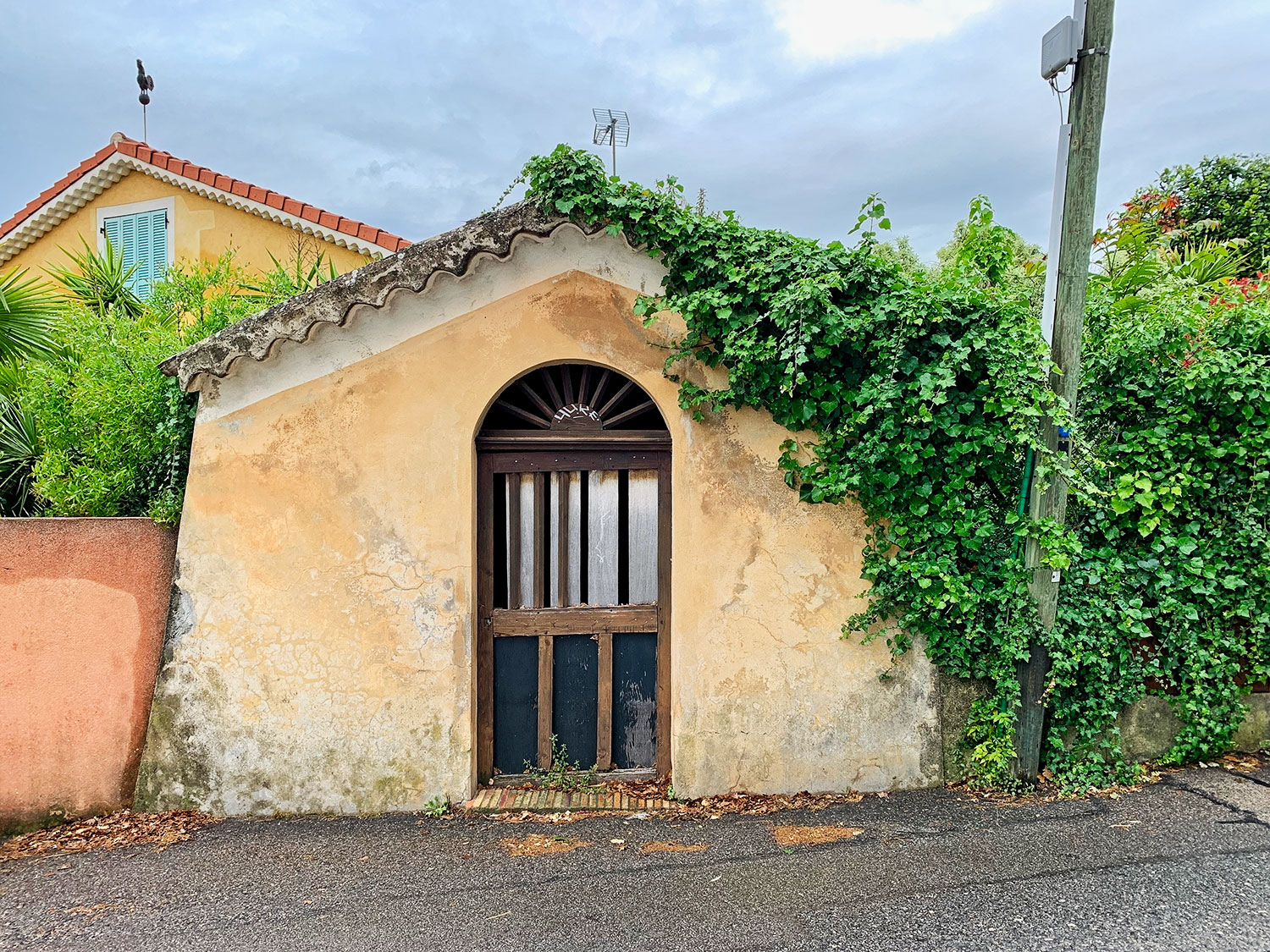
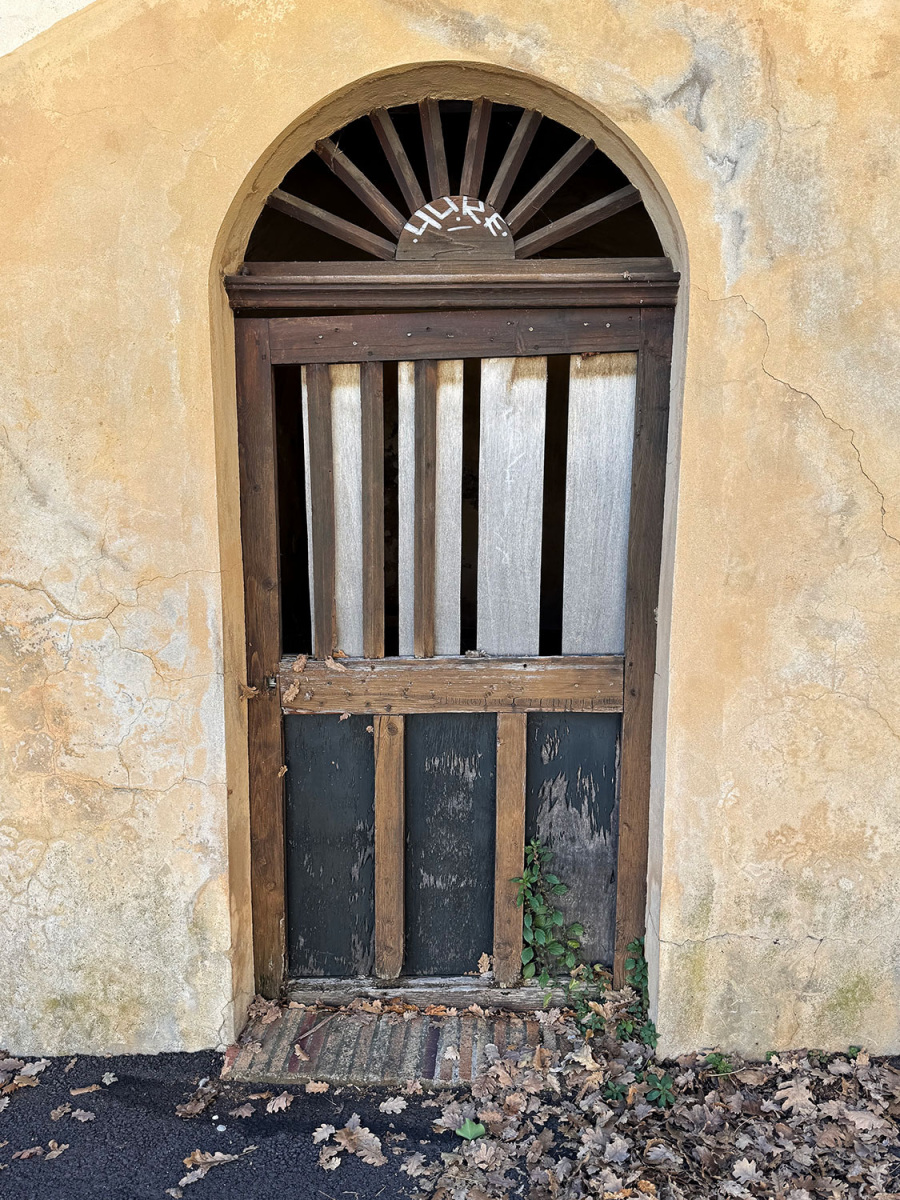
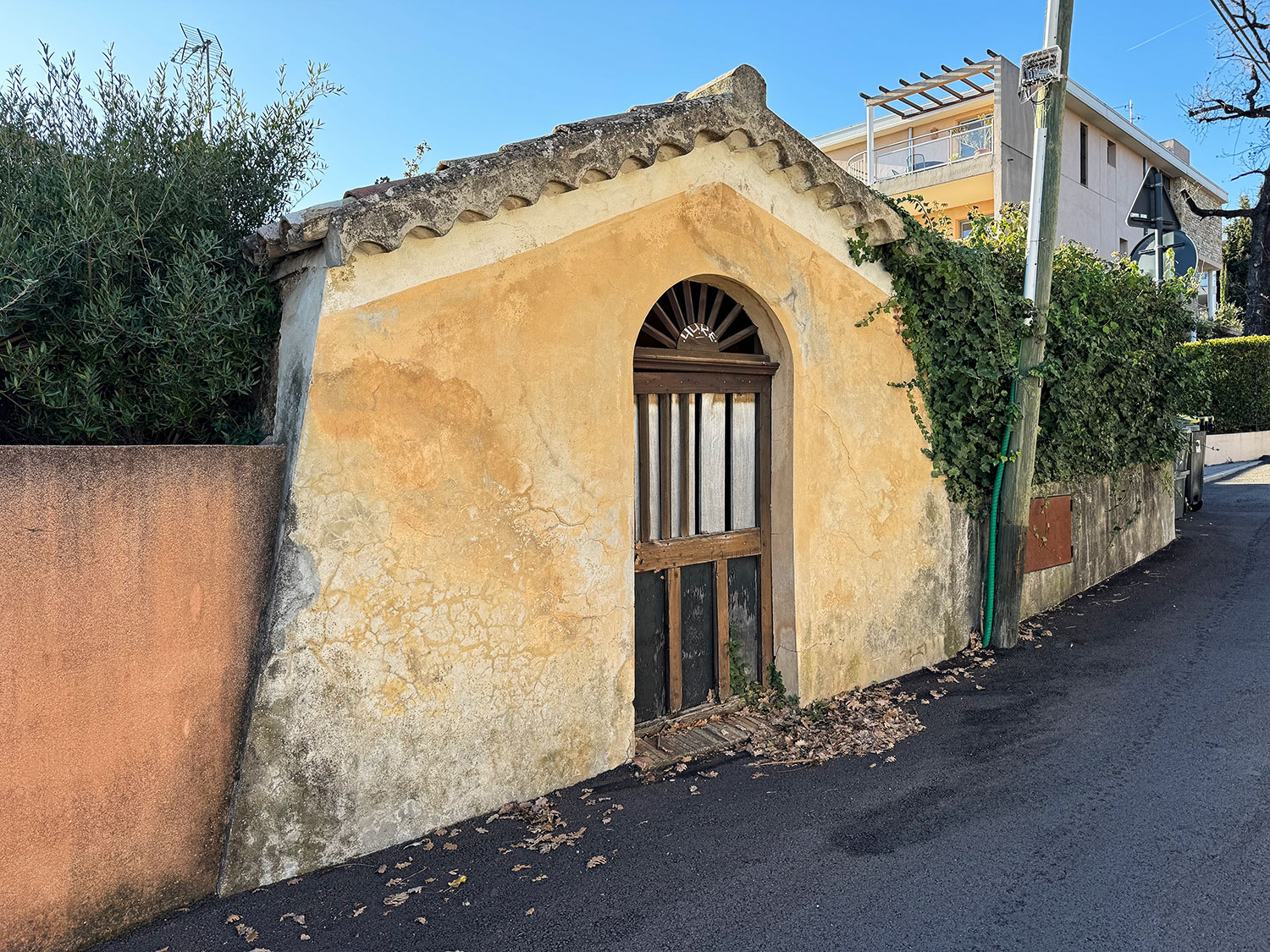
The first four small chapels that line the west side of Chemin du Calvaire are all very similar. They are all very close to the same size (though they do become slightly bigger as you progress uphill) and each includes a door made of wood facing the street. The middle portion of the door contains vertical wooden slats which allow the visitor to see into the chapel while the top features wooden rods arranged in a fan. Each chapel features a gabled roof with a scalloped design on the gable ends. The roofs are covered with rounded clay tiles, very common in this part of the Côte d’Azur. Only one of the chapels, the fifth chapel, features a cross at the summit of the roof above the door.
On four of the five smaller chapels the front façade is covered in plaster while the stone walls are visible on the other three sides. The exteriors of all the chapels are all in relatively good condition though the plaster is cracking and peeling in some places. There are some minor differences in the façades. Each of the five small chapels has a concrete “stage” against the back wall of the interior, presumably where the statues were once displayed. The fifth chapel is significantly larger than the first four and the sixth chapel (the “grand” chapel) is completely different.
Today each of the first four chapels sits in front of and/or beside large, modern apartment buildings. Concrete walls and/or iron fences (usually covered in greenery) extend from the sides of the chapels. These barriers integrate the chapels into the various private properties, restricting access and preventing movement around them. It’s impossible to measure the depth of these chapels without getting access to the private property. They can only be viewed from the road.
[click on any image for a larger version]
The First Chapel
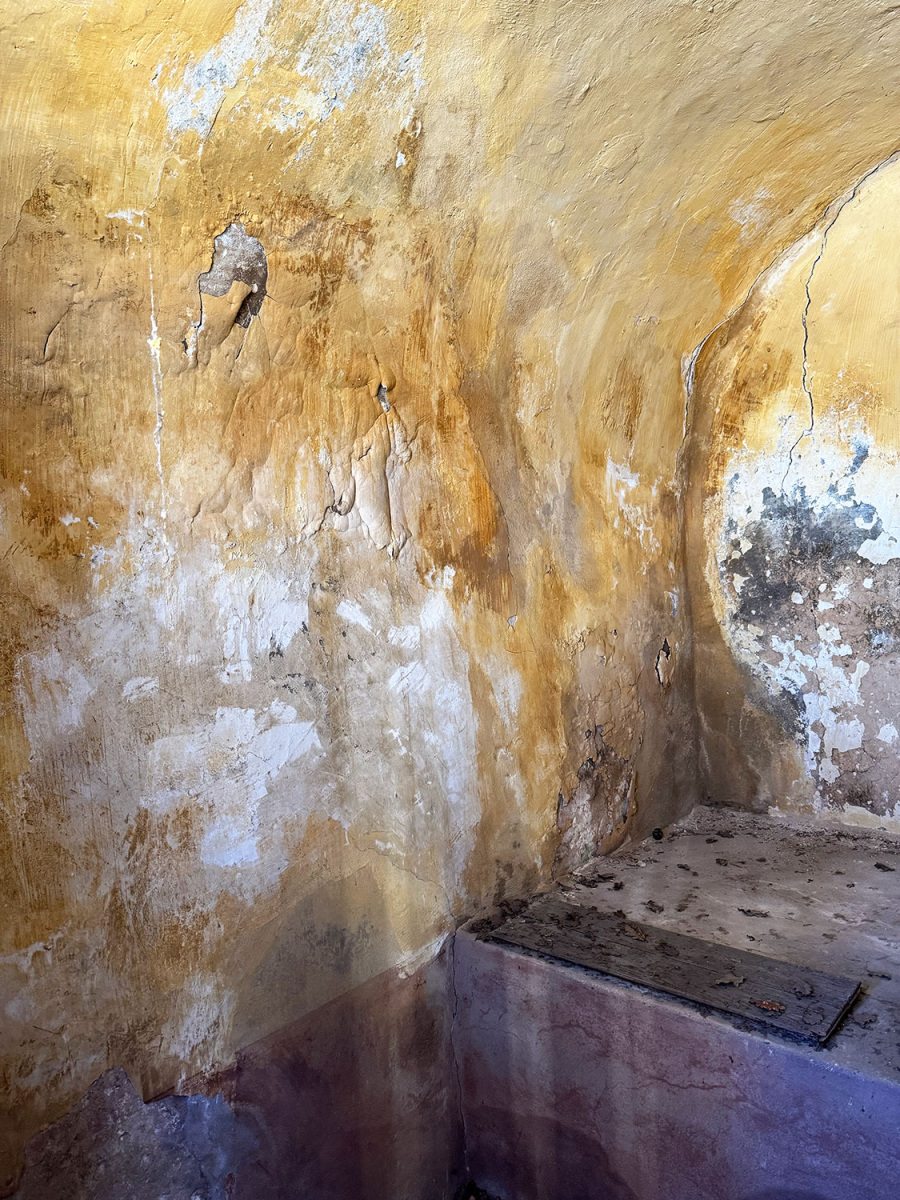
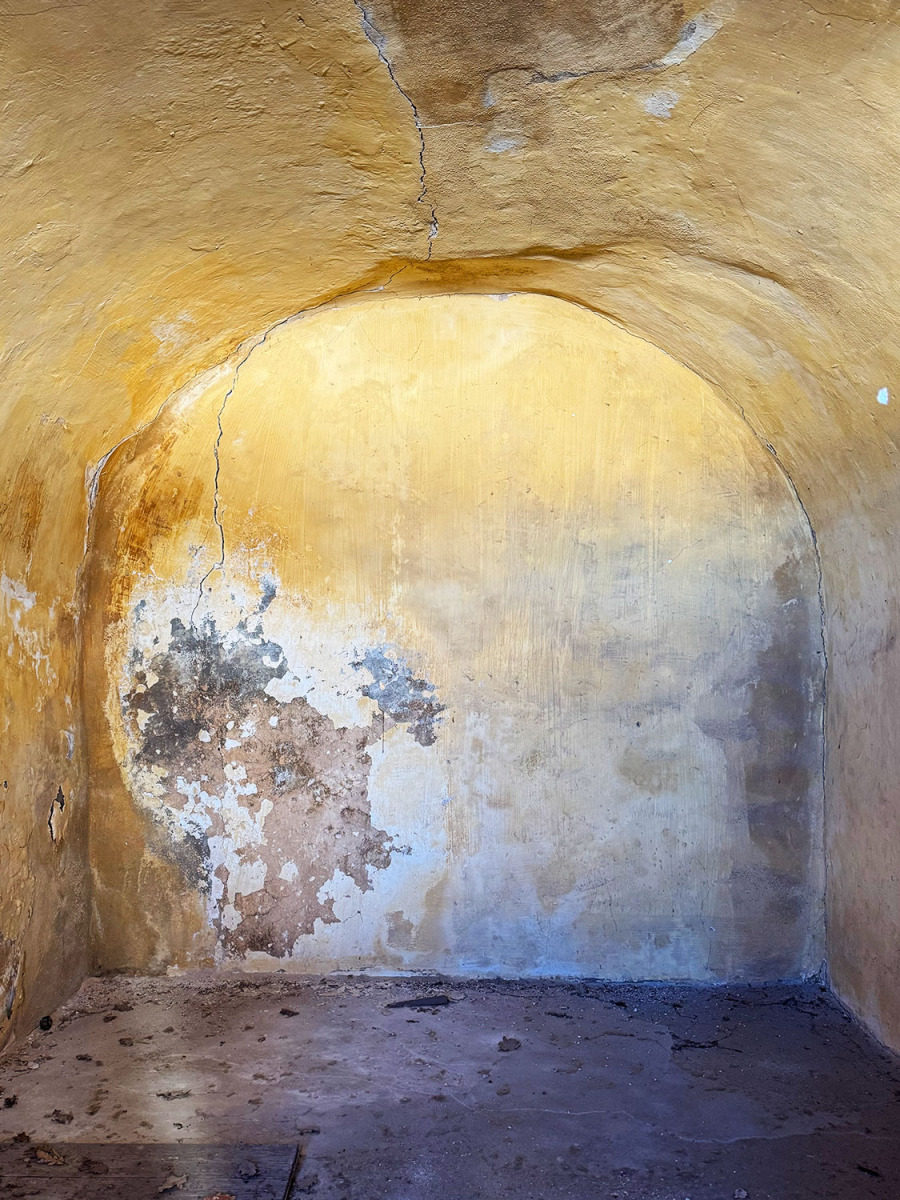
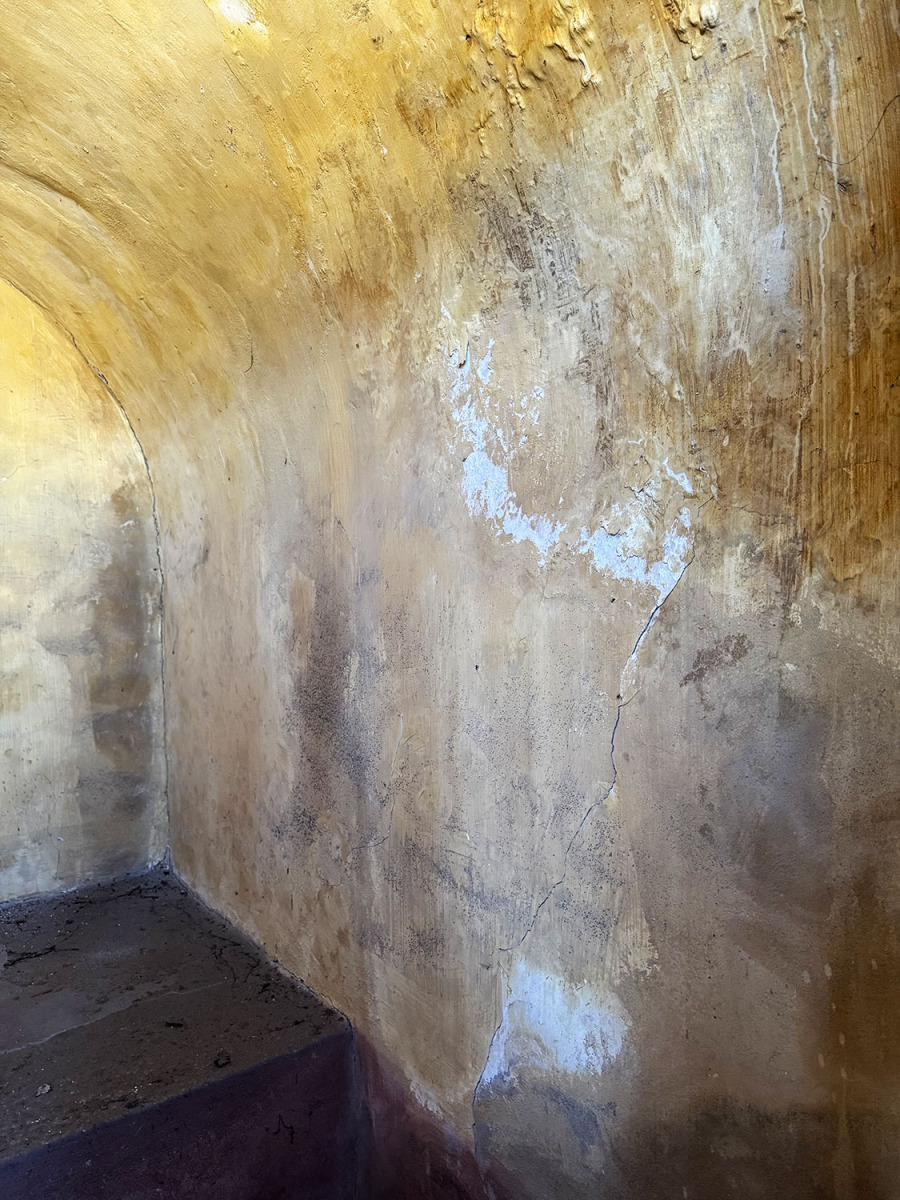
The 1st Chapel can be found just a short bit after turning onto the Chemin du Calvaire from Boulevard Emmanuel Maurel. This chapel differs a bit from the others in that the front façade has been modified to create sloping, angled sides on the left and the right. Several of the wooden slats at the top of the door have been broken and replaced by even larger ones making it more difficult to see inside. The chapel measures 4 meters wide and 3.15 meters tall at the peak of the roof. There is no trace of the frescoes which once adorned the interior walls, they are completely gone.
[click on any image for a larger version]
The Second Chapel
A bit further on, past two large modern apartment complexes, the 2nd chapel sits. Often times the fence to the apartment complex behind this chapel is open so it is possible to walk around to the back side. The chapel measures 4.57 meters across the front and approximately 4.40 meters high. The inside features a fresco on the back wall depicting Jesus carrying the cross with several additional figures, including a woman holding a child on her left arm while another child presses against her. The fresco has been badly damaged with several large portions missing. There are no traces of previous frescos on the left or the right walls.
[click on any image for a larger version]
The Third Chapel
The 3rd Chapel is 5.15 meters wide at the front and 3.65 meters high in the center. The fresco inside features seven figures representing the Flagellation of Jesus. The right portion of the fresco is badly damaged with large portions missing while the left side is in remarkably good condition. Another badly damaged fresco exists on the left wall though it is currently obscured by a large piece of old furniture. The right wall shows no traces of the original fresco. The lock on the wooden door is currently broken so the door is tied with rope to prevent entry. Unfortunately, there is a designated parking place in front of this chapel making it difficult to get good photos. Like the third chapel it is often possible to walk around the back of this chapel as the gate to the apartment complex behind it is usually open.
[click on any image for a larger version]
The Fourth Chapel
The 4th Chapel is adjacent to a large, modern apartment complex known as “Les Terraces à l’Ara.” Unlike the other small chapels it has plaster on both of the sides walls as well as the front. One can assume the back wall is also plastered but it is impossible to see because of the fences surrounding the chapel. It measures 5.27 meters wide across the front and approximately 4.8 meters tall. When Daurelle described the chapels in 1934 he said there were seventeen statues being stored inside this one, but today, of course, there are none. This is the only remaining chapel with all three frescos still in place. The one on the rear wall is badly damaged, missing almost a third of the scene. The remains of a fresco on the right wall show nothing other than a small mountain peak. There are six figures decorating the left wall fresco, but only the shoulders and heads of the men are still visible.
[click on any image for a larger version]
The Fifth Chapel
The 5th Chapel is sometimes referred to as the Upper Chapel due to the fact that it is the highest on the hill of all the chapels. It also faces a different direction with door opening towards the east, not the north. It is the most significant of the smaller chapels measuring 6 meters wide, 8.95 meters long and 4.8 meters tall. There is a small wrought-iron cross with fleur-de-lis tips on top, the only one of the small chapels to feature a cross on the roof. The rear of the structure features a small stone stage, different than the simple concrete stages of the other chapels. The fresco on the back wall represents the city of Jerusalem. There were likely other frescos on the left and right walls, but they are gone. Daurelle noted that statues were being stored here in 1934.
[click on any image for a larger version]
The 6th Chapel
The 6th Chapel (sometimes referred to as the grand, mother or main chapel) is located on the opposite side of the road, a bit further back down. With two interior chapels, one on the left and one on the right, this chapel is designed to form a cross. The wooden doorway, consisting of two parts, is framed with stone. Directly above it a small recess houses a large cross. In the upper right portion of the facade is a sundial. All the walls are plastered. Daurelle mentions that there has been some confusion over the years about the name of this chapel, noting that it was often confused with the nearby Chapelle Sainte-Anne. He says that is should “rightfully bear the name Notre-Dame de Larrat,” though this is the name that was sometimes given for the Chapelle Sainte-Anne. He goes on to say that some have even referred to it as the Chapelle de la Madeleine, which he says is simply wrong.
The interior measures 14.7 meters in length, 4.1 meters in width and almost 8 meters in height. In the past services were held in this chapel every May 3rd (Feast of the Invention, or Discovery, of the Holy Cross) and September 14 (Feast of the Exaltation of the Holy Cross). Daurelle notes that on these days the attendance was so large that not everyone could be accommodated in the chapel and many stood outside.
Daurelle also describes a small bell-tower on the main chapel which he says was “reconstructed.” There is no sign of this tower today, however it can be seen in old photographs and postcards. An inventory of the main chapel taken in 1906 listed 43 items, though none were considered to be particularly valuable, including statues of the Virgin, Saint John and Jesus.
An ambitious renovation project was undertaken in March 2018 to preserve and enhance this “Grand” chapel and to stem the continued deterioration. Private donors, the City of Vence, DRAC PACA and the Fondation du Patrimoine all contributed towards the hefty 457,000€ price tag for the work. Improvements included refurbishment of both the interior and exterior facades, replacement of woodwork, roof renovation and various improvements to the floors, lighting and windows. Plans were made to move the Calvary statues into the chapel when the work was finished.
Unfortunately, due to a variety of factors the statues still remain in the Vence Cathedral. Serious problems with the completed work (including water leakage) were immediately discovered and the idea of moving the statues into the chapel was once again put on hold.
[click on any image for a larger version]
The “Converted” Chapel
Between the first chapel and the second chapel sits another small building which can be easily overlooked. In fact, it is what remains of what was once another chapel but at some point was converted to a “laundry” building. It measures 3.23 meters wide across the front, 3.6 meters at the highest point of the roof and 3.12 meters deep. It appears as if the chapel has been cut in half as the roof consists of only one side, sloping down from the left to the right. Like the other small chapels it has been integrated into the private property behind it by fences on each side. Unlike the other small chapels it features a roof of flat clay tiles with a metal vent pipe for a small fireplace found inside.


The Priory
Today the priory which once housed the priests and hermits who cared for the chapels is in a state of almost complete ruin. The roof is gone and the walls are in bad shape. Nothing remains of the windows or doors. Greenery has overtaken a significant portion of it, especially on the south wall. Old postcards from the early 1900s shows it in better shape than it is today, but not by much. Without some type of intervention this structure is probably going to continue to deteriorate. For many years the local pétanque club used a portion of it as a snack bar and today restrooms are built into the northern side.
The Hermits of the Calvaire
For many years a series of “hermits” lived near the chapels and cared for them. It is believed that they were there before the French Revolution and then departed for a time. Records show that Jacques Martin, a native of Auribeau, held the position until he died on August 15, 1815. He was replaced by François Guigou, a native of Clans until 1819. The most notable of the hermits was probably Louis-Joseph Guisol, appointed in 1841 by the Bishop of Fréjus, Jean-Baptiste Michel. In his mandate Bishop Michel specifically forbade Guisol from wearing ecclesiastical attire (a cassock and triangular hat) and instructed him to only conduct collections with the parishes of the district and then only after obtaining approval from the parish priests and mayors.
In his book Un Touriste À Vence, Tisserand says, “A hermit is appointed to guard these sanctuaries, tends to his small garden, and lives in an old ruin said to have belonged formerly to some religious individuals. He lives solely on alms from visitors and the faithful.” This “old ruin” is undoubtedly the priory built by Blanc where priests were originally housed. Tisserand includes a short poem in his book dedicated to these hermits. It reads, in part:
At his side hangs the rosary;
Noble gaze and serious demeanor,
Bushy beard and austere robe,
Everything about him inspires respect.
After The French Revolution
According to surviving notarial deeds on September 24, 1794, during the French Revolution, nine chapels which comprised the Calvary of Vence were sold in Grasse, the district capital, to Honoré Brézet in three lots. He paid 1,600 francs for the large chapel, 455 francs for the first six small chapels and 515 francs for the final two small chapels. (Again we have contradictory information about the number of chapels. Earlier we noted that Tisserand observed “nine small ones and a large one.” How could there have been only nine in 1794 but ten in 1855?)
A deed dated February 2, 1805 show that Abbé Abou later purchased three of the chapels, the main chapel and the two higher ones, from Brézét. Baudot notes that “The deed specifies that Abbé Abou is buying in the public interest, that he undertakes to leave the chapels to the inhabitants of Vence, and that the sale is agreed to on this condition.” At the time the chapels were reported to be in poor condition. Materials that could be reused elsewhere had been removed and the chapels had been left to deteriorate. Abou undertook some restoration work in and entrusted the care of the chapels to one of the hermits. Only two years later we have a record of Jean-François Florens, the vicar general of the archbishop of Aix, visiting Vence and writing that “We went from the chapel of the White Penitents to the chapel of the Calvary. We found it in very good condition…, as well as the eleven oratories used for the Via crucis.”
In 1833 Father Jean-Pierre Chaix purchased the remaining six small chapels for 150 francs and donated them to the Parish. The money to purchase the chapels was donated by the women of the Sainte-Anne congregation. Father Chaix said, “My intention is and will remain irrevocable that these chapels be used for the exercise of the Catholic faith, thus transferring the ownership and use of these chapels to the Parish.” The deed from this transaction mentions that these six chapels represented Our Lord Jesus Christ in the Garden of Olives, before Pilate, before Caiaphas, the Flagellation, the Crowning with Thorns, and the Carrying of the Cross.
The following year, all nine chapels are clearly visible on the 1834 cadastral map of the area. Daurelle states that throughout the 1800s the people of Vence never failed to practice the Way of the Cross on Good Friday, always coming to the Calvary and following path of the eight small chapels.
In 1875, the parish register recorded a major campaign to renovate the Calvaire, whose chapels and sculpted figures had fallen into poor condition. The parish priest, Abbé Bruny, commissioned Auguste Vincent, a painter from Cannes, to carry out the work after obtaining the approval of the fabrique, the council responsible for administering parish property and finances. Vincent completed the restoration for a total cost of 2,000 francs. His work included the decoration of the chapel interiors with painted scenes illustrating the successive Stations of the Cross.
Most of the expense for this work was met personally by Bruny, who contributed 1,500 francs. Baudot suggests that this unusually large payment may have come from funds maintained outside the formal accounts and supervision of the fabrique. A further 200 francs was donated by the sisters of the Sainte-Anne congregation, effectively the women of the Vence parish, while the remaining 300 francs was raised through collections and individual offerings. It was most likely at this time that the frescos we see remnants of today were created (though Daurelle says they were “repainted,” implying that they already existed). Baudot says the people of Vence were not fond of the frescoes. Henri Giraud, mayor of Vence in the 1920s, wrote in his book Les Brûle Bon Dieu, that Vincent was “an infamous dauber who covered the walls of the chapels with abominable frescoes and damaged with his brush the naive statues of Dalon.” A large ceremony was held on Sunday, May 9th of that year to bless the stations.

Nine chapels are listed in a 1906 inventory made by the state in accordance with the Loi du 9 décembre 1905 concernant la séparation des Églises et de l’État (Law of December 9, 1905, on the Separation of Churches and the State). This law established the principle of laïcité (secularism) in France, ensuring that the Republic does not recognize, subsidize, or support any religion and that religious institutions are separate from and operate independently of the state. This principle sought to ensure state neutrality in religious matters and guarantee freedom of conscience.
The law required that religious properties (such as churches, synagogues, and temples) that had been owned by the state or public entities but were used for religious purposes be transferred to local municipalities or entrusted to new nonprofit religious associations called associations cultuelles. However, these associations were tasked only with managing the properties and their use for worship, not owning them outright. Religious buildings constructed before 1905 remained the property of the state or municipalities and were made available for free use by religious organizations for worship.
This transfer of property from the state to local municipalities caused some uncertainty with regard to these particular chapels. In 1911 Léonie Berthe, a niece of Joseph-Stanislas Chaix (likely a descendant of Father Chaix), sold six of the small chapels to Lieutenant-Colonel Giraud even though Father Chaix had made it very clear he wished the chapels to remain part of the Parish forever. Berthe was told that she had inherited the chapels from her uncle, when it fact, this was not true.
In 1914, Emmanuel Maurel, who owned property adjacent to the chapels declared that he was the rightful owner of the large chapel and two others and initiated legal proceedings against the city of Vence. The city opposed this claim referring to the deed of 1805 when Abbé Abou purchased the chapels. Things remained uncertain for several years though it seems in the end Maurel abandoned his claims when he realized he would most likely lose in court.
Today only seven chapels remain, one of which is barely recognizable. Two of the chapels were destroyed sometime between 1906 and 1976 though we have no record of exactly when or why.
The Statues of the Calvary of Vence
The statues of the Calvary of Vence are undeniably unique in many ways, due in part to the fact that they were obviously not all designed and created by just one artist or even one workshop. Instead they seem to have been created by a wide variety of artists, the evidence of which is clear in their design and execution. Only one of the statues, a depiction of Jesus with his hands bound by rope, is signed. The majority of them do not seem to have been created by “professional” artists. They have been described as “rustic,” “crude” and even “grotesque.”

The collection includes eleven representations of Jesus, five of the apostles, five of the holy women and two of the Virgin Mary. There are also figures of the High Priest, Pilate, thieves, angels and soldiers. The earliest of these statues date back to the 18th century when the chapels were first built. Over the years some have been destroyed and later replaced.
At least one author and Vence historian, Daniel Petite, believed that originally the fourteen Stations of the Cross were depicted in pairs, two in each of seven small chapels. In his book Vence – Parcourue Pour Vous, he continues that the other two chapels illustrated the arrest of Jesus in the Garden of Gethsemane and the Resurrection. This however, contradicts Canon Blanc’s description of the scenes in the chapels from his small guidebook:
First Chapel: Jesus in the Garden of Olives (Gethsemane)
Second Chapel (now destroyed): Jesus is bound and led before Caiaphas
Third Chapel (now destroyed): Jesus is tied to a column where he is flagellated
Fourth Chapel (now partially destroyed): Jesus is crowned with thorns
Fifth Chapel: Jesus carries his cross to Calvary
Sixth Chapel: Jesus is crucified
Seventh Chapel: Jesus dies on the cross
Eighth Chapel (the upper chapel): Jesus is taken down from the cross and placed in his tomb
Ninth Chapel (the large chapel): Blanc does not mention it, leading to speculation that no statues were originally housed here and that maybe it was reserved for worship.
Very little is known about the creation of these statues. There are no records in the historical archives of the church or the town which offer any insight. It seems that because the statues were commissioned personally by Cannon Blanc no official records were kept. Fortunately, we do have a few sources from which to draw information.


The first source is the Chronicle of Vence which says that, “There was in Vence a holy priest, whom I was told was Messire Honoré Blanc, canon of Vence, who worked, with the assistance of pious individuals, on the construction of the Calvary and who depicted the mysteries of the Passion of Our Lord Jesus Christ in life-sized sculptures.” Who exactly were these “pious individuals” who assisted Canon Blanc and how many of them were there?
The second source is the report from Bishop Bourchenu’s 1716 visit to Vence mentioned briefly earlier. In a section about the Sainte-Anne chapel (then known as the Notre-Dame de Larrat), he mentions two hermits who cared for the chapel, one of whom had created the wooden altarpiece for the main altar. One or both of these hermits would most likely have known Canon Blanc. Could they have been some of the before mentioned “pious individuals?”
Chave writes that it is, “not out of the question to attribute some of our statues, or at least their inspiration, to the hermit. In any case, he certainly did not create all of them, and given their naïve, folk-like appearance and rustic craftsmanship, it seems unlikely that they came from a workshop specializing in statue production. We can thus assume that the creation of the sculptures (apart from those made by the hermit) was likely carried out by local carpenters or woodworkers from Vence.”


The third source is the inventory taken by the state in 1906. This lists nine chapels and fifty statues. Today there are a total of 49 statues which means only one has been lost since the inventory. We will probably never know how many statues there were originally and how many were destroyed or lost during the French Revolution, numerous wars and the neglect and indifference of the last three hundred years.
Based on the research of Jacques Chaves, most (almost 40) of the surviving statues date from the 18th century, a handful date from the 19th century, and at least one is most likely from the 17th century. This somewhat contradicts Tisserand’s account of the statues in 1855. Tisserand claims, “… the old statues have been replaced by figures more horrible than the others. The Revolution destroyed everything, and it wasn’t until 1833 that it was repaired.” In his section about the Chapelle Sainte-Anne, he goes on to say, “In a small adjoining space next to this chapel, there is a painted wooden statue representing a Centurion. Unfortunately, it is cut off at mid-leg, but the statue likely originates from the old Calvary. It is certainly from that period and is probably the only one to have escaped the 1793 auto-da-fé (a ritual of condemnation or public penance)”. However, he somewhat contradicts himself in another passage, saying you can still see some of the old sculptures. His claim that everything was destroyed seems to be at variance with the fact that we have almost 40 statues today that date from the 1700s. We can only assume that Tisserand was mistaken.
The statues of the Calvary of Vence were granted status as a Historical Monument in 1997. The official statement read, in part: “These sculptures are the remnants of an exceptional work in the Southeast of France, comparable to the Sacri Monti of Piedmont, both for its rarity and its importance in the former diocese of Vence.”
A more in-depth account of the statues of the Calvary of Vence is coming soon.
The Deterioration of the Chapels
Over the years the chapels began to deteriorate. The grilles on the windows, designed to protect the interiors of the chapels, were broken, often times to retrieve coins faithful visitors had tossed inside. The frescos inside were damaged, sometimes by children throwing stones at the various figures depicted on the walls.
Baudot recalls: “In my early youth (if I can rely on my rather unreliable memory as a document), that is to say, at the end of the 1920s or the beginning of the 1930s, the chapels were still intact. Their openwork doors were doubled with a heavy wire mesh through which one could see the figures standing in their postures… The statues were no longer protected. They were gathered in the Sainte-Anne chapel, and then in the Grand Chapel.”
Later the chapels were once again forgotten and abandoned. Some were used for storage. During World War Two they were used as temporary barracks for soldiers. Petite says that the statues were restored in a Parisian workshop in 1958.


During the 1970s the doors to the main chapel would be opened during the tourist season and a volunteer guide would provide information and commentary on the chapels and the statues. During the other nine months of the year the statues were locked away from view. The damp and dirty conditions of the chapel contributed to their continuing decay. A report by the municipal arts Commission recommended that the statuary be transferred to the Sainte-Anne chapel due to the condition of the large Calvary chapel.
In 1976 the statues were moved again, this time to the Vence Cathedral where they remain to this day. In his book Vence – Parcourue Pour Vous, Daniel Petite says that in 1958 the chapels were officially recognized and designated as historic or culturally significant sites by the Monuments Historiques division, overseen by the Beaux-Arts (Fine Arts) administration. This classification provides protection and acknowledges their architectural, artistic, or historical value. This led to the chapels being officially classified as an Historical Monument on December 14, 1989 by the French Ministry of Culture. This last classification was very important in opening doors for the possible restoration and renovation of the chapels.
In the winter of 1999 the statues were gathered and displayed in the Chapelle des Pénitents Blancs (Chapel of the White Penitents) in Vence where they drew over 5,000 visitors.
Marc Chagall and the Chapels
The famous painter Marc Chagall moved to Vence in 1949 and on December 12th of that year he attended the ceremony for the laying of the foundation stone of the Chapelle du Rosaire de Vence, commonly known as the Matisse Chapel. Chagall was there to show support for his friend, fellow artist and sometimes friendly “rival” Henri Matisse who had conceived and created the chapel. Some say that Matisse’s work inspired Chagall to contribute something similar to the town of Vence. A project was devised for Chagall to renovate and revitalize the Chapelle des Pénitents Blancs (The Chapel of the White Penitents). Although an initial plan was approved by the bishopric it never went anywhere, most likely due to the costs involved.
In September of 1952 Chagall made an offer to the city to decorate the Calvaire chapels. The mayor asked the owners of the small chapels not owned by the municipality to donate them to the city free of charge so that the project could move forward and they agreed. Nearly two year later, in late July of 1954, nothing had transpired. Minutes for a council meeting at the time seem to indicate that maybe the project was now focused on Chagall restoring and decorating just the large chapel. Everyone was enthusiastic about the project but there were some obstacles that had to be overcome before work could actually begin.


An opinion from the bishop who represented the diocesan association and the diocesan commission of sacred art, from which several conditions were imposed on the impending project, included the following:
- the chapel must remain designated for worship
- the statues had to remain in the chapel
- the costs for the restoration and decoration must be borne by the municipality
- the decorations must not alter the essential purpose of the chapels for Catholic worship
- and probably most importantly, the chapels must not, under any circumstances, be “deconsecrated” and transformed into mere museums
The church feared, probably correctly, that the presence of Chagall’s artwork would transform these chapels (intentionally or not) from places of worship into small museums.
Movement on the project was slow. In January 1955 Chagall was quoted in the local newspaper as saying he wanted to utilize glass in his work decorating the chapel. In March of the same year another newspaper proclaimed that the Calvary statues must be protected at all costs and not discarded in favor of new decorations from Chagall. Throughout 1955 discussions and negotiations between members of Vence’s sacred art commission and several museum curators occurred. It finally became apparent that the works Chagall wished to display in the chapel simply could not coexist with the statuary, mainly due to their size. The project slowly ran out of steam and eventually faded away.
Much of the work that Chagall had initially considered donating for the chapel ended up as the centerpiece of the Musée National Marc Chagall which opened in 1973. Known as the “Biblical Message”, this series of 17 large-scale paintings illustrates themes from the Old Testament, specifically the books of Genesis, Exodus, and the Song of Songs. A few years later, Chagall would donate a unique and treasured mosaic to the Vence Cathedral titled “Moses Saved from the Waters” (Moïse sauvé des eaux), completed in 1979.
Another Project for Decorating the Chapels
In the early 1990s another project surfaced with a proposal to “decorate” the Calvary chapels. Yvon Lambert, a renowned French art dealer with a gallery in Paris (and native of Vence), organized an exhibition at the Fondation Émile-Hugues (now the Vence Museum) featuring projects designed to decorate the Calvary chapels. Unfortunately, he did not coordinate this exhibition with the Diocese of Nice (who oversaw the chapels). In April of 1994 Lambert submitted a different proposal regarding the renovation of the chapels and organized another exhibition, this one titled “For the Chapels of Vence.” The exhibition consisted of works by eighteen contemporary artists, a few drawings by Matisse and a small group of the Calvary statues.
The project became bogged down in many of the same issues that eventually sank the Chagall project, namely the lack of coordination between the city officials and the parish and the fact that the church held authority and sovereignty with regard to the chapels.
Father Costa, the parish priest of Vence at the time, expressed “joy” at the thought of the chapels being restored. However, this joy was countered by a “feeling of concern” that the chapels and statues would be separated, with the chapels being entrusted to living artists for decoration and the statues being grouped in a new building. He once again protested strongly against the idea of the chapels being “decommissioned” and transformed into exhibition halls, no longer being used for worship. Additionally, he was not impressed with the proposed artwork for the chapels, saying, “Most of the artists seem to ignore what a Calvary is. Their works lack any religious research and have no place in the exhibition. Their art has neither touched nor even sensed the mystery; it is not enough to draw a few religious objects to reach the spiritual dimension. Decorating a Calvary, illustrating a station of the Way of the Cross is a demanding endeavor.”
Costa did agree to reserving the large chapel for the statues and decorating the small chapels with suitable works of art which the church would be involved in selecting. The large chapel would also have to remain available for worship at certain times.
Studies and discussions continued and the project seemed to move slowly forward. The Vence municipal council voted to allow the commencement of the redevelopment of the chapels. Unfortunately, everything collapsed in November 1997 when serious obstacles were encountered with the restoration and renovation of the large Calvary chapel.

What the Future Holds for the Calvary of Vence
In 2002 a new association was formed, the Association pour les édifices et objets religieux vençois (the Association for Vence Religious Buildings and Objects). Jacques Chave helped establish this new organization and was appointed President. In his book on the Calvary he says:
“Since the establishment of this association (whose name was later abbreviated to Patrimoine religieux vençois – PRV – Vence Religious Heritage), a succession of agreements and disagreements, difficulties with administrations (Monuments of France, regional directorate of cultural affairs, etc.), and changes in the municipality have constantly delayed the restoration and installation of the statues.”
As of January 2025 little (if any) progress has been made with the Calvary of Vence. The small chapels still remain in a concerning state of disrepair. The large chapel was indeed “renovated” but as mentioned earlier the work was apparently not done well enough to facilitate the moving of the statues back to the chapel. They still remain in the Vence Cathedral.
Most everyone involved hopes that some resolution, some solution will emerge sooner rather than later, but for now, everything seems at a standstill. One can only hope that someday soon the statues of Calvary will be reunited with the chapels and once again find their rightful place in their original home.

Access
Vence can easily be reached from just about anywhere in France by taking the A8 until you get to Cagnes-sur-Mer. If you are coming from the east get off on Exit 48 and if you are coming from the west you’ll want Exit 47. Take the M336, then the M36 and finally the M236 north into Vence. The most accessible parking is in the Parking du Grand Jardin, right next to the old town. Parking Toreille and Marie Antoinette Parking are both close by as well.
There are two buses which run from Nice to Vence: #9 and #655. Just be careful with the #9, it can be a bit confusing because it has two routes leaving from the Park Phoenix in Nice. One route stops at the Shopping Promenade mall which is still about 8kms from Vence. Look at the route displayed on the front of the bus at the top. It should say “L’Ara” which is the last bus stop in Vence. All the #9 buses returning to Nice from Vence go all the way to Park Phoenix.
There is no train service directly to Vence. You can take the train to Cagnes-sur-Mer and then take either the #9 or #655 bus from Cagnes-sur-Mer to Vence.
To reach the Calvaire de Vence proceed to the large roundabout where Avenue de la Résistance and Avenue Emile Hugues meet. Take Boulevard Emmanuel Maurel until you reach the Chemin du Calvaire on the right.
The Vence Office de Tourisme is just across the street from the Grand Jardin. While you can visit the chapels of the Calvaire de Vence on any day of the year, I would suggest that you try to come on any day but Sunday or Monday so that you might also enjoy some of the shops and boutiques in Vence that will otherwise be closed.
What: A Pilgrimage Through Time and Faith: Discovering the Chapels of the Calvaire de Vence
Where: Vence (Alpes-Maritimes) (Google Maps)
When: All year
Phone: Vence Office de Tourisme: 04 93 58 06 38
Website: vence-tourisme.com
Facebook: vencetourisme