Among the ancient documents that may preserve a reference to Saint Véran of Vence, the Martyrologium Hieronymianum, or Martyrology of Saint Jerome, stands out as one of the most intriguing. It is one of the oldest and most important collections of Christian saints’ commemorations, with origins stretching back more than 1,500 years. Buried among its thousands of entries is a brief reference to a Bishop Véran, commemorated on November 11 at Lyon. At first glance, this seems straightforward enough, but it raises an important historical question. Was this the Saint Véran who served as Bishop of Vence during the fifth century, or another bishop with the same name? The question has occupied historians for centuries and involves conflicting traditions, uncertain burial places, and the complicated relationship between the early Church in Lyon and the little town of Vence. To understand the problem, we need to begin with the document itself.
What Is the Martyrologium Hieronymianum?
A martyrology is essentially a calendar of Christian saints, arranged according to the dates on which they are commemorated. The earliest examples concentrated primarily on martyrs, but later collections expanded to include bishops, monks, confessors, and other figures considered worthy of remembrance. The Martyrologium Hieronymianum takes its name from Saint Jerome (c. 347–420), the famous biblical scholar and translator of the Latin Vulgate, the standard version of the Bible used by the Catholic Church for over a thousand years. For centuries, people attributed the work to him, partly because its manuscript tradition includes introductory letters supposedly connecting Jerome to its creation. Modern historians, however, agree that Jerome did not write it. The attribution was intended to lend authority to a collection that developed gradually, incorporating material from several different sources over an extended period.
The Martyrologium Hieronymianum was not written and published as a single book in the modern sense. It developed gradually as different collections of saints’ commemorations were brought together, copied, expanded, and revised. Scholars generally believe that the earliest version was compiled in northern Italy, perhaps around Aquileia, during the second half of the fifth century. It drew on still older Christian calendars, including those associated with Rome, Africa, and the eastern Christian communities.
At some point, a copy traveled north into Gaul. Around the end of the sixth century, probably at Auxerre, the text underwent an important revision. The collection incorporated commemorations of additional saints, particularly bishops and other figures associated with the churches of Gaul, many of whom had not appeared in the original Italian compilation, creating the complex martyrology that has survived to the present day. In his 1885 study Les sources du Martyrologe hiéronymien, Louis Duchesne argued that all the surviving principal manuscripts ultimately descended from this revised Gallic version, rather than directly from the original Italian compilation. This remains a fundamental distinction in the study of the martyrology.
Unlike later martyrologies, which often provided short biographical accounts, the Hieronymianum generally contains little more than names, places, and dates. Unfortunately, centuries of copying also introduced numerous errors. Names were misspelled, places confused, and entries occasionally duplicated or assigned to different dates. These problems have made the Martyrologium Hieronymianum one of the more challenging documents for historians of early Christianity, but also one of the most valuable.
The Surviving Manuscripts
No copy of the original fifth-century Martyrologium Hieronymianum is known to survive, and we know the text primarily from three manuscripts produced in the eighth and early ninth centuries. These are not successive editions or direct copies of one another, but surviving manuscripts that descend through different lines of copying from a much older version of the text.
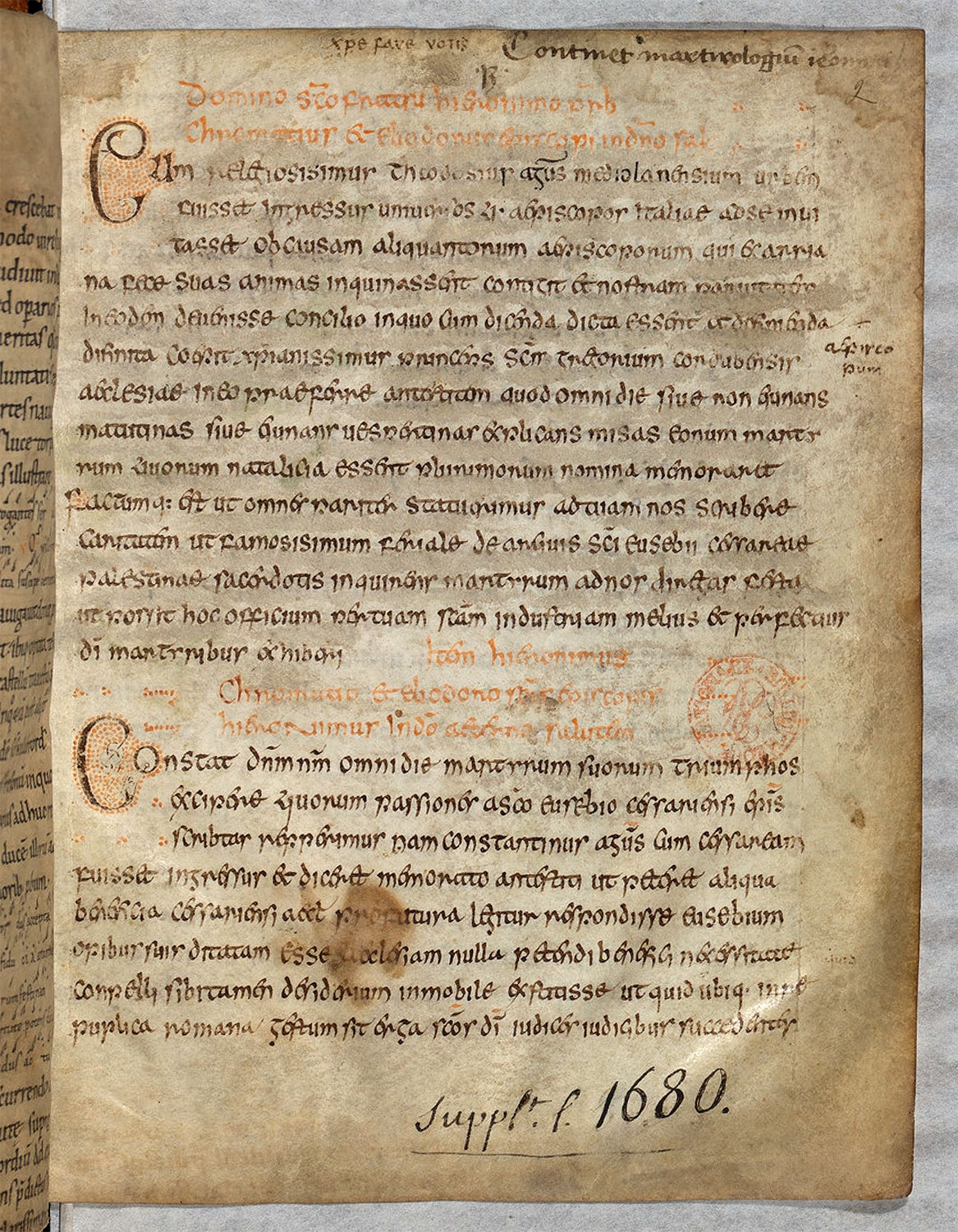
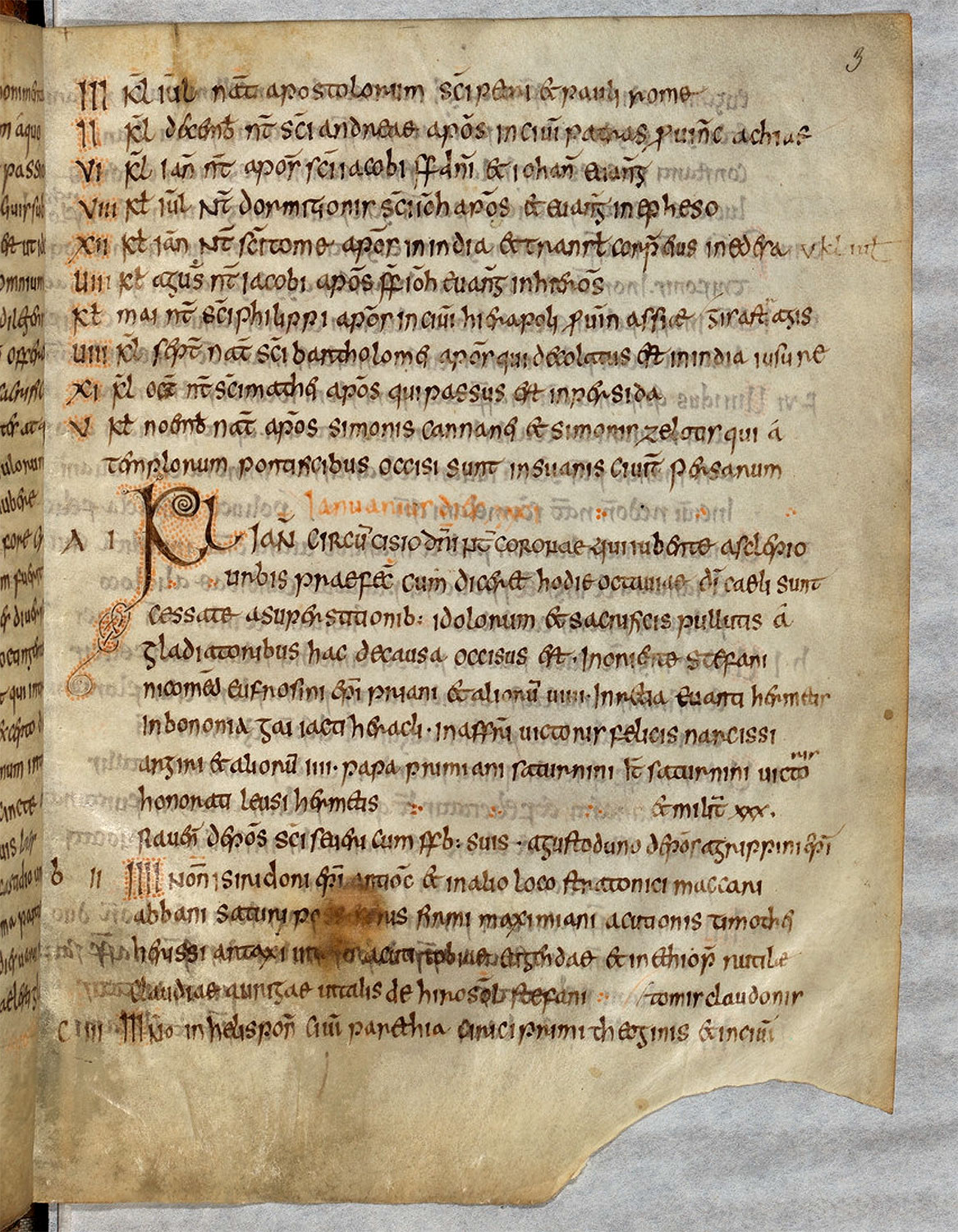
The Echternach Manuscript
The Echternach manuscript, now preserved in the Bibliothèque nationale de France in Paris as Latin 10837, is the oldest of the three principal surviving witnesses. It was probably copied during the early eighth century, perhaps between 703 and 710, at the Abbey of Echternach, in what is now Luxembourg. Saint Willibrord, an Anglo-Saxon missionary who played an important role in spreading Christianity through the Low Countries, founded the abbey in 698. Remarkably, we know the name of the person who copied this manuscript. He was a scribe called Laurentius, who identifies himself in a short prayer at the end of the text. His handwriting is a distinctive Anglo-Saxon minuscule, reflecting the monastery’s strong English influence in its earliest years. Documents written by a scribe named Laurentius at Echternach in 704, 710, and 711 help scholars date the manuscript.
Laurentius almost certainly worked from an earlier manuscript brought to the monastery or otherwise made available to him. Unfortunately, we do not know exactly where that earlier copy originated, how old it was, or how many generations of copying separated it from the sixth-century Gallic revision.
The surviving martyrology occupies approximately 31 parchment leaves, from folio 2r to folio 32v. It is therefore quite a compact manuscript. The important point is that Echternach represents its own branch of the manuscript tradition. In many places, it preserves noticeably different readings from the Bern and Wissembourg manuscripts. This does not automatically make its readings more accurate, despite its greater age. An older manuscript can preserve a less complete or more heavily altered text than a younger one copied from a better manuscript.
The Bern Manuscript
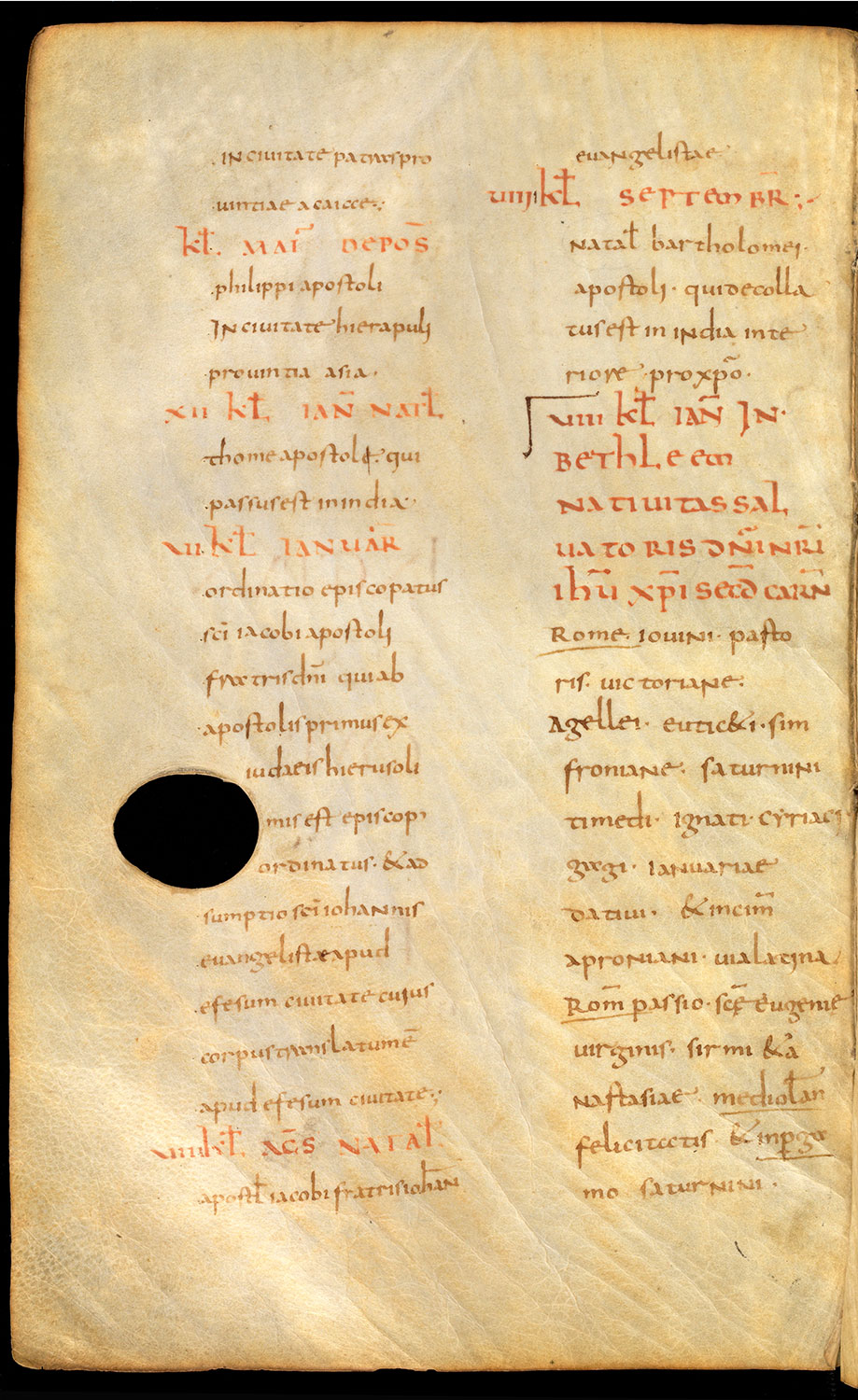
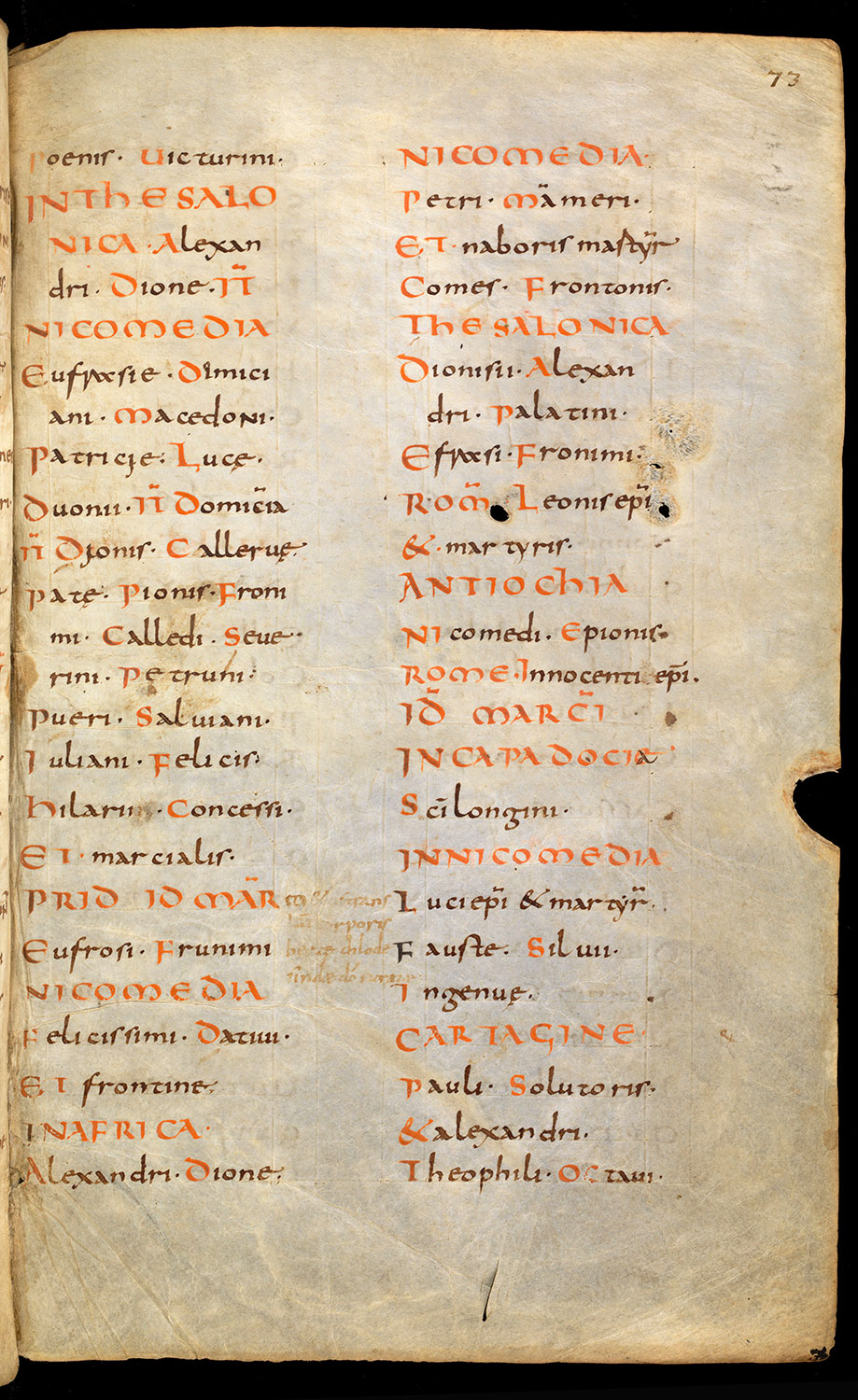
Preserved in the Burgerbibliothek in Switzerland as Codex 289, the Bern manuscript is a different case. It was almost certainly produced in the Metz region of northeastern France. It may have been associated with the Abbey of Saint-Avold or the ecclesiastical community attached to Metz Cathedral. Older scholars often dated this manuscript to the late eighth century. However, the Burgerbibliothek’s detailed catalog, revised in May 2025, explains that Codex 289 is actually a composite manuscript assembled in several stages, extending from the end of the eighth century into the middle of the ninth. The section containing the Martyrologium Hieronymianum is assigned to the first third of the ninth century.
Unlike the Echternach manuscript, which was copied by one identifiable scribe, the Bern manuscript contains several different texts written by multiple hands. Alongside the martyrology are religious instructions, homilies, and other ecclesiastical writings. The martyrology begins around folio 53v and continues to folio 129v. Unfortunately, the final portion of the calendar is missing. The surviving text begins with December 25 and continues through November 21, leaving the entries for November 22 through December 24 absent.
The Bern text is especially interesting because it was adapted for use in the Metz region. Scribes incorporated local commemorations and death notices, some of which appear in margins or other available spaces. It was therefore not simply a mechanical reproduction of an older text. It had become a working religious document that could be adapted to the needs of its community.
Bern was not copied from the surviving Echternach manuscript. The two belong to different lines of transmission that ultimately lead back to a common earlier version. The Bern text also belongs to the broader family of manuscripts associated with Wissembourg. Later, the manuscript passed into the collection of the scholar Jacques Bongars (1554–1612) and eventually entered the library at Bern in 1632. That is why we call it the Bern manuscript, even though it was not originally produced there.
The Wissembourg Manuscript
The third principal manuscript, now preserved in the Herzog August Bibliothek in Wolfenbüttel, Germany, takes its name from the Benedictine Abbey of Wissembourg, in Alsace. It was probably copied during the second half of the eighth century, with some scholars proposing a date around 772 and others placing it closer to 800. The manuscript contains 102 parchment leaves, measuring approximately 22 × 15.5 centimeters. In addition to the martyrology, it includes chronological calculations, tables for determining the date of Easter, and historical notes associated with Wissembourg. The manuscript’s liturgical text was copied in an early form of Carolingian minuscule, with additional notes entered by other writers.
What makes Wissembourg especially interesting is its relationship with the monastery of Fontenelle, better known as Saint-Wandrille, in Normandy. Scholars have identified a particular branch of the Martyrologium Hieronymianum associated with Fontenelle. The Wissembourg manuscript appears to descend from that textual tradition, suggesting its scribe worked from a copy whose earlier history passed through, or was influenced by, the religious community of Saint-Wandrille.
This does not necessarily mean that the physical manuscript now at Wolfenbüttel was produced at Saint-Wandrille. Evidence for its manufacture points instead to Wissembourg or the surrounding region. We need to distinguish between the place where a surviving manuscript was copied and the earlier geographical history of the text being copied. Wissembourg is not believed to be a direct copy of the surviving Bern manuscript. The two are closely related, but their textual relationship involves earlier versions that no longer survive. In fact, Wissembourg may be physically older than the surviving Bern manuscript, even though both preserve related forms of the text.
These three manuscripts formed the foundation of the major scholarly editions published during the nineteenth and twentieth centuries, allowing historians to compare different readings and trace changes introduced over centuries of copying. Scholars examine thousands of small differences among the manuscripts, including spelling mistakes, duplicated names, omitted entries, geographical variations, and saints assigned to different commemorative dates.
Suppose two manuscripts contain the same unusual mistake, such as changing a city’s name into a saint’s. If that mistake is unlikely to have occurred independently, it suggests that both manuscripts may have inherited it from a common earlier source. If a third manuscript does not contain the mistake, it may have been copied from a different, earlier version of the text. By comparing these differences, scholars can gradually reconstruct a family tree showing how the surviving manuscripts are related. The Martyrologium Hieronymianum is especially complicated because the text was continually adapted and accumulated errors across generations.
In general, scholars find that Echternach frequently differs quite substantially from Bern and Wissembourg, while the latter two are more closely related. But none of the three can be regarded as the definitive or original version.
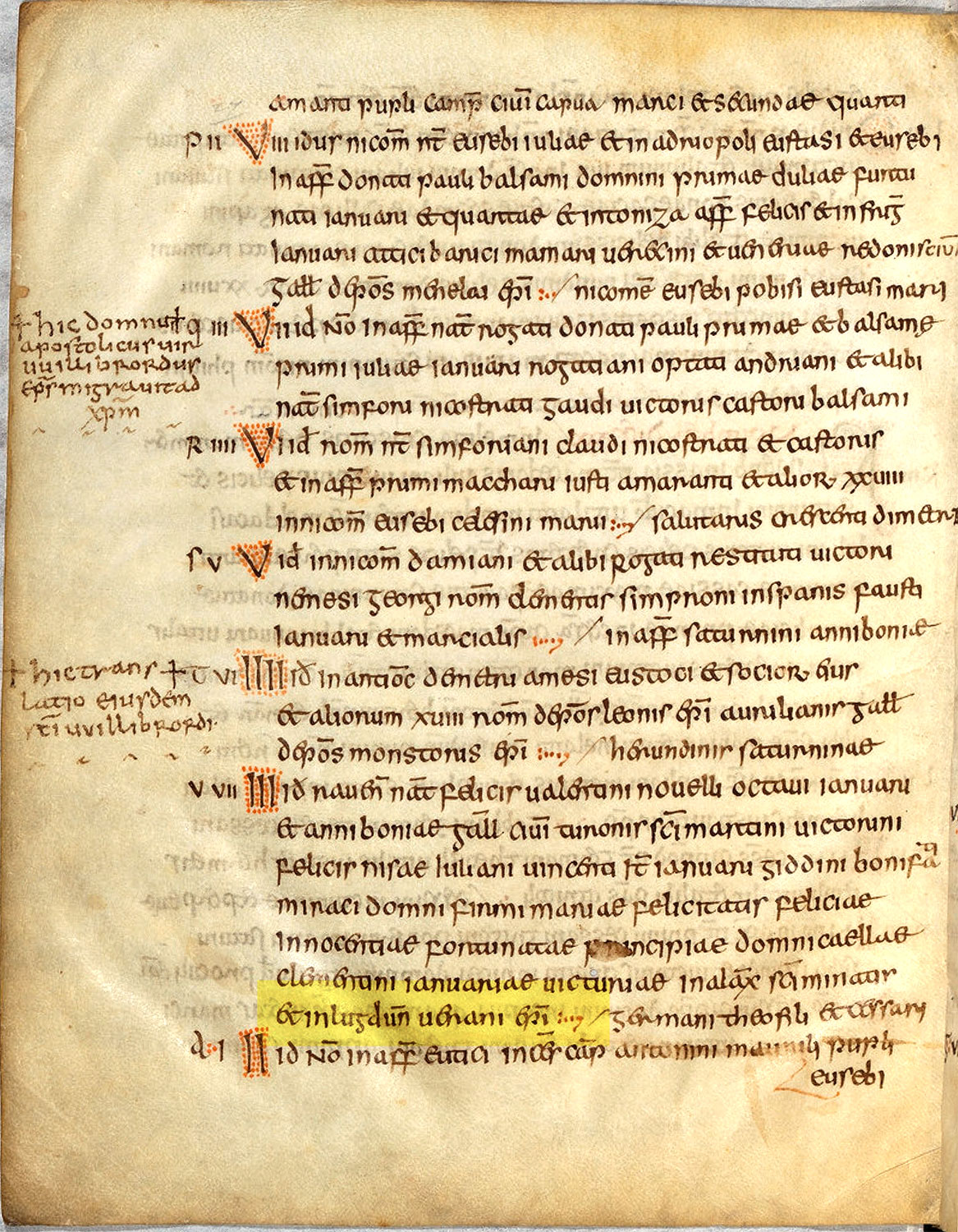
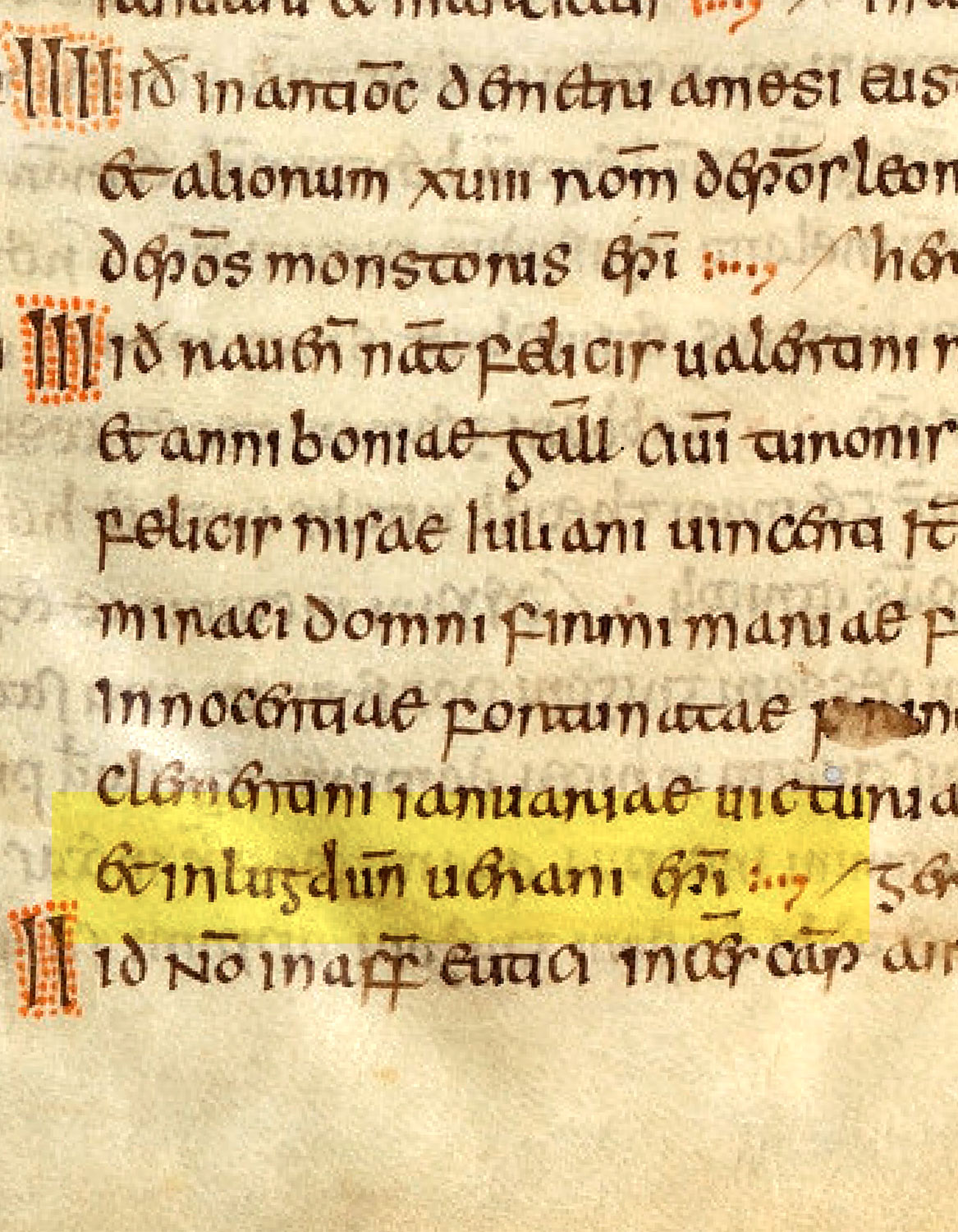
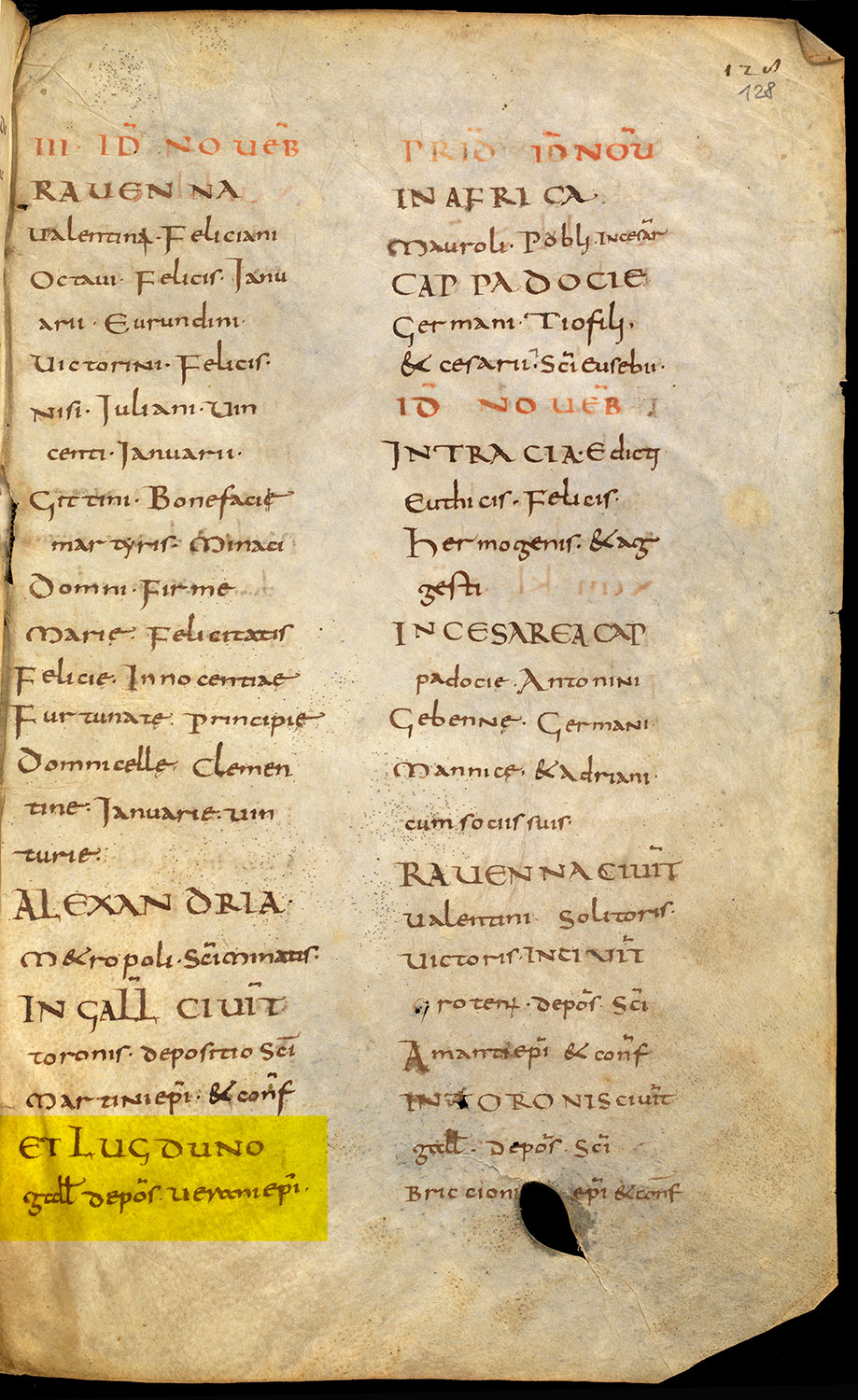
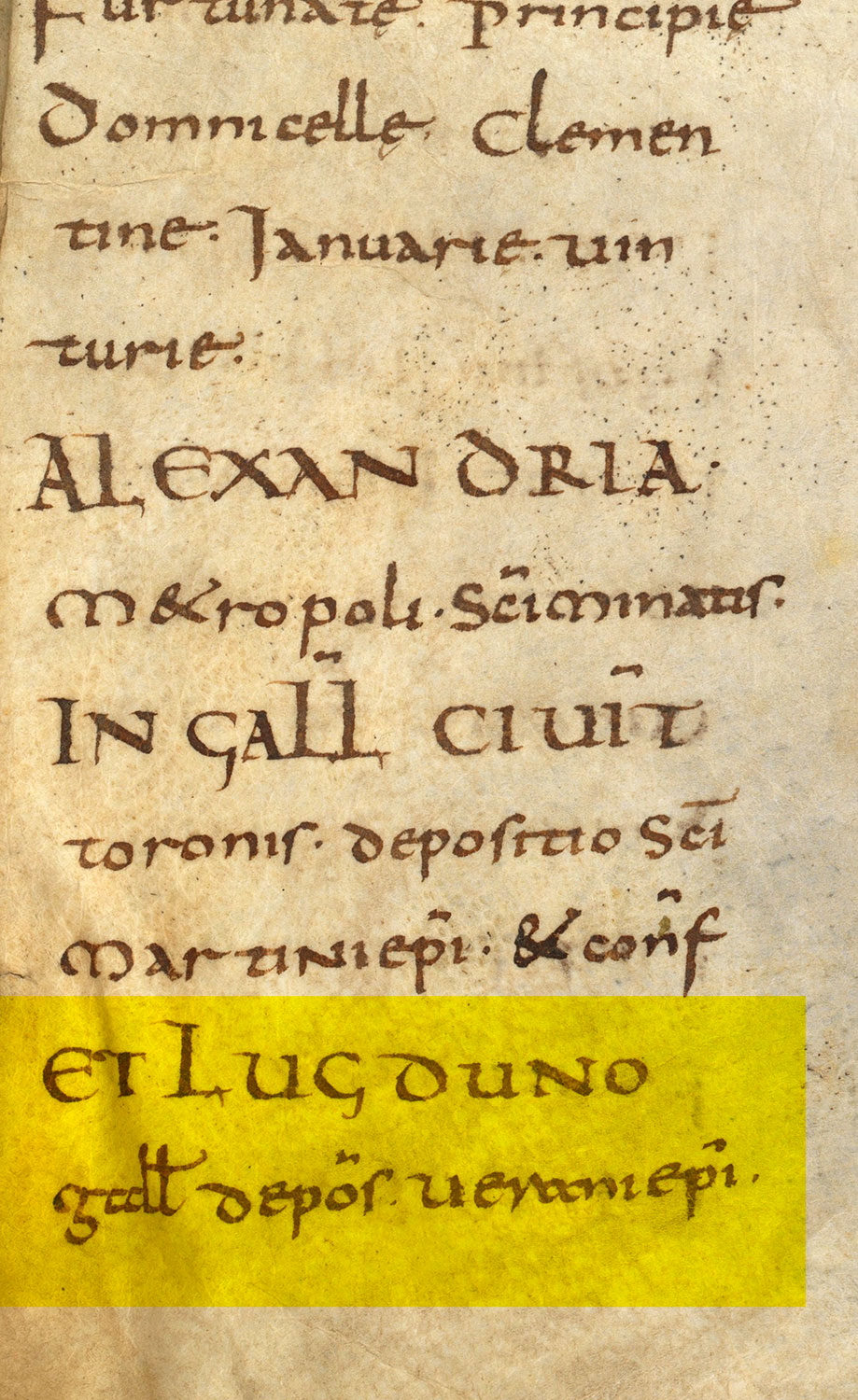
The fact that all three manuscripts contain the November 11 reference to Bishop Véran at Lyon is particularly significant. Although their wording differs slightly, they agree on the essential details: the name Véran, his status as a bishop, the association with Lyon, and the date of commemoration. Since the manuscripts represent different lines of copying rather than successive copies of one another, this agreement strongly suggests that the entry was already present in an earlier common source. However, it does not establish whether the commemoration belonged to the original fifth-century compilation or was introduced during the sixth-century revision in Gaul, when additional saints and bishops associated with the region were incorporated into the martyrology.
One more detail is worth noting. Although we generally speak of three principal manuscripts, an important early fragment is also preserved in the Vatican Library: Palatinus Latinus 238, originating from Lorsch in the early ninth century. It contains only a small portion of the calendar, covering parts of December and January, so it cannot help with the November 11 entry.
The November 11 Entry
In 1931, the Belgian Jesuit scholar and historian Hippolyte Delehaye (1859–1941), a member of the Bollandists, a group of scholars devoted to the critical study of Christian saints and their histories, published an extensive examination of the Martyrologium Hieronymianum. Working from an earlier reconstruction prepared by his colleague Henri Quentin, Delehaye compared the surviving manuscript evidence, examined discrepancies between the different versions, and provided detailed historical commentary on individual entries. His work remains one of the most important scholarly studies of this ancient martyrology.
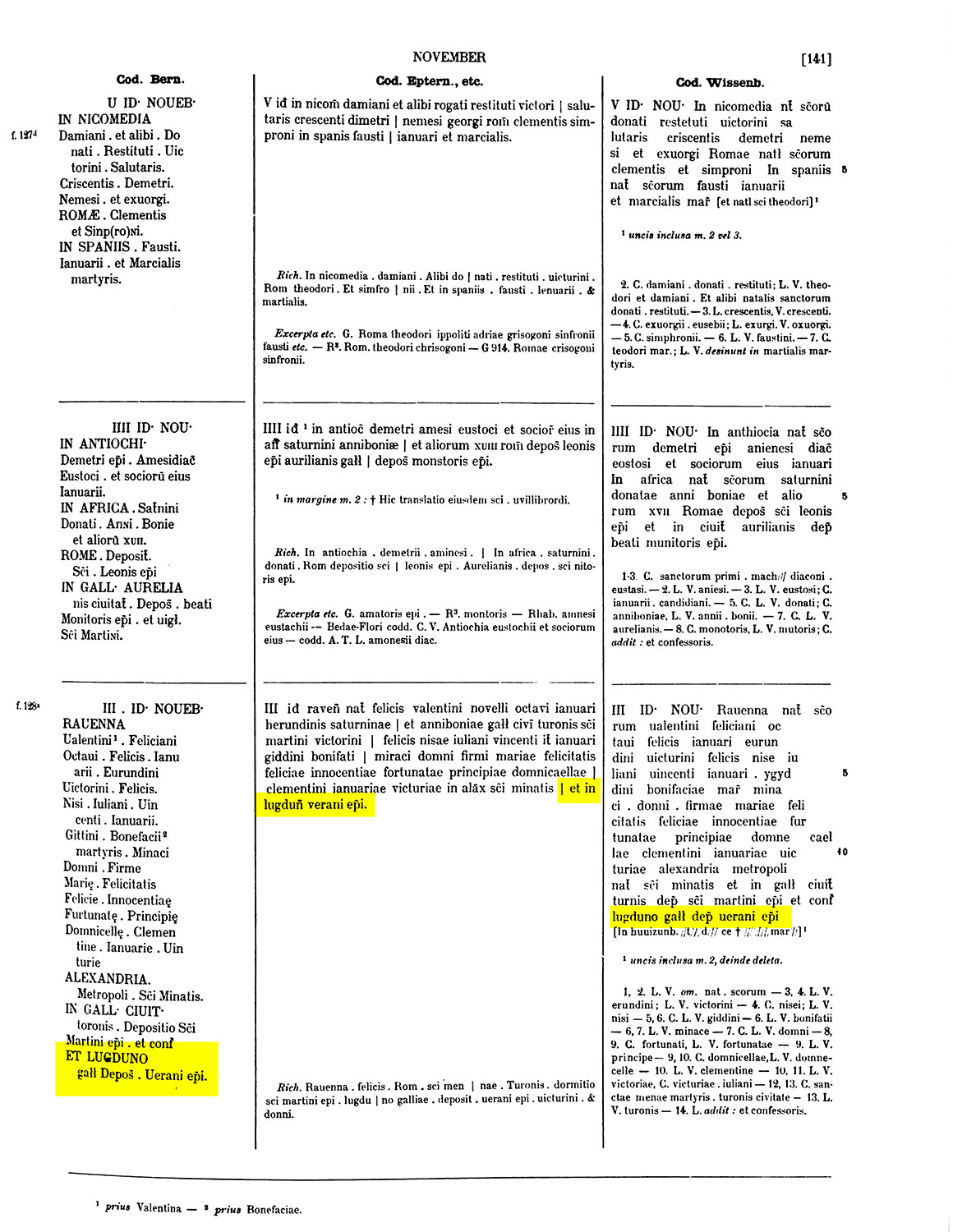
In the critical reconstruction published by Delehaye in 1931, the November 11 entry reads: In Lugduno depositio Verani episcopi. Translated into English, this means: At Lyon, the commemoration of the death of Bishop Véran. The Latin calendar heading is III Idus Novembris, meaning November 11. However, this reconstructed wording does not match that found in all three surviving manuscripts. The Echternach manuscript, the oldest of the three, copied around 700–710, contains the shorter entry Et in Lugduno Verani episcopi, meaning And at Lyon, [the commemoration] of Bishop Véran. Unlike the Bern and Wissembourg manuscripts, which explicitly include the word depositio, the Echternach version does not specifically mention death or burial.
The distinction matters because, in early Christian calendars, depositio often indicates a burial or the anniversary of a death. However, its appearance in a martyrology does not necessarily establish where the person died or was buried. Despite these differences in wording, all three manuscripts agree on the essential details: a Bishop Véran was commemorated at Lyon on November 11. What none of them says is equally important. There is no reference to Vence, no account of Véran’s life, no mention of his family, and no explanation of why he should be commemorated at Lyon. The entry establishes that a Bishop Véran was remembered there on November 11, but everything beyond that requires historical interpretation.
Was This Saint Véran of Vence?
According to the traditional biography of Saint Véran, he was the son of Saint Eucherius, Bishop of Lyon, and the brother of Saint Salonius, Bishop of Geneva. Véran himself became Bishop of Vence during the fifth century, and his name appears in contemporary ecclesiastical correspondence, including documents associated with Popes Leo I and Hilarius. His connection with Lyon is therefore entirely understandable. His father was bishop there, and his family occupied an important position in the religious life of fifth-century Gaul. Nevertheless, the November 11 entry raises a difficult question. Does it commemorate Véran of Vence because of his family connections with Lyon, or does it refer to another bishop who happened to bear the same name?
Earlier historians offered several competing explanations. Some treated the Véran associated with Lyon as a separate saint, occasionally describing him as a Bishop of Lyon. Others argued that no such additional bishop had existed and that the Lyon reference actually concerned Véran of Vence. Adding to the confusion, different calendars commemorated Véran on different dates. In Vence, the traditional date was September 10, while the Lyon commemoration appeared on November 11. These discrepancies became a recurring problem in historical investigations of the saint and contributed to the multiplication of supposed bishops named Véran in later ecclesiastical histories.
Jean Périer and the Investigation of 1750
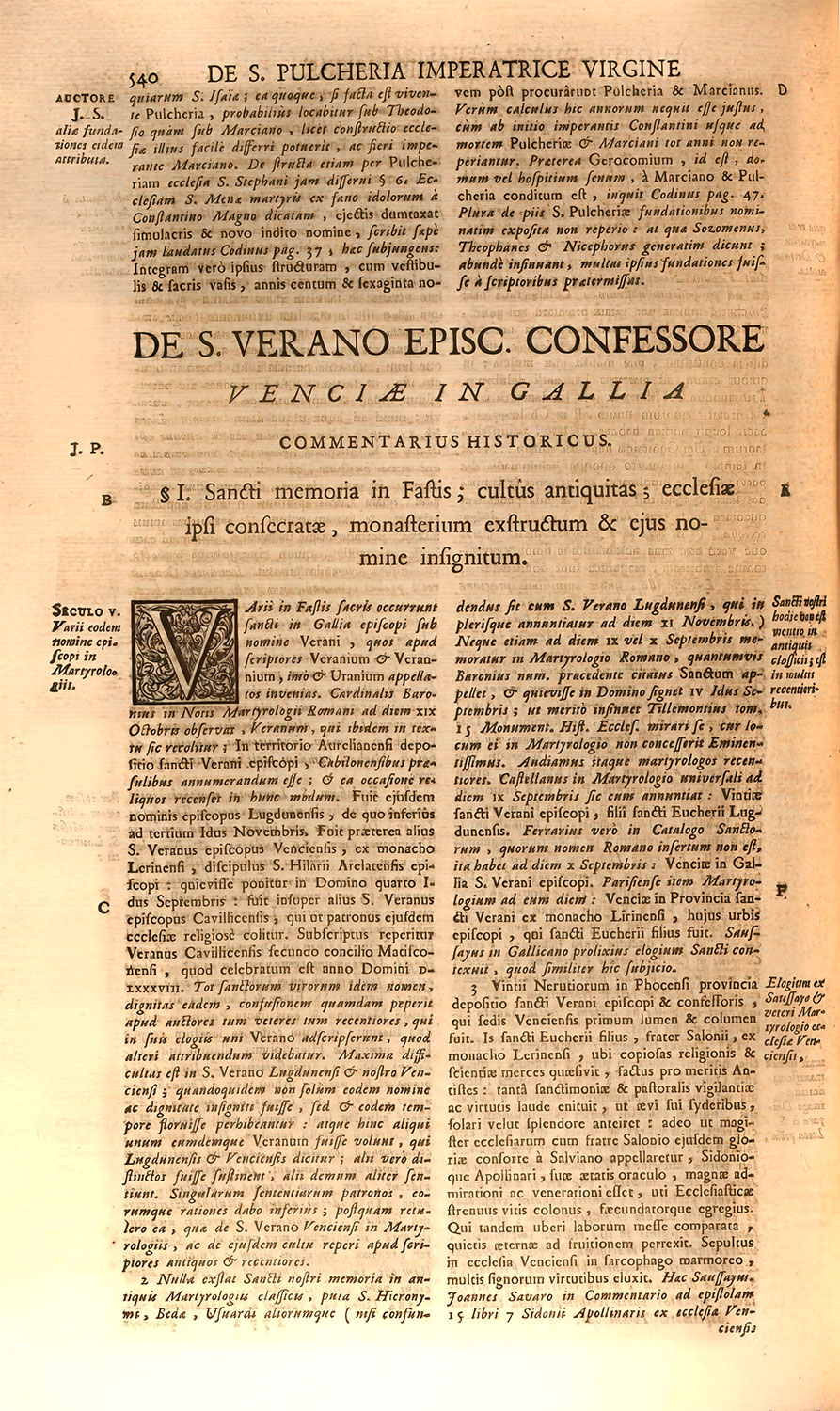
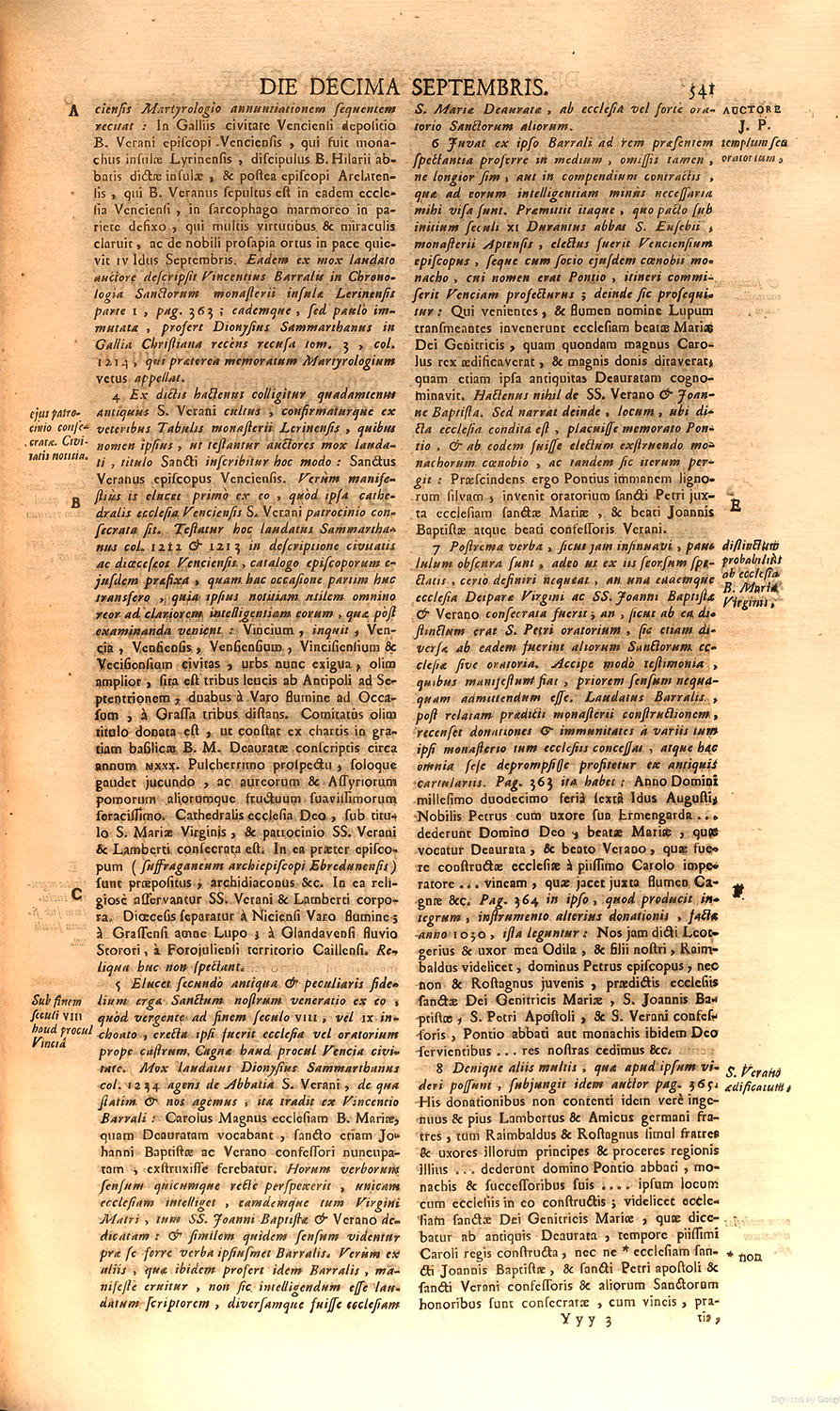
One of the earliest important attempts to resolve this problem appeared in 1750, when the Jesuit scholar Jean Périer published an extensive historical commentary on Saint Véran in the Acta Sanctorum. Périer was particularly interested in distinguishing genuine historical evidence from the traditions that had accumulated around the saint. At the beginning of his investigation, he observed that Saint Véran of Vence did not appear explicitly in the oldest classical martyrologies, including the work attributed to Jerome. However, he immediately qualified this statement with the words nisi confundendus sit cum S. Verano Lugdunensi, meaning unless he is to be identified with Saint Véran of Lyon. Périer was clearly aware of the November 11 commemoration. He wondered whether it referred to the same person or to another saint whose identity had become confused with that of the Bishop of Vence.
Périer examined several competing interpretations. Some historians believed that Véran had been Bishop of Vence and had never occupied the episcopal seat of Lyon. Others maintained that he had served both cities, while still others considered the bishops of Lyon and Vence to have been distinct individuals. Périer did not consider the geographical heading of a martyrology sufficient proof that a bishop had governed the city named in the entry. This distinction mattered because a saint might be commemorated in a particular city because of family connections, local devotion, the presence of relics, or a burial tradition, without ever having served as its bishop. His cautious treatment of the evidence illustrates the difficulties historians face in reconstructing the life of a fifth-century bishop from sources written and copied over many centuries.
You can read a more in-depth account of Périer’s Acta Sanctorum article here: The Acta Sanctorum and the Mystery of Saint Véran of Vence.
Download the original Latin version of the Acta Sanctorum article along with French and English translations.
The Scholarly Editions of 1894 and 1931
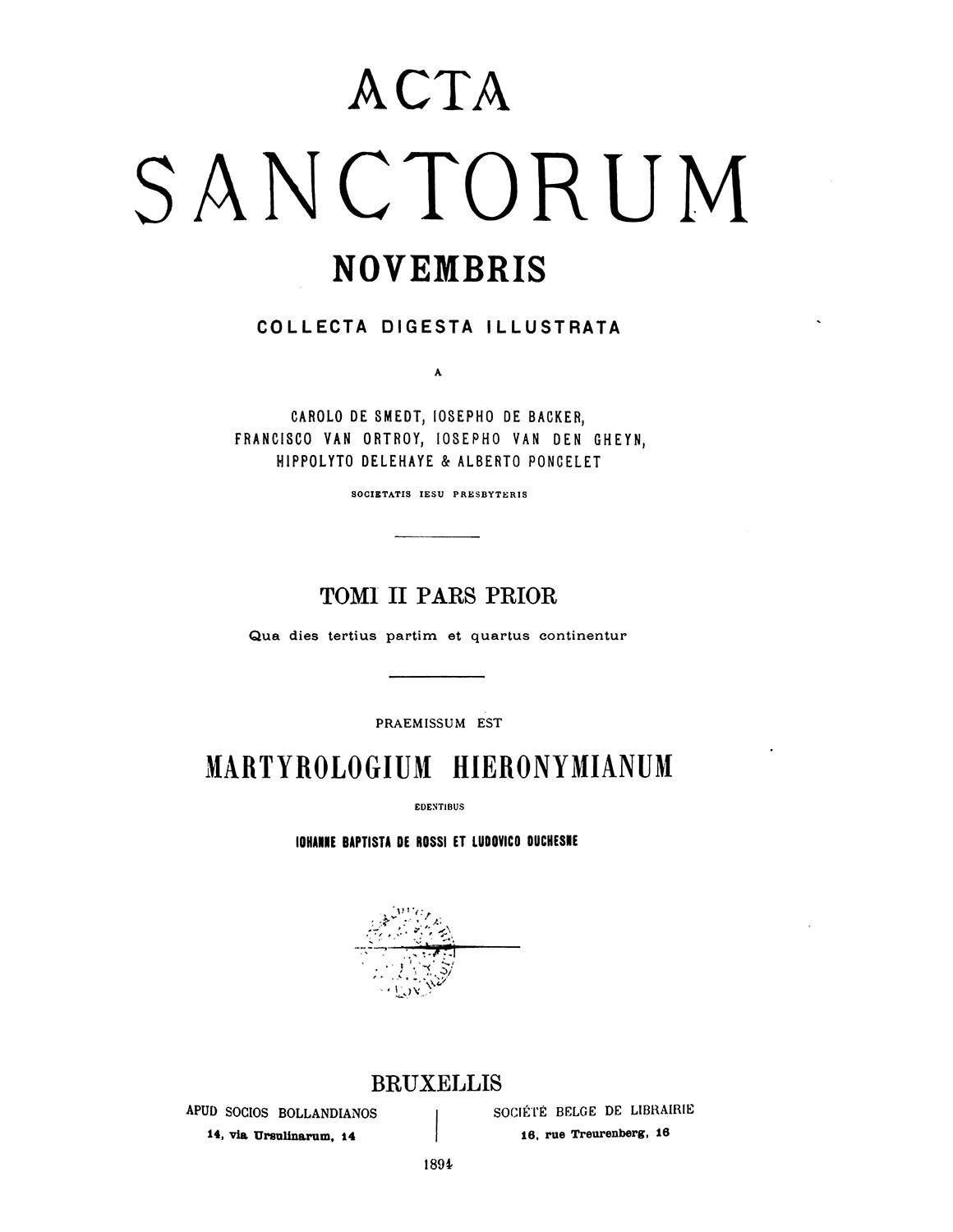
Toward the end of the nineteenth century, scholars systematically reconstructed the Martyrologium Hieronymianum. The first major critical edition appeared in Brussels in 1894, prepared by Giovanni Battista de Rossi and Louis Duchesne and published in the November volumes of the Acta Sanctorum. Rather than producing a single corrected text, the editors presented the readings of the principal manuscripts side by side, making it possible to examine their similarities and differences directly. In their introductory reconstruction of the Lyon calendar, the editors placed the November 11 entry among commemorations associated with that city. They added the identification Vinciensis, meaning “of Vence,” in square brackets. This distinction is important because the reference to Vence was an editorial interpretation, not part of the ancient manuscript text.
Delehaye’s 1931 study went considerably further than the 1894 edition, providing detailed historical commentary on the individual entries. Delehaye devoted a specific note to the November 11 entry, and his conclusion was unambiguous: Veranus unus erat e filiis S. Eucherii, neque Lugdunensis sed Venciensis episcopus fuit. Translated into English, this means Véran was one of the sons of Saint Eucherius, and was Bishop not of Lyon but of Vence. Delehaye supported this conclusion by citing contemporary papal correspondence and studies of the episcopal succession at Lyon. He also noted that Véran and his brother Salonius had been incorrectly inserted into certain lists of Lyon’s bishops after their father, Eucherius. For Delehaye, the man commemorated at Lyon on November 11 was indeed the Bishop of Vence, and there was no convincing reason to suppose another Bishop Véran at Lyon.
Was Saint Véran Buried at Lyon?
The question of Véran’s burial introduces another complication. Because the November 11 entries in the Bern and Wissembourg manuscripts use the word depositio, some historians interpreted it as evidence that Véran was buried in Lyon. Delehaye specifically acknowledged that this interpretation had been advanced, citing the historian Alfred Coville. Yet the traditional account preserved at Vence places Véran’s burial in the cathedral of the city where he served as bishop. The tradition is also associated with a physical object: a fourth-century Roman sarcophagus, reused as the presumed tomb of Saint Véran and preserved in Vence Cathedral. According to the local tradition, Véran’s remains were removed from their original burial place during the fifteenth century and placed in reliquaries. The sarcophagus and the relics have remained important features of the cathedral’s history.
Does this prove that Véran was buried in Vence rather than Lyon? Not conclusively. The surviving evidence does not establish when the burial tradition began or whether the remains attributed to Véran can be identified independently. Similarly, the martyrology cannot, by itself, establish a Lyon burial. The geographical reference might reflect a local commemoration rather than the tomb’s actual location. Different traditions may have developed independently, with one city preserving the memory of Véran’s family connections and another preserving the memory of his episcopate and supposed burial. For now, the disagreement remains an interesting historical question rather than a settled fact.
Another Family Connection: Saint Salonius
The Martyrologium Hieronymianum contains another entry of particular interest to the history of Saint Véran: the commemoration of his brother, Saint Salonius, on September 28. The manuscripts associate Salonius with a city called Genua, creating a geographical confusion remarkably similar to the one concerning Véran. Delehaye’s reconstructed entry for September 28 reads: In Galliis Genua civitate natale sancti Salonii episcopi. Translated: In Gaul, at the city of Geneva, the commemoration of Saint Salonius, bishop. Some later writers interpreted the name as Genoa in Italy and consequently identified Salonius as a bishop of that city. However, the historical Salonius was Bishop of Geneva, and the reference to Genua in Gallia is generally understood as referring to Geneva rather than Genoa. The manuscripts also preserve variations in his name, including Salvini, which added to the confusion. Delehaye examined this problem in his 1931 commentary and identified the bishop commemorated on September 28 as Eucherius’s son and Véran’s brother. It is a useful reminder of how easily geographical names and personal identities could become confused as manuscripts were copied and recopied, particularly when later historians attempted to reconcile fragmentary records with established local traditions.
Other References and the Absence of Saint Lambert
The index of the 1894 edition contains one additional occurrence of the name Veranus, under June 3. This name appears within a lengthy collection of commemorations rather than as a clearly identified bishop associated with Lyon or Vence. Without additional evidence, there is no reason to assume that it refers to our Saint Véran. However, it is worth recording as part of a broader examination of the name in early Christian calendars. As for Saint Lambert, Vence’s other patron saint, his absence from the early Martyrologium Hieronymianum is entirely expected. Lambert lived during the twelfth century, several hundred years after the principal surviving manuscripts were produced. His life and cult therefore belong to a much later period of martyrological history, and we must turn to medieval biographies, local liturgical calendars, and later martyrologies to trace his commemoration.
What Can We Actually Conclude?
The Martyrologium Hieronymianum offers a valuable early reference to a Bishop Véran associated with Lyon on November 11. The entry survives in the three principal manuscript witnesses, establishing that it was part of the early medieval tradition and not simply an invention of later historians. However, the manuscripts do not explicitly identify him as Bishop of Vence. That identification rests on historical interpretation, supported by Véran’s documented family connections, his known episcopate at Vence, and the absence of convincing evidence for a separate Bishop Véran at Lyon. The interpretation was already being debated in 1750, was reflected in the critical edition of 1894, and received particularly clear support from Delehaye in 1931. The November 11 entry does not establish the precise date of Véran’s death, nor does it settle the question of his burial. It does, however, offer an important example of how a saint’s historical record can become complicated as his memory passes through different cities, monasteries, manuscripts, and generations of scholars.
For me, that is what makes this little entry so fascinating. A handful of Latin words, preserved in manuscripts more than 1,200 years old, opens another window onto the life of one of Vence’s most important historical figures. The entry is brief, but the questions surrounding it touch on the origins of the early Christian Church in Gaul, the relationship between Lyon and Vence, the development of local religious traditions, and the efforts of scholars over several centuries to establish what can actually be known about Saint Véran of Vence. As is so often the case with the early history of our little town, the deeper we look into the surviving documents, the more complicated and interesting the story becomes.
You can read a more in-depth account of Saint Véran in this article: Faith and Legends: Uncovering the 5th-Century Mystique of Saint Véran of Vence.